

Volume 14, Issue 4 (Autumn 2026)
Pract Clin Psychol 2026, 14(4): 305-314 |
Back to browse issues page




Download citation:
BibTeX | RIS | EndNote | Medlars | ProCite | Reference Manager | RefWorks
Send citation to:


BibTeX | RIS | EndNote | Medlars | ProCite | Reference Manager | RefWorks
Send citation to:
Rayatdoust M, Taher M, Hosseinkhanzadeh A A, Tabatabaee S M. The Role of Olfaction in Memory and Emotional Processing: Implications for Psychodynamic Psychotherapy. Pract Clin Psychol 2026; 14 (4) :305-314
URL: http://jpcp.uswr.ac.ir/article-1-1139-en.html
URL: http://jpcp.uswr.ac.ir/article-1-1139-en.html

1- Department of Psychology, Sha.C., Islamic Azad University, Shahrood, Iran.
2- Department of Psychology, Sha.C., Islamic Azad University, Shahrood, Iran. ,Mahboobe.Taher@iau.ac.ir
3- Department of Psychology, Faculty of Literature and Humanities, University of Guilan. Rast, Iran.
4- Department of Cognitive Sciences, Faculty of Psychology and Education, Semnan University, Semnan, Iran
2- Department of Psychology, Sha.C., Islamic Azad University, Shahrood, Iran. ,
3- Department of Psychology, Faculty of Literature and Humanities, University of Guilan. Rast, Iran.
4- Department of Cognitive Sciences, Faculty of Psychology and Education, Semnan University, Semnan, Iran
Keywords: Olfaction, Memory, Emotion, Intensive short-term dynamic psychotherapy (ISTDP), Experiential dynamic therapy (EDT)
Full-Text [PDF 651 kb]
(101 Downloads)
| Abstract (HTML) (562 Views)
Full-Text: (29 Views)
Introduction
Emotion and memory are central to many psychotherapies, though their roles differ by framework. Experiential models emphasize accessing salient emotion over cognitive insight. Eye movement desensitization and reprocessing pairs memory activation with working-memory tasks to aid reprocessing (de Jongh et al., 2024). Emotion-focused therapy (EFT) transforms maladaptive emotion via awareness and adaptive activation (Kramer et al., 2026). Accelerated experiential dynamic psychotherapy (AEDP) processes previously avoided emotion relationally (Yeung & Fosha, 2015), and positive emotion itself aids change (Gross et al., 2026). These approaches share an interest in emotional processing without presupposing a universal need for unconscious access.
Within the psychodynamic tradition, intensive short-term dynamic psychotherapy (ISTDP) (developed by Habib Davanloo) targets resistance to emotions tied to unconscious conflict: defenses restrict affective awareness, while active facilitation helps patients experience warded-off emotions such as anger, guilt, grief, and love (Beeber et al., 2025), arising from conflict, anxiety, and defense interplay (Abbass et al., 2021). Sensory modalities tied to affective and mnemonic circuits may offer additional ways to engage such experience. Olfaction is of interest given its distinctive neuroanatomy and links to emotion and memory, yet remains poorly integrated into the experiential literature despite relevance to early psychoanalytic thought (Perkins, 2007) and advancing neuroscience.
Unlike most senses, olfactory information reaches primary cortex without an obligatory thalamic relay (Thaploo et al., 2022), and connects closely with the amygdala, piriform cortex, entorhinal cortex, and hippocampus. Emotionally salient odors engage amygdala-hippocampal networks with context-dependent activation (Herz et al., 2004), evoking affective and mnemonic responses, including Proust-phenomenon recollections, via interacting rather than automatic mechanisms (Green et al., 2023; Zucco et al., 2012).
Research on olfactory memory, emotion, and regulation has developed along separate tracks, with unclear integration into psychotherapy. Olfactory procedures also differ: stimulation broadly means odorant presentation; training means structured exposure targeting olfactory function; aromatherapy means aromatics for relaxation or symptom relief; and person-specific cues carry acquired emotional significance. Here, targeted olfactory stimulation denotes deliberate, therapist-controlled presentation of person-specific cues to evoke emotionally significant experience. This review addresses three questions: how olfactory neuroanatomy supports interaction with emotion/memory circuits; what evidence shows olfactory stimuli influence memory and emotion, and its limits; and how this might inform targeted olfactory stimulation as an experiential-psychotherapy adjunct, particularly ISTDP.
Materials and Methods
This narrative review synthesized theoretical and empirical literature published between 1979 and 2026 on olfaction and its relationships with autobiographical memory, emotional processing, and psychodynamic psychotherapy. We identified relevant literature through targeted searches of PubMed, Google Scholar, and ScienceDirect between June and September 2026, using combinations of terms including olfaction, olfactory, odor, smell, autobiographical memory, episodic memory, emotional processing, emotion, affective memory, psychodynamic psychotherapy, and psychoanalytic psychotherapy. Sources were considered eligible when they addressed olfactory perception and processing, odor-evoked autobiographical or episodic memory, emotional or affective responses to odors, or the theoretical and clinical relevance of these processes to psychodynamic or psychoanalytic psychotherapy. Included sources spanned experimental studies, clinical/case reports, systematic reviews and meta-analyses, narrative and scoping reviews, and relevant theoretical publications. They were thematically grouped by primary focus: olfactory processing, memory, emotional responses, or psychotherapeutic relevance, with key studies summarized in Table 1.
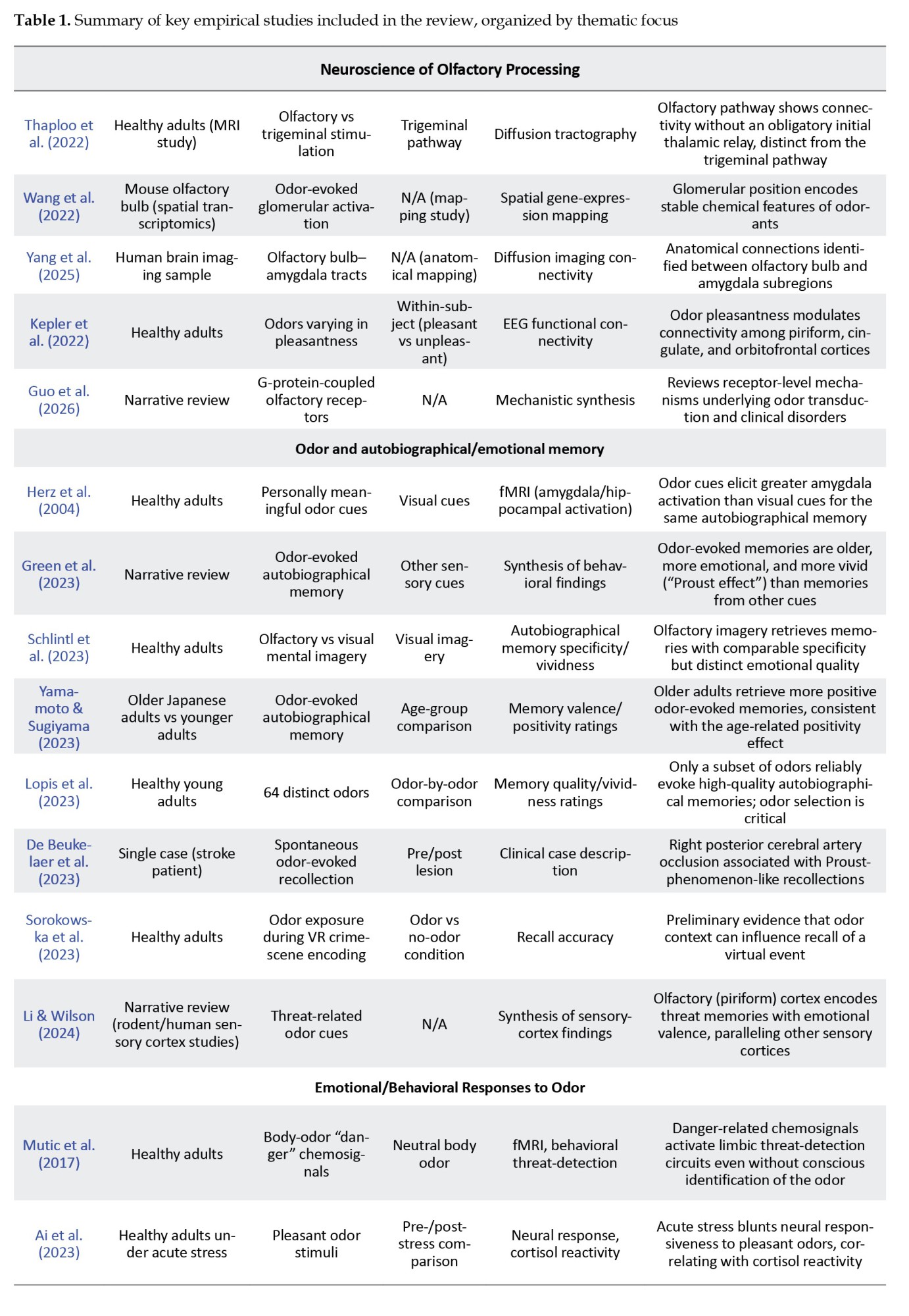
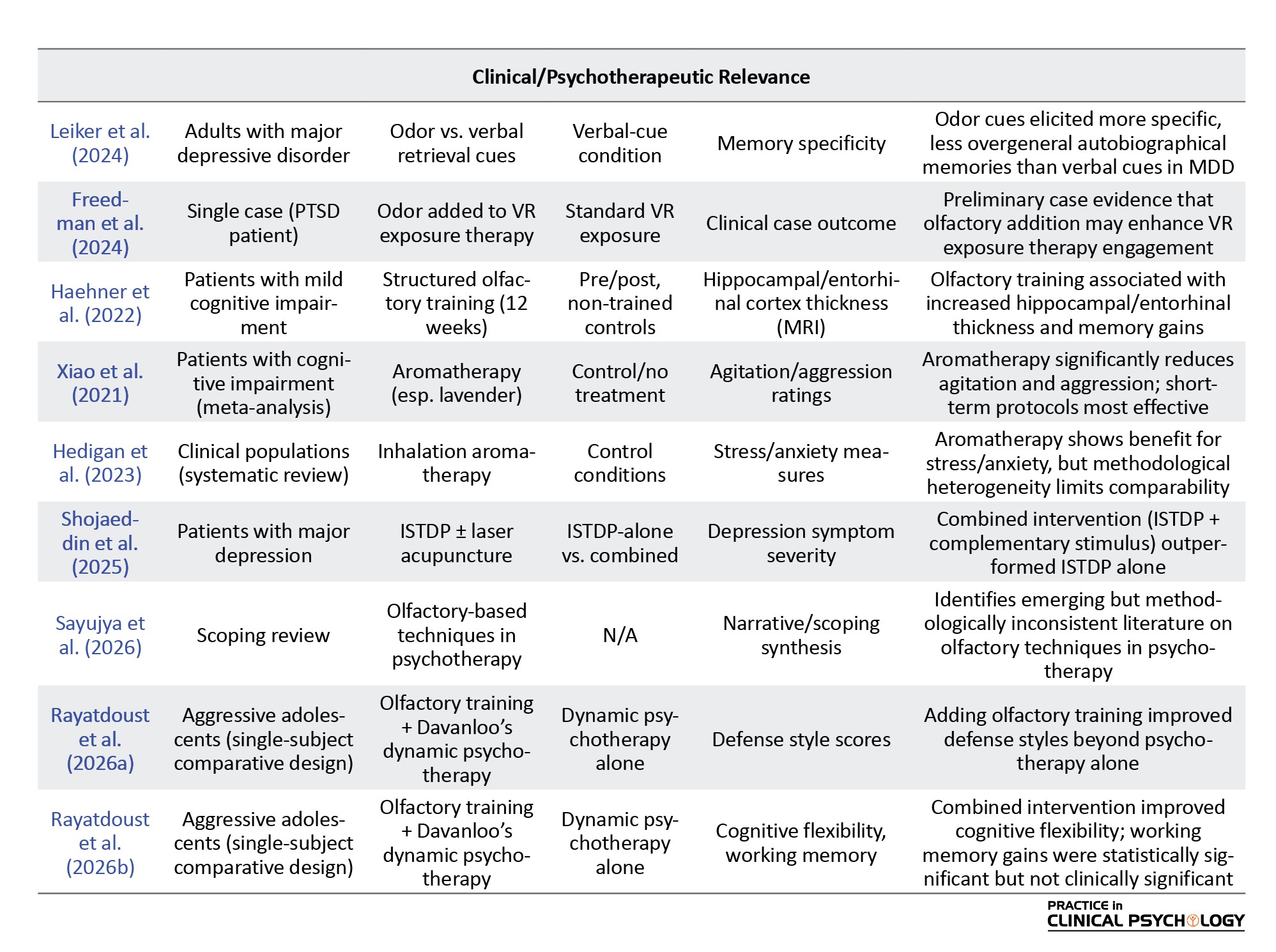
Interpretation accounted for study design, sample characteristics, stimulus/measurement procedures, and control conditions, though no formal risk-of-bias scoring was applied given the review’s narrative design. Findings were integrated via thematic synthesis across neuroscience, psychology, and psychotherapy, with convergent and divergent results considered alongside population, paradigm, stimulus, and outcome differences; contradictory or limited findings were retained and contextualized rather than excluded, distinguishing established from emerging evidence. The final set comprised 53 English- and Persian-language sources, informing an integrative conceptual account of olfaction’s relevance to autobiographical memory, emotional processing, and psychodynamic psychotherapy.
Results
Fundamentals: The olfactory system and its association with emotional and memory circuits
Olfactory perception begins when odorant molecules bind to G-protein-coupled receptors on olfactory sensory neurons in the nasal epithelium, transducing chemical information into electrochemical signals (Guo et al., 2026). Their axons converge in olfactory-bulb glomeruli, which extract molecular odor features and organize them into distinct spatial patterns (Wang et al., 2022), before projecting to substrates underlying emotion and memory (Thaploo et al., 2022). From the bulb, information travels via the lateral olfactory tract to the piriform cortex, the cortical relay, which integrates afferent signals through recurrent connections into “olfactory objects” (Li & Wilson, 2024). Here, olfactory experience becomes a distinct holistic percept shaped by experience, learning, and affective context (Zucco et al., 2012). The olfactory bulb projects relatively directly to amygdala subregions, a key site of affective processing, without an obligatory thalamic relay (Yang et al., 2025).
The olfactory system connects with the hippocampus and entorhinal cortex via the piriform cortex, which consolidates and retrieves odor-linked memories (McKissick et al., 2024). This coupling’s relevance is evident in olfactory training research. In patients with mild cognitive impairment, olfactory practice increased hippocampal and entorhinal thickness, correlating with memory and executive-function gains (Haehner et al., 2022).
Influence of the olfactory modality on memory
A widely recognized manifestation of the olfaction–memory link is the “Proustian effect”: in In search of lost time, the taste and scent of a madeleine restored Marcel Proust’s vivid, emotionally intense childhood memories (Green et al., 2023). Research corroborates this, showing that olfactory stimuli can spontaneously retrieve autobiographical memories relative to other modalities (Green et al., 2023). Direct amygdala stimulation during pre-surgical epilepsy evaluation and case reports of hippocampal lesions confirm that odor-evoked memory retrieval is grounded in distinct neural substrates (De Beukelaer et al., 2023).
Comparative studies show that odor-evoked memories are emotionally richer and rooted in earlier life stages, especially early childhood (Schlintl et al., 2023), with heightened reliving and a more positive, cohesive affective profile (Green et al., 2023). In older Japanese adults, odor-evoked autobiographical memories were significantly more positively valenced than in younger counterparts (Yamamoto & Sugiyama, 2023), suggesting this affective function may persist or strengthen across the lifespan.
Beyond pleasant recollections, olfaction’s connection to emotional-memory representations may facilitate retrieval of consciously avoided memories, including trauma-related ones. Patients with posttraumatic stress disorder (PTSD) often avoid odors reminiscent of their index event, and olfactory cues can trigger such memories (Freedman et al., 2024). This finding may reflect olfaction’s capacity to access affective content less readily reached through verbal routes, though this theory remains theoretical rather than demonstrated (Herz, 2021). This issue may explain olfactory differences from other modalities. Verbal and visual cues typically access memory through top-down pathways, whereas olfactory stimuli may activate the affective component of a remote experience with less conscious mediation. This account draws largely on case-level observations and is best regarded as a plausible interpretation rather than an established pathway (De Beukelaer et al., 2023).
As Table 1 summarizes, findings are not alike: several studies failed to replicate an olfactory advantage in memory retrieval, with effects varying by population, stimulus, and paradigm. One study using 64 odors found that only a restricted subset reliably evoked high-quality memories, suggesting that inconsistencies in the literature partly reflect inattention to stimulus-selection criteria rather than an absent effect (Lopis et al., 2023). Thus, precise stimulus design and cautious comparative claims are important for clinical relevance.
The impact of olfaction on emotional processing
As a secondary olfactory cortex, the orbitofrontal cortex integrates olfactory information with other sensory inputs, especially taste and vision. It helps determine odor reward value (Robin & Bastin, 2025), giving sensory experience motivational and emotional meaning. Activity here tracks subjective odor pleasantness, and pleasantness levels evoke distinct connectivity patterns among olfactory, posterior cingulate, and orbitofrontal cortices (Kepler et al., 2022). Whereas the amygdala supports rapid emotional evaluation, the orbitofrontal cortex may modulate and interpret this response, allowing experience-based regulation.
Olfaction’s capacity for fear and threat conditioning is well documented: exposure to body odors from aggressive individuals, even without conscious identification, induces attentional bias toward threat and automatically activates defense systems via a limbic network including the thalamus, hypothalamus, and insula (Mutic et al., 2017). Thus, such conditioning can occur with limited reliance on conscious processing. At the regulatory end, a meta-analysis found aromatherapy (particularly lavender) can alleviate emotional distress in vulnerable populations, with brief protocols most effective (Xiao et al., 2021). Together, this evidence spans rapid threat conditioning to gradual mood modulation, indicating olfaction’s involvement across a wide range of emotional responses.
Odor can serve as a contextual memory cue: in context-dependent memory, congruency between encoding and retrieval environments facilitates access to stored information, and odor is one of the cues studied in this paradigm (Sorokowska et al., 2023). This issue is clinically significant in patient populations with major depressive disorder; olfactory (versus verbal) cues significantly facilitated retrieval of specific, less overgeneral memories, notable given depressed patients’ well-established deficits in voluntary verbal memory retrieval (Leiker et al., 2024).
This mechanism aligns with experiential approaches such as ISTDP and accelerated experiential dynamic psychotherapy, where defenses disrupt direct emotional experience and therapy emphasizes direct access over avoidance (Abbass & Town, 2021; Thoma & Abbass, 2022). A specific odor, given its direct olfactory–limbic connections, might similarly reactivate an experience’s bound affective state, though psychotherapy has not established this effect. Recent work on odor-cued retrieval suggests olfaction may effectively cue autobiographical memory, with effectiveness depending on several cognitive factors (Greco-Vuilloud et al., 2026).
Historical background of olfactory stimulation in psychological interventions
Early indications of a link between the olfactory apparatus, the body, and psychological experience trace to the Freud-Fliess collaboration (1858–1928). Fliess, an otolaryngologist and close interlocutor of Freud, proposed a “nasal reflex neurosis” linking somatic nasal mechanisms to neurotic manifestations and assigning the nose psychic and sexual-emotional significance. Though later discredited, this theory suggests that the body-nose-emotion-neurosis relationship existed at the margins of psychoanalytic theory from its inception (Perkins, 2007).
Behavioral interventions later incorporated olfactory stimuli into aversion therapy, pairing unpleasant odors with targeted behaviors; however, such conditioning was also used in sexual-orientation conversion practices involving severe ethical violations (Spandler & Carr, 2022). More recently, aromatherapy has become the most widespread clinical use of olfactory stimuli, with evidence of benefit for sleep, labor pain and anxiety, menopausal symptoms, academic stress, and memory/concentration. However, methodological heterogeneity obscures its efficacy and calls for standardization (Hedigan et al., 2023).
This lineage, however, has focused on conditioning, anxiety reduction, or well-being rather than deliberately evoking visceral emotional experience within experiential psychotherapy, leaving the latter largely unformulated and underinvestigated; testing its clinical implications for modalities such as psychodynamic psychotherapy is a crucial next step toward a testable hypothesis.
Preliminary empirical evidence
Indirect evidence from adjacent clinical domains offers preliminary support for this application. Trauma-related olfactory cues have been incorporated into virtual-reality exposure protocols for PTSD (Freedman et al., 2024), and combining a complementary stimulus with standard ISTDP, as in a trial pairing ISTDP with laser acupuncture for major depression, has shown superior outcomes relative to ISTDP alone (Shojaeddin et al., 2025). Two preliminary single-subject studies combining olfactory training with Davanloo’s dynamic psychotherapy in aggressive adolescents reported improvements in defense styles and cognitive flexibility (Rayatdoust et al., 2026a). A related investigation in the same population found that this combination also enhanced cognitive flexibility, with the authors proposing shared olfactory-prefrontal neural circuits as a candidate mechanism (Rayatdoust et al., 2026b); the Discussion critically examines these studies’ methodological limitations.
Discussion
The dual linkage of olfaction with memory and emotion, elucidated in the preceding sections, may be of interest for experiential, emotion-focused approaches. In modalities such as ISTDP, the foundational premise is that psychological suffering arises not from underlying feelings but from defenses and avoidance strategies deployed against directly experiencing unconscious emotions; such defensive processes have been operationalized and measured in clinical research (Di Giuseppe & Perry, 2021). Accordingly, rather than relying exclusively on verbal discourse, the therapeutic process centers on cultivating conditions that actively facilitate direct visceral experience of avoided feelings (Abbass & Town, 2021). Evaluating whether olfaction could contribute to this process requires distinguishing three levels of inference: established olfactory findings, plausible but unverified mechanistic interpretations, and untested clinical hypotheses. These levels are considered in turn below.
Anatomical work shows relatively direct connections between the olfactory bulb and amygdala subregions (Yang et al., 2025), and experimental studies indicate that odor-evoked memories are often experienced as emotionally potent (Herz et al., 2004; Green et al., 2023). Among adults with major depressive disorder, odor cues have also been reported to elicit autobiographical memories that differ from those elicited by verbal cues (Leiker et al., 2024). These findings are the most firmly grounded part of the argument, yet they largely derive from experimental or non-psychotherapeutic settings; odor-evoked memories depend on odor selection (Lopis et al., 2023), and they may vary with participant characteristics such as age (Yamamoto & Sugiyama, 2023). They do not, in themselves, address therapeutic outcomes.
Moving from these findings to a mechanistic interpretation requires caution. Anatomical connectivity does not show that odors selectively access unconscious emotions or improve ISTDP outcomes. A personally meaningful odor might facilitate access to emotionally laden memories without verbal retrieval and support ISTDP’s experiential processes, but this notion remains untested; no study has examined effects on resistance, defenses, or experiencing of unconscious feelings during psychotherapy. This proposed application also differs from conventional aromatherapy, which uses generic calming scents to reduce arousal without regard to individual emotional history (Men et al., 2025). Here, person-specific olfactory cues would aim to evoke, rather than suppress, emotionally laden affect.
At the clinical-hypothesis level, proposals that targeted olfactory stimulation can evoke buried affect in therapy, and that doing so improves ISTDP outcomes, remain untested. Only 2 preliminary studies have combined olfactory training with Davanloo’s dynamic psychotherapy (Rayatdoust et al., 2026a, Rayatdoust et al., 2026b), and they should be read critically. The first used a single-subject comparative design with aggressive adolescents and examined defense styles; the second examined cognitive flexibility and working memory in adolescents with aggressive behaviors. Both studies used a parallel treatment single-subject comparative design with 8 participants (four per group), and neither included a follow-up assessment, blinding, or an active control condition. Several features limit inference: very small samples and single-subject designs; a narrow, specific population; an intervention consisting of olfactory training rather than targeted olfactory stimulation; outcomes that indirectly indicate access to unconscious feeling; and the absence of blinding or adequate control conditions. At most, these studies suggest that combining the 2 approaches is practicable; they cannot establish efficacy, mechanisms, or that odors reached unconscious affect. Similarly, a trial combining ISTDP with laser acupuncture in major depression (Shojaeddin et al., 2025) supports the idea that a complementary stimulus can be added to ISTDP without undermining the core therapeutic process. Still, it used a different stimulus and population and therefore provides only indirect, analogical support.
Several alternative explanations for any observed benefit of targeted olfactory stimulation should also be considered. These include expectancy effects, non-specific arousal effects of a novel stimulus, general context-dependent memory cueing, changes in the therapeutic alliance, and cognitive effects of olfactory training itself, any of which could account for apparent improvements independent of the proposed mechanism.
Although evidence on integrating olfactory training with psychodynamic interventions is preliminary, it suggests feasibility for further investigation, but it remains insufficient to establish mechanisms, optimal integration conditions, or generalizability. Clinical implementation should account for individual differences in olfactory sensitivity; more than one-fifth of adults show some degree of olfactory dysfunction, depending on the assessment method (Desiato et al., 2021), supporting initial olfactory assessment. Because the proposed rationale depends on odor-emotion associations, a systematic protocol would also be needed to identify personally meaningful olfactory stimuli for each patient.
Potential adverse effects require explicit attention because the approach aims to evoke rather than soothe affect. Trauma-linked odors may provoke strong reactions; olfactory cues have been used under controlled conditions in PTSD exposure work (Freedman et al., 2024; Herz, 2021), and threat-related odor memories can be robust (Li & Wilson, 2024). In uncontrolled settings, odors could trigger trauma-related reactivity, distress, or unwanted autobiographical memories (Green et al., 2023). Additional concerns include allergies, olfactory dysfunction (Desiato et al., 2021), and culturally or individually specific odor meanings that complicate standardization (Lopis et al., 2023). Clinical evaluation should therefore include exclusion criteria, informed consent, continuous distress monitoring, the option to stop stimulation, and systematic adverse-event reporting.
Targeted olfactory stimulation thus represents a testable hypothesis rather than an established intervention. Optimal timing within the ISTDP trajectory remains unknown; the proposed timing model is hypothesis-generating, not evidence-based. Although olfactory-limbic linkages suggest that stimulation during unconscious unlocking might facilitate retrieval of emotionally laden memories, no study has examined timing across ISTDP phases, and early introduction could instead provoke avoidance or overwhelm. Stimulus timing, olfactory-profile selection, and individual sensitivity therefore remain priorities for future research.
A possible clinical framework
Although no empirically validated protocol currently exists, a preliminary framework for integrating targeted olfactory stimulation into ISTDP can be outlined for research purposes. First, screening would use validated olfactory assessments (e.g. odor identification and threshold tests) to flag olfactory dysfunction, known sensitivities, and trauma-related olfactory triggers. Second, the patient and therapist would collaboratively identify person-specific odors using explicit selection criteria (e.g. autobiographical relevance, emotional salience, tolerability). Third, administration would be standardized, brief, and therapist-controlled, with timing within the ISTDP sequence treated as an open empirical question. Fourth, monitoring would include continuous assessment of anxiety and tolerance, pre-specified stopping rules, and systematic documentation of adverse events. This framework is explicitly presented as an untested proposal for future research.
Limitations and research recommendations
Existing research is methodologically heterogeneous in odor profile, delivery, duration, and outcomes, limiting generalizability (Sayujya et al., 2026); most pleasant-scent studies target aromatherapy rather than deliberate evocation of unconscious feeling, leaving direct ISTDP investigation scarce. Future work should include systematic reviews with defined criteria, standardized olfactory assessment as an efficacy moderator (Patel et al., 2025), and adequately powered longitudinal trials across psychodynamic phases, assessing symptom severity, defense style, and therapeutic alliance.
Conclusion
The research aimed to examine the role of olfaction in memory and emotional processing and its implications for psychodynamic psychotherapy. First, olfactory pathways are closely connected with affective and memory-related structures within cortical and subcortical networks, and odor cues can evoke emotionally salient autobiographical memories, with effects varying by odor selection, population, and design. Second, it is plausible but unverified that these properties could help patients avoid emotional experiences, an important therapeutic process in experiential approaches such as ISTDP; no study has tested this interpretation. Third, the proposals that targeted olfactory stimulation improves ISTDP outcomes and should be delivered at particular phases of the ISTDP sequence remain untested. Potential risks, including trauma-related triggering, distress escalation, allergies, olfactory dysfunction, and culturally specific odor meanings, require evaluation before clinical application.
Although olfactory stimuli have been applied in psychotherapy, applications have largely remained confined to behavioral aversion therapy, aromatherapy, and trauma-related odors in exposure therapy. Little attention has been given to targeted olfactory stimulation within experiential psychodynamic psychotherapy. The only preliminary investigations combining olfactory training with psychodynamic psychotherapy involved 8 participants, used olfactory training rather than targeted stimulation, and cannot address mechanisms, integration parameters, stimulus timing, or generalizability. Overall, because of its connectivity to affective and mnemonic circuits, olfaction offers a testable but unproven foundation for enriching experiential, emotion-focused interventions.
Ethical Considerations
Compliance with ethical guidelines
This study was approved by the research Ethics Committee of Shahrood Branch, Islamic Azad University, Shahrood, Iran (Code: IR.IAU.SHAHROOD.REC.1403.018). As this article involves no human or animal experimentation or primary data collection, no separate ethical approval or informed consent was required. This work follows the principles of the Declaration of Helsinki, APA ethical guidelines, and COPE publication standards.
Funding
This study was extracted from the PhD dissertation of Masoud Rayatdoust approved by the Department of Psychology, Shahrood Branch, Islamic Azad University, Shahrood, Iran. This research received no specific grant from any funding agency in the public, commercial, or not-for-profit sectors.
Authors' contributions
Conceptualization, methodology, and project administration: Masoud Rayatdoust and Mahboobe Taher; Investigation, Resources, and data curation: Masoud Rayatdoust and Abbas Ali Hosseinkhanzadeh; Formal analysis and visualization: Seyed Mosa Tabatabaee; Writing the original draft: Masoud Rayatdoust; Review, editing and supervision: Mahboobe Taher, Abbas Ali Hosseinkhanzadeh, and Seyed Mosa Tabatabaee; Final approval: All authors.
Conflict of interest
The authors declared no conflict of interest.
Acknowledgments
We sincerely thank Luca Rossi (Instructor and Official Supervisor at the International Experiential Dynamic Therapy Association), Rachel Herz (Professor of Olfactory Neuropsychology at Brown University), Gholamreza Bandali, and Davoud Manavipour for their professional insights and invaluable guidance. The feedback and expert contributions of these esteemed scholars substantially enhanced the quality and scientific rigor of this research.
References
Abbass, A., Lumley, M. A., Town, J., Holmes, H., Luyten, P., & Cooper, A., et al. (2021). Short-term psychodynamic psychotherapy for functional somatic disorders: A systematic review and meta-analysis of within-treatment effects. Journal of Psychosomatic Research, 145, 110473. [DOI:10.1016/j.jpsychores.2021.110473] [PMID]
Abbass, A., & Town, J. (2021). Alliance rupture‐repair processes in intensive short‐term dynamic psychotherapy: Working with resistance. Journal of Clinical Psychology, 77(2), 398-413. [DOI:10.1002/jclp.23115] [PMID]
Ai, Y., Hummel, T., Nie, H., Yang, J., & Han, P. (2023). Reduced neural responses to pleasant odor stimuli after acute psychological stress is associated with cortisol reactivity. NeuroImage, 284, 120474. [DOI:10.1016/j.neuroimage.2023.120474] [PMID]
Beeber, A., Gottwik, G., & Rosseti, S. (2025). A Tribute: Habib Davanloo, MD. American Journal of Psychotherapy, 78(3), 135-136. [DOI:10.1176/appi.psychotherapy.20240055] [PMID]
De Beukelaer, S., Sokolov, A., & Müri, R. (2023). Case report: “Proust phenomenon” after right posterior cerebral artery occlusion. Frontiers in Neurology, 14, 1183265. [DOI:10.3389/fneur.2023.1183265] [PMID] [PMCID]
De Jongh, A., De Roos, C., & El‐Leithy, S. (2024). State of the science: Eye movement desensitization and reprocessing (EMDR) therapy. Journal of Traumatic Stress, 37(2), 205-216. [DOI:10.1002/jts.23012] [PMID]
Desiato, V., Levy, D., Byun, Y., Nguyen, S., Soler, Z., & Schlosser, R. (2021). The prevalence of olfactory dysfunction in the general population: A systematic review and meta-analysis. American Journal of Rhinology & Allergy, 35(2), 195-205. [DOI:10.1177/1945892420946254] [PMID] [PMCID]
Di Giuseppe, M., & Perry, C. (2021). The hierarchy of defense mechanisms: Assessing defensive functioning with the defense mechanisms rating scales Q-sort. Frontiers in Psychology, 12, 718440. [DOI:10.3389/fpsyg.2021.718440] [PMID] [PMCID]
Freedman, S., Dayan, E., Senitsky, M., Bellin, E., Attias, Y., Richman, T., Eitan, R., & Tatsa-Laur, L. (2024). Case report: The addition of olfaction to virtual reality enhanced exposure therapy for PTSD. Frontiers in Virtual Reality, 5, 1284299. [DOI:10.3389/frvir.2024.1284299]
Greco-Vuilloud, J., Ruby, P., Plailly, J., & Saive, A. L. (2025). What makes a scent trigger a memory? A cognitive decomposition of odor-evoked retrieval. iScience, 29(1), 114467. [DOI:10.1016/j.isci.2025.114467] [PMID] [PMCID]
Green, J., Reid, C., Kneuer, M., & Hedgebeth, M. (2023). The proust effect: Scents, food, and nostalgia. Current Opinion in Psychology, 50, 101562. [DOI:10.1016/j.copsyc.2023.101562] [PMID]
Gross, N., Bar-Kalifa, E., & Shahar, B. (2026). The role of positive emotions in accelerated experiential dynamic psychotherapy. Psychotherapy Research, 36(5), 959-970. [DOI:10.1080/10503307.2025.2534972] [PMID]
Guo, Z., Du, H., Yuan, F., Dong, Y., Zhu, F., & Liu, J., et al. (2026). G protein-coupled receptors in olfactory signaling and related disorders: Mechanisms and therapeutic implications. Sensory Neuroscience, 2(1), e70023. [DOI:10.1002/sen2.70023]
Haehner, A., Chen, B., Espin, M., Haussmann, R., Matthes, C., & Desser, D., et al. (2022). Training with odors impacts hippocampal thickness in patients with mild cognitive impairment. Journal of Alzheimer’s Disease, 88(2), 743-755. [DOI:10.3233/JAD-220248] [PMID]
Hedigan, F., Sheridan, H., & Sasse, A. (2023). Benefit of inhalation aromatherapy as a complementary treatment for stress and anxiety in a clinical setting-A systematic review. Complementary Therapies in Clinical Practice, 52, 101750. [DOI:10.1016/j.ctcp.2023.101750] [PMID]
Herz, R. (2021). Olfactory virtual reality: A new frontier in the treatment and prevention of posttraumatic stress disorder. Brain Sciences, 11(8), 1070. [DOI:10.3390/brainsci11081070] [PMID] [PMCID]
Herz, R., Eliassen, J., Beland, S., & Souza, T. (2004). Neuroimaging evidence for the emotional potency of odor-evoked memory. Neuropsychologia, 42(3), 371-378. [DOI:10.1016/j.neuropsychologia.2003.08.009] [PMID]
Kepler, V., Seet, M., Hamano, J., Saba, M., Thakor, N., Dimitriadis, S., & Dragomir, A. (2022). Odor pleasantness modulates functional connectivity in the olfactory hedonic processing network. Brain Sciences, 12(10), 1408. [DOI:10.3390/brainsci12101408] [PMID]
Kramer, U., Sutter, M., Rubel, J., Machinea, J., Woldarsky, C., Auszra, L., Herrmann, I., & Holtforth, M. (2026). Effectiveness of emotion-focused therapy: Main results of a practice-research network study. Psychotherapy Research, 36(1), 1-9. [DOI:10.1080/10503307.2025.2454455] [PMID]
Leiker, E., Riley, E., Barb, S., Lazzaro, S., Compère, L., Webb, C., Canovali, G., & Young, K. (2024). Recall of autobiographical memories following odor vs verbal cues among adults with major depressive disorder. JAMA Network Open, 7(2), e2355958. [DOI:10.1001/jamanetworkopen.2023.55958] [PMID] [PMCID]
Li, W., & Wilson, D. (2024). Threat memory in the sensory cortex: Insights from olfaction. The Neuroscientist, 30(3), 285-293. [DOI:10.1177/10738584221148994] [PMID] [PMCID]
Lopis, D., Valentin, D., & Manetta, C. (2023). Odor-evoked memories: The importance of choosing the right odor. Acta Psychologica, 236, 103932. [DOI:10.1016/j.actpsy.2023.103932] [PMID]
McKissick, O., Klimpert, N., Ritt, J. T., & Fleischmann, A. (2024). Odors in space. Frontiers in Neural Circuits, 18, 1414452. [DOI:10.3389/fncir.2024.1414452] [PMID] [PMCID]
Men, L., Liang, L. L., Wu, S. W., Sun, Y., Liu, H., & Mi, Q., et al. (2025). A narrative review of aromatherapy: Mechanisms and clinical value in physiological and psychological regulation. Complementary Therapies in Medicine, 94, 103261. [DOI:10.1016/j.ctim.2025.103261] [PMID]
Mutic, S., Brünner, Y. F., Rodriguez-Raecke, R., Wiesmann, M., & Freiherr, J. (2017). Chemosensory danger detection in the human brain: Body odor communicating aggression modulates limbic system activation. Neuropsychologia, 99, 187–198. [DOI:10.1016/j.neuropsychologia.2017.02.018] [PMID]
Patel, K., Ebert Jr, C., & Kong, K. (2025). Comparative review of olfactory assessment methods. Ear, Nose & Throat Journal, 01455613251351770. [DOI:10.1177/01455613251351770] [PMID]
Perkins, P. (2007). Fleiss, Freud and the nose. Journal of the Royal Society of Medicine, 100(9), 398. [DOI:10.1258/jrsm.100.9.398] [PMID]
Rayatdoust, M., Taher, M., Hossein Khanzadeh, A. A., & Tabatabaee, S. M. (2026). [Effect of adding olfactory training to davanloo’s dynamic psychotherapy on defense styles in aggressive adolescents: A single-subject comparative design (Persian)]. Clinical Psychology and Personality, e5045. [DOI:10.22070/cpap.2026.21208.1831]
Rayatdoust, M., Taher, M., Hosseinkhanzadeh, A. A., & Tabatabaee, S. M. (2026b). [Effect of adding olfactory training to davanloo’s dynamic psychotherapy on cognitive flexibility and working memory in adolescents with aggressive behaviors (Persian)]. Quarterly Journal of Child Mental Health, 13(1), 134-156. [DOI:10.66224/jcmh.13.1.8]
Robin, A., & Bastin, J. (2025). Role and functions of the human orbitofrontal cortex. Journal of Clinical Neurophysiology, 42(7), 609-615. [DOI:10.1097/WNP.0000000000001207] [PMID]
Sayujya, J., Romate, J., Gopi, A., Mona, A. E., & Manjima, M. (2026). Incorporating olfactory-based techniques in psychotherapies: A scoping review. Indian Journal of Social Psychiatry, 10.4103. [DOI:10.4103/ijsp.ijsp_362_25]
Schlintl, C., Zorjan, S., & Schienle, A. (2023). Olfactory imagery as a retrieval method for autobiographical memories. Psychological Research, 87(3), 862-871. [DOI:10.1007/s00426-022-01701-y] [PMID] [PMCID]
Shojaeddin, A., Jafarian Namini, F., Razzaghi, Z., Abbass, A., & Ghorbani, N. (2025). Efficacy of intensive short-term dynamic psychotherapy, laser acupuncture, and the combination in major depression. Basic and Clinical Neuroscience Journal, 16(1), 131-142. [DOI:10.32598/bcn.2024.5960.2] [PMID] [PMCID]
Sorokowska, A., Trzciński, M., Cieśla, R., Skubisz-Ślusarczyk, S. A., Zieniewicz, I., Hummel, T., & Sorokowski, P. (2023). Odor exposure and recall of a virtual reality crime scene: A preliminary study. Science & Justice, 63(4), 537-541. [DOI:10.1016/j.scijus.2023.06.002] [PMID]
Spandler, H., & Carr, S. (2022). Lesbian and bisexual women’s experiences of aversion therapy in England. History of the Human Sciences, 35(3-4), 218-236. [DOI:10.1177/09526951211059422] [PMID] [PMCID]
Thaploo, D., Joshi, A., Georgiopoulos, C., Warr, J., & Hummel, T. (2022). Tractography indicates lateralized differences between trigeminal and olfactory pathways. NeuroImage, 261, 119518. [DOI:10.1016/j.neuroimage.2022.119518] [PMID]
Thoma, N., & Abbass, A. (2022). Intensive short-term dynamic psychotherapy (ISTDP) offers unique procedures for acceptance of emotion and may contribute to the process-based therapy movement. Journal of Contextual Behavioral Science, 25, 106-114. [DOI:10.1016/j.jcbs.2022.07.003]
Wang, I. H., Murray, E., Andrews, G., Jiang, H. C., Park, S. J., & Donnard, E., et al. (2022). Spatial transcriptomic reconstruction of the mouse olfactory glomerular map suggests principles of odor processing. Nature Neuroscience, 25(4), 484–492. [DOI:10.1038/s41593-022-01030-8] [PMID] [PMCID]
Xiao, S., Wang, Y., Duan, S., & Li, B. (2021). Effects of aromatherapy on agitation and aggression in cognitive impairment: A meta‐analysis. Journal of Clinical Nursing, 34(12), 4974-4988. [DOI:10.1111/jocn.15984] [PMID]
Yamamoto, K., & Sugiyama, H. (2023). Influences of age-related positivity effect on characteristics of odor-evoked autobiographical memories in older Japanese adults. Frontiers in Psychology, 13, 1027519. [DOI:10.3389/fpsyg.2022.1027519] [PMID] [PMCID]
Yang, Q., Zhou, G., Sheriff, A., Sagar, V., Echevarria-Cooper, S., & Lane, G., et al. (2025). The human olfactory amygdala: Anatomical connections between the olfactory bulb and amygdala subregions. Imaging Neuroscience, 3, imag_a_00571. [DOI:10.1162/imag_a_00571] [PMID] [PMCID]
Yeung, D., & Fosha, D. (2015). Accelerated experiential dynamic psychotherapy. In Neukrug, E. S. (Ed.). The Sage Encyclopedia of Theory in Counseling and Psychotherapy (PP. 1-5). Thousand Oaks: Sage Publications. [DOI:10.4135/9781483346502.n10]
Zucco, G. M., Schaal, B., & Herz, R. S. (2012). Olfactory cognition. Amsterdam: John Benjamins Publishing Company. [DOI:10.1075/aicr.85]
Emotion and memory are central to many psychotherapies, though their roles differ by framework. Experiential models emphasize accessing salient emotion over cognitive insight. Eye movement desensitization and reprocessing pairs memory activation with working-memory tasks to aid reprocessing (de Jongh et al., 2024). Emotion-focused therapy (EFT) transforms maladaptive emotion via awareness and adaptive activation (Kramer et al., 2026). Accelerated experiential dynamic psychotherapy (AEDP) processes previously avoided emotion relationally (Yeung & Fosha, 2015), and positive emotion itself aids change (Gross et al., 2026). These approaches share an interest in emotional processing without presupposing a universal need for unconscious access.
Within the psychodynamic tradition, intensive short-term dynamic psychotherapy (ISTDP) (developed by Habib Davanloo) targets resistance to emotions tied to unconscious conflict: defenses restrict affective awareness, while active facilitation helps patients experience warded-off emotions such as anger, guilt, grief, and love (Beeber et al., 2025), arising from conflict, anxiety, and defense interplay (Abbass et al., 2021). Sensory modalities tied to affective and mnemonic circuits may offer additional ways to engage such experience. Olfaction is of interest given its distinctive neuroanatomy and links to emotion and memory, yet remains poorly integrated into the experiential literature despite relevance to early psychoanalytic thought (Perkins, 2007) and advancing neuroscience.
Unlike most senses, olfactory information reaches primary cortex without an obligatory thalamic relay (Thaploo et al., 2022), and connects closely with the amygdala, piriform cortex, entorhinal cortex, and hippocampus. Emotionally salient odors engage amygdala-hippocampal networks with context-dependent activation (Herz et al., 2004), evoking affective and mnemonic responses, including Proust-phenomenon recollections, via interacting rather than automatic mechanisms (Green et al., 2023; Zucco et al., 2012).
Research on olfactory memory, emotion, and regulation has developed along separate tracks, with unclear integration into psychotherapy. Olfactory procedures also differ: stimulation broadly means odorant presentation; training means structured exposure targeting olfactory function; aromatherapy means aromatics for relaxation or symptom relief; and person-specific cues carry acquired emotional significance. Here, targeted olfactory stimulation denotes deliberate, therapist-controlled presentation of person-specific cues to evoke emotionally significant experience. This review addresses three questions: how olfactory neuroanatomy supports interaction with emotion/memory circuits; what evidence shows olfactory stimuli influence memory and emotion, and its limits; and how this might inform targeted olfactory stimulation as an experiential-psychotherapy adjunct, particularly ISTDP.
Materials and Methods
This narrative review synthesized theoretical and empirical literature published between 1979 and 2026 on olfaction and its relationships with autobiographical memory, emotional processing, and psychodynamic psychotherapy. We identified relevant literature through targeted searches of PubMed, Google Scholar, and ScienceDirect between June and September 2026, using combinations of terms including olfaction, olfactory, odor, smell, autobiographical memory, episodic memory, emotional processing, emotion, affective memory, psychodynamic psychotherapy, and psychoanalytic psychotherapy. Sources were considered eligible when they addressed olfactory perception and processing, odor-evoked autobiographical or episodic memory, emotional or affective responses to odors, or the theoretical and clinical relevance of these processes to psychodynamic or psychoanalytic psychotherapy. Included sources spanned experimental studies, clinical/case reports, systematic reviews and meta-analyses, narrative and scoping reviews, and relevant theoretical publications. They were thematically grouped by primary focus: olfactory processing, memory, emotional responses, or psychotherapeutic relevance, with key studies summarized in Table 1.
Interpretation accounted for study design, sample characteristics, stimulus/measurement procedures, and control conditions, though no formal risk-of-bias scoring was applied given the review’s narrative design. Findings were integrated via thematic synthesis across neuroscience, psychology, and psychotherapy, with convergent and divergent results considered alongside population, paradigm, stimulus, and outcome differences; contradictory or limited findings were retained and contextualized rather than excluded, distinguishing established from emerging evidence. The final set comprised 53 English- and Persian-language sources, informing an integrative conceptual account of olfaction’s relevance to autobiographical memory, emotional processing, and psychodynamic psychotherapy.
Results
Fundamentals: The olfactory system and its association with emotional and memory circuits
Olfactory perception begins when odorant molecules bind to G-protein-coupled receptors on olfactory sensory neurons in the nasal epithelium, transducing chemical information into electrochemical signals (Guo et al., 2026). Their axons converge in olfactory-bulb glomeruli, which extract molecular odor features and organize them into distinct spatial patterns (Wang et al., 2022), before projecting to substrates underlying emotion and memory (Thaploo et al., 2022). From the bulb, information travels via the lateral olfactory tract to the piriform cortex, the cortical relay, which integrates afferent signals through recurrent connections into “olfactory objects” (Li & Wilson, 2024). Here, olfactory experience becomes a distinct holistic percept shaped by experience, learning, and affective context (Zucco et al., 2012). The olfactory bulb projects relatively directly to amygdala subregions, a key site of affective processing, without an obligatory thalamic relay (Yang et al., 2025).
The olfactory system connects with the hippocampus and entorhinal cortex via the piriform cortex, which consolidates and retrieves odor-linked memories (McKissick et al., 2024). This coupling’s relevance is evident in olfactory training research. In patients with mild cognitive impairment, olfactory practice increased hippocampal and entorhinal thickness, correlating with memory and executive-function gains (Haehner et al., 2022).
Influence of the olfactory modality on memory
A widely recognized manifestation of the olfaction–memory link is the “Proustian effect”: in In search of lost time, the taste and scent of a madeleine restored Marcel Proust’s vivid, emotionally intense childhood memories (Green et al., 2023). Research corroborates this, showing that olfactory stimuli can spontaneously retrieve autobiographical memories relative to other modalities (Green et al., 2023). Direct amygdala stimulation during pre-surgical epilepsy evaluation and case reports of hippocampal lesions confirm that odor-evoked memory retrieval is grounded in distinct neural substrates (De Beukelaer et al., 2023).
Comparative studies show that odor-evoked memories are emotionally richer and rooted in earlier life stages, especially early childhood (Schlintl et al., 2023), with heightened reliving and a more positive, cohesive affective profile (Green et al., 2023). In older Japanese adults, odor-evoked autobiographical memories were significantly more positively valenced than in younger counterparts (Yamamoto & Sugiyama, 2023), suggesting this affective function may persist or strengthen across the lifespan.
Beyond pleasant recollections, olfaction’s connection to emotional-memory representations may facilitate retrieval of consciously avoided memories, including trauma-related ones. Patients with posttraumatic stress disorder (PTSD) often avoid odors reminiscent of their index event, and olfactory cues can trigger such memories (Freedman et al., 2024). This finding may reflect olfaction’s capacity to access affective content less readily reached through verbal routes, though this theory remains theoretical rather than demonstrated (Herz, 2021). This issue may explain olfactory differences from other modalities. Verbal and visual cues typically access memory through top-down pathways, whereas olfactory stimuli may activate the affective component of a remote experience with less conscious mediation. This account draws largely on case-level observations and is best regarded as a plausible interpretation rather than an established pathway (De Beukelaer et al., 2023).
As Table 1 summarizes, findings are not alike: several studies failed to replicate an olfactory advantage in memory retrieval, with effects varying by population, stimulus, and paradigm. One study using 64 odors found that only a restricted subset reliably evoked high-quality memories, suggesting that inconsistencies in the literature partly reflect inattention to stimulus-selection criteria rather than an absent effect (Lopis et al., 2023). Thus, precise stimulus design and cautious comparative claims are important for clinical relevance.
The impact of olfaction on emotional processing
As a secondary olfactory cortex, the orbitofrontal cortex integrates olfactory information with other sensory inputs, especially taste and vision. It helps determine odor reward value (Robin & Bastin, 2025), giving sensory experience motivational and emotional meaning. Activity here tracks subjective odor pleasantness, and pleasantness levels evoke distinct connectivity patterns among olfactory, posterior cingulate, and orbitofrontal cortices (Kepler et al., 2022). Whereas the amygdala supports rapid emotional evaluation, the orbitofrontal cortex may modulate and interpret this response, allowing experience-based regulation.
Olfaction’s capacity for fear and threat conditioning is well documented: exposure to body odors from aggressive individuals, even without conscious identification, induces attentional bias toward threat and automatically activates defense systems via a limbic network including the thalamus, hypothalamus, and insula (Mutic et al., 2017). Thus, such conditioning can occur with limited reliance on conscious processing. At the regulatory end, a meta-analysis found aromatherapy (particularly lavender) can alleviate emotional distress in vulnerable populations, with brief protocols most effective (Xiao et al., 2021). Together, this evidence spans rapid threat conditioning to gradual mood modulation, indicating olfaction’s involvement across a wide range of emotional responses.
Odor can serve as a contextual memory cue: in context-dependent memory, congruency between encoding and retrieval environments facilitates access to stored information, and odor is one of the cues studied in this paradigm (Sorokowska et al., 2023). This issue is clinically significant in patient populations with major depressive disorder; olfactory (versus verbal) cues significantly facilitated retrieval of specific, less overgeneral memories, notable given depressed patients’ well-established deficits in voluntary verbal memory retrieval (Leiker et al., 2024).
This mechanism aligns with experiential approaches such as ISTDP and accelerated experiential dynamic psychotherapy, where defenses disrupt direct emotional experience and therapy emphasizes direct access over avoidance (Abbass & Town, 2021; Thoma & Abbass, 2022). A specific odor, given its direct olfactory–limbic connections, might similarly reactivate an experience’s bound affective state, though psychotherapy has not established this effect. Recent work on odor-cued retrieval suggests olfaction may effectively cue autobiographical memory, with effectiveness depending on several cognitive factors (Greco-Vuilloud et al., 2026).
Historical background of olfactory stimulation in psychological interventions
Early indications of a link between the olfactory apparatus, the body, and psychological experience trace to the Freud-Fliess collaboration (1858–1928). Fliess, an otolaryngologist and close interlocutor of Freud, proposed a “nasal reflex neurosis” linking somatic nasal mechanisms to neurotic manifestations and assigning the nose psychic and sexual-emotional significance. Though later discredited, this theory suggests that the body-nose-emotion-neurosis relationship existed at the margins of psychoanalytic theory from its inception (Perkins, 2007).
Behavioral interventions later incorporated olfactory stimuli into aversion therapy, pairing unpleasant odors with targeted behaviors; however, such conditioning was also used in sexual-orientation conversion practices involving severe ethical violations (Spandler & Carr, 2022). More recently, aromatherapy has become the most widespread clinical use of olfactory stimuli, with evidence of benefit for sleep, labor pain and anxiety, menopausal symptoms, academic stress, and memory/concentration. However, methodological heterogeneity obscures its efficacy and calls for standardization (Hedigan et al., 2023).
This lineage, however, has focused on conditioning, anxiety reduction, or well-being rather than deliberately evoking visceral emotional experience within experiential psychotherapy, leaving the latter largely unformulated and underinvestigated; testing its clinical implications for modalities such as psychodynamic psychotherapy is a crucial next step toward a testable hypothesis.
Preliminary empirical evidence
Indirect evidence from adjacent clinical domains offers preliminary support for this application. Trauma-related olfactory cues have been incorporated into virtual-reality exposure protocols for PTSD (Freedman et al., 2024), and combining a complementary stimulus with standard ISTDP, as in a trial pairing ISTDP with laser acupuncture for major depression, has shown superior outcomes relative to ISTDP alone (Shojaeddin et al., 2025). Two preliminary single-subject studies combining olfactory training with Davanloo’s dynamic psychotherapy in aggressive adolescents reported improvements in defense styles and cognitive flexibility (Rayatdoust et al., 2026a). A related investigation in the same population found that this combination also enhanced cognitive flexibility, with the authors proposing shared olfactory-prefrontal neural circuits as a candidate mechanism (Rayatdoust et al., 2026b); the Discussion critically examines these studies’ methodological limitations.
Discussion
The dual linkage of olfaction with memory and emotion, elucidated in the preceding sections, may be of interest for experiential, emotion-focused approaches. In modalities such as ISTDP, the foundational premise is that psychological suffering arises not from underlying feelings but from defenses and avoidance strategies deployed against directly experiencing unconscious emotions; such defensive processes have been operationalized and measured in clinical research (Di Giuseppe & Perry, 2021). Accordingly, rather than relying exclusively on verbal discourse, the therapeutic process centers on cultivating conditions that actively facilitate direct visceral experience of avoided feelings (Abbass & Town, 2021). Evaluating whether olfaction could contribute to this process requires distinguishing three levels of inference: established olfactory findings, plausible but unverified mechanistic interpretations, and untested clinical hypotheses. These levels are considered in turn below.
Anatomical work shows relatively direct connections between the olfactory bulb and amygdala subregions (Yang et al., 2025), and experimental studies indicate that odor-evoked memories are often experienced as emotionally potent (Herz et al., 2004; Green et al., 2023). Among adults with major depressive disorder, odor cues have also been reported to elicit autobiographical memories that differ from those elicited by verbal cues (Leiker et al., 2024). These findings are the most firmly grounded part of the argument, yet they largely derive from experimental or non-psychotherapeutic settings; odor-evoked memories depend on odor selection (Lopis et al., 2023), and they may vary with participant characteristics such as age (Yamamoto & Sugiyama, 2023). They do not, in themselves, address therapeutic outcomes.
Moving from these findings to a mechanistic interpretation requires caution. Anatomical connectivity does not show that odors selectively access unconscious emotions or improve ISTDP outcomes. A personally meaningful odor might facilitate access to emotionally laden memories without verbal retrieval and support ISTDP’s experiential processes, but this notion remains untested; no study has examined effects on resistance, defenses, or experiencing of unconscious feelings during psychotherapy. This proposed application also differs from conventional aromatherapy, which uses generic calming scents to reduce arousal without regard to individual emotional history (Men et al., 2025). Here, person-specific olfactory cues would aim to evoke, rather than suppress, emotionally laden affect.
At the clinical-hypothesis level, proposals that targeted olfactory stimulation can evoke buried affect in therapy, and that doing so improves ISTDP outcomes, remain untested. Only 2 preliminary studies have combined olfactory training with Davanloo’s dynamic psychotherapy (Rayatdoust et al., 2026a, Rayatdoust et al., 2026b), and they should be read critically. The first used a single-subject comparative design with aggressive adolescents and examined defense styles; the second examined cognitive flexibility and working memory in adolescents with aggressive behaviors. Both studies used a parallel treatment single-subject comparative design with 8 participants (four per group), and neither included a follow-up assessment, blinding, or an active control condition. Several features limit inference: very small samples and single-subject designs; a narrow, specific population; an intervention consisting of olfactory training rather than targeted olfactory stimulation; outcomes that indirectly indicate access to unconscious feeling; and the absence of blinding or adequate control conditions. At most, these studies suggest that combining the 2 approaches is practicable; they cannot establish efficacy, mechanisms, or that odors reached unconscious affect. Similarly, a trial combining ISTDP with laser acupuncture in major depression (Shojaeddin et al., 2025) supports the idea that a complementary stimulus can be added to ISTDP without undermining the core therapeutic process. Still, it used a different stimulus and population and therefore provides only indirect, analogical support.
Several alternative explanations for any observed benefit of targeted olfactory stimulation should also be considered. These include expectancy effects, non-specific arousal effects of a novel stimulus, general context-dependent memory cueing, changes in the therapeutic alliance, and cognitive effects of olfactory training itself, any of which could account for apparent improvements independent of the proposed mechanism.
Although evidence on integrating olfactory training with psychodynamic interventions is preliminary, it suggests feasibility for further investigation, but it remains insufficient to establish mechanisms, optimal integration conditions, or generalizability. Clinical implementation should account for individual differences in olfactory sensitivity; more than one-fifth of adults show some degree of olfactory dysfunction, depending on the assessment method (Desiato et al., 2021), supporting initial olfactory assessment. Because the proposed rationale depends on odor-emotion associations, a systematic protocol would also be needed to identify personally meaningful olfactory stimuli for each patient.
Potential adverse effects require explicit attention because the approach aims to evoke rather than soothe affect. Trauma-linked odors may provoke strong reactions; olfactory cues have been used under controlled conditions in PTSD exposure work (Freedman et al., 2024; Herz, 2021), and threat-related odor memories can be robust (Li & Wilson, 2024). In uncontrolled settings, odors could trigger trauma-related reactivity, distress, or unwanted autobiographical memories (Green et al., 2023). Additional concerns include allergies, olfactory dysfunction (Desiato et al., 2021), and culturally or individually specific odor meanings that complicate standardization (Lopis et al., 2023). Clinical evaluation should therefore include exclusion criteria, informed consent, continuous distress monitoring, the option to stop stimulation, and systematic adverse-event reporting.
Targeted olfactory stimulation thus represents a testable hypothesis rather than an established intervention. Optimal timing within the ISTDP trajectory remains unknown; the proposed timing model is hypothesis-generating, not evidence-based. Although olfactory-limbic linkages suggest that stimulation during unconscious unlocking might facilitate retrieval of emotionally laden memories, no study has examined timing across ISTDP phases, and early introduction could instead provoke avoidance or overwhelm. Stimulus timing, olfactory-profile selection, and individual sensitivity therefore remain priorities for future research.
A possible clinical framework
Although no empirically validated protocol currently exists, a preliminary framework for integrating targeted olfactory stimulation into ISTDP can be outlined for research purposes. First, screening would use validated olfactory assessments (e.g. odor identification and threshold tests) to flag olfactory dysfunction, known sensitivities, and trauma-related olfactory triggers. Second, the patient and therapist would collaboratively identify person-specific odors using explicit selection criteria (e.g. autobiographical relevance, emotional salience, tolerability). Third, administration would be standardized, brief, and therapist-controlled, with timing within the ISTDP sequence treated as an open empirical question. Fourth, monitoring would include continuous assessment of anxiety and tolerance, pre-specified stopping rules, and systematic documentation of adverse events. This framework is explicitly presented as an untested proposal for future research.
Limitations and research recommendations
Existing research is methodologically heterogeneous in odor profile, delivery, duration, and outcomes, limiting generalizability (Sayujya et al., 2026); most pleasant-scent studies target aromatherapy rather than deliberate evocation of unconscious feeling, leaving direct ISTDP investigation scarce. Future work should include systematic reviews with defined criteria, standardized olfactory assessment as an efficacy moderator (Patel et al., 2025), and adequately powered longitudinal trials across psychodynamic phases, assessing symptom severity, defense style, and therapeutic alliance.
Conclusion
The research aimed to examine the role of olfaction in memory and emotional processing and its implications for psychodynamic psychotherapy. First, olfactory pathways are closely connected with affective and memory-related structures within cortical and subcortical networks, and odor cues can evoke emotionally salient autobiographical memories, with effects varying by odor selection, population, and design. Second, it is plausible but unverified that these properties could help patients avoid emotional experiences, an important therapeutic process in experiential approaches such as ISTDP; no study has tested this interpretation. Third, the proposals that targeted olfactory stimulation improves ISTDP outcomes and should be delivered at particular phases of the ISTDP sequence remain untested. Potential risks, including trauma-related triggering, distress escalation, allergies, olfactory dysfunction, and culturally specific odor meanings, require evaluation before clinical application.
Although olfactory stimuli have been applied in psychotherapy, applications have largely remained confined to behavioral aversion therapy, aromatherapy, and trauma-related odors in exposure therapy. Little attention has been given to targeted olfactory stimulation within experiential psychodynamic psychotherapy. The only preliminary investigations combining olfactory training with psychodynamic psychotherapy involved 8 participants, used olfactory training rather than targeted stimulation, and cannot address mechanisms, integration parameters, stimulus timing, or generalizability. Overall, because of its connectivity to affective and mnemonic circuits, olfaction offers a testable but unproven foundation for enriching experiential, emotion-focused interventions.
Ethical Considerations
Compliance with ethical guidelines
This study was approved by the research Ethics Committee of Shahrood Branch, Islamic Azad University, Shahrood, Iran (Code: IR.IAU.SHAHROOD.REC.1403.018). As this article involves no human or animal experimentation or primary data collection, no separate ethical approval or informed consent was required. This work follows the principles of the Declaration of Helsinki, APA ethical guidelines, and COPE publication standards.
Funding
This study was extracted from the PhD dissertation of Masoud Rayatdoust approved by the Department of Psychology, Shahrood Branch, Islamic Azad University, Shahrood, Iran. This research received no specific grant from any funding agency in the public, commercial, or not-for-profit sectors.
Authors' contributions
Conceptualization, methodology, and project administration: Masoud Rayatdoust and Mahboobe Taher; Investigation, Resources, and data curation: Masoud Rayatdoust and Abbas Ali Hosseinkhanzadeh; Formal analysis and visualization: Seyed Mosa Tabatabaee; Writing the original draft: Masoud Rayatdoust; Review, editing and supervision: Mahboobe Taher, Abbas Ali Hosseinkhanzadeh, and Seyed Mosa Tabatabaee; Final approval: All authors.
Conflict of interest
The authors declared no conflict of interest.
Acknowledgments
We sincerely thank Luca Rossi (Instructor and Official Supervisor at the International Experiential Dynamic Therapy Association), Rachel Herz (Professor of Olfactory Neuropsychology at Brown University), Gholamreza Bandali, and Davoud Manavipour for their professional insights and invaluable guidance. The feedback and expert contributions of these esteemed scholars substantially enhanced the quality and scientific rigor of this research.
References
Abbass, A., Lumley, M. A., Town, J., Holmes, H., Luyten, P., & Cooper, A., et al. (2021). Short-term psychodynamic psychotherapy for functional somatic disorders: A systematic review and meta-analysis of within-treatment effects. Journal of Psychosomatic Research, 145, 110473. [DOI:10.1016/j.jpsychores.2021.110473] [PMID]
Abbass, A., & Town, J. (2021). Alliance rupture‐repair processes in intensive short‐term dynamic psychotherapy: Working with resistance. Journal of Clinical Psychology, 77(2), 398-413. [DOI:10.1002/jclp.23115] [PMID]
Ai, Y., Hummel, T., Nie, H., Yang, J., & Han, P. (2023). Reduced neural responses to pleasant odor stimuli after acute psychological stress is associated with cortisol reactivity. NeuroImage, 284, 120474. [DOI:10.1016/j.neuroimage.2023.120474] [PMID]
Beeber, A., Gottwik, G., & Rosseti, S. (2025). A Tribute: Habib Davanloo, MD. American Journal of Psychotherapy, 78(3), 135-136. [DOI:10.1176/appi.psychotherapy.20240055] [PMID]
De Beukelaer, S., Sokolov, A., & Müri, R. (2023). Case report: “Proust phenomenon” after right posterior cerebral artery occlusion. Frontiers in Neurology, 14, 1183265. [DOI:10.3389/fneur.2023.1183265] [PMID] [PMCID]
De Jongh, A., De Roos, C., & El‐Leithy, S. (2024). State of the science: Eye movement desensitization and reprocessing (EMDR) therapy. Journal of Traumatic Stress, 37(2), 205-216. [DOI:10.1002/jts.23012] [PMID]
Desiato, V., Levy, D., Byun, Y., Nguyen, S., Soler, Z., & Schlosser, R. (2021). The prevalence of olfactory dysfunction in the general population: A systematic review and meta-analysis. American Journal of Rhinology & Allergy, 35(2), 195-205. [DOI:10.1177/1945892420946254] [PMID] [PMCID]
Di Giuseppe, M., & Perry, C. (2021). The hierarchy of defense mechanisms: Assessing defensive functioning with the defense mechanisms rating scales Q-sort. Frontiers in Psychology, 12, 718440. [DOI:10.3389/fpsyg.2021.718440] [PMID] [PMCID]
Freedman, S., Dayan, E., Senitsky, M., Bellin, E., Attias, Y., Richman, T., Eitan, R., & Tatsa-Laur, L. (2024). Case report: The addition of olfaction to virtual reality enhanced exposure therapy for PTSD. Frontiers in Virtual Reality, 5, 1284299. [DOI:10.3389/frvir.2024.1284299]
Greco-Vuilloud, J., Ruby, P., Plailly, J., & Saive, A. L. (2025). What makes a scent trigger a memory? A cognitive decomposition of odor-evoked retrieval. iScience, 29(1), 114467. [DOI:10.1016/j.isci.2025.114467] [PMID] [PMCID]
Green, J., Reid, C., Kneuer, M., & Hedgebeth, M. (2023). The proust effect: Scents, food, and nostalgia. Current Opinion in Psychology, 50, 101562. [DOI:10.1016/j.copsyc.2023.101562] [PMID]
Gross, N., Bar-Kalifa, E., & Shahar, B. (2026). The role of positive emotions in accelerated experiential dynamic psychotherapy. Psychotherapy Research, 36(5), 959-970. [DOI:10.1080/10503307.2025.2534972] [PMID]
Guo, Z., Du, H., Yuan, F., Dong, Y., Zhu, F., & Liu, J., et al. (2026). G protein-coupled receptors in olfactory signaling and related disorders: Mechanisms and therapeutic implications. Sensory Neuroscience, 2(1), e70023. [DOI:10.1002/sen2.70023]
Haehner, A., Chen, B., Espin, M., Haussmann, R., Matthes, C., & Desser, D., et al. (2022). Training with odors impacts hippocampal thickness in patients with mild cognitive impairment. Journal of Alzheimer’s Disease, 88(2), 743-755. [DOI:10.3233/JAD-220248] [PMID]
Hedigan, F., Sheridan, H., & Sasse, A. (2023). Benefit of inhalation aromatherapy as a complementary treatment for stress and anxiety in a clinical setting-A systematic review. Complementary Therapies in Clinical Practice, 52, 101750. [DOI:10.1016/j.ctcp.2023.101750] [PMID]
Herz, R. (2021). Olfactory virtual reality: A new frontier in the treatment and prevention of posttraumatic stress disorder. Brain Sciences, 11(8), 1070. [DOI:10.3390/brainsci11081070] [PMID] [PMCID]
Herz, R., Eliassen, J., Beland, S., & Souza, T. (2004). Neuroimaging evidence for the emotional potency of odor-evoked memory. Neuropsychologia, 42(3), 371-378. [DOI:10.1016/j.neuropsychologia.2003.08.009] [PMID]
Kepler, V., Seet, M., Hamano, J., Saba, M., Thakor, N., Dimitriadis, S., & Dragomir, A. (2022). Odor pleasantness modulates functional connectivity in the olfactory hedonic processing network. Brain Sciences, 12(10), 1408. [DOI:10.3390/brainsci12101408] [PMID]
Kramer, U., Sutter, M., Rubel, J., Machinea, J., Woldarsky, C., Auszra, L., Herrmann, I., & Holtforth, M. (2026). Effectiveness of emotion-focused therapy: Main results of a practice-research network study. Psychotherapy Research, 36(1), 1-9. [DOI:10.1080/10503307.2025.2454455] [PMID]
Leiker, E., Riley, E., Barb, S., Lazzaro, S., Compère, L., Webb, C., Canovali, G., & Young, K. (2024). Recall of autobiographical memories following odor vs verbal cues among adults with major depressive disorder. JAMA Network Open, 7(2), e2355958. [DOI:10.1001/jamanetworkopen.2023.55958] [PMID] [PMCID]
Li, W., & Wilson, D. (2024). Threat memory in the sensory cortex: Insights from olfaction. The Neuroscientist, 30(3), 285-293. [DOI:10.1177/10738584221148994] [PMID] [PMCID]
Lopis, D., Valentin, D., & Manetta, C. (2023). Odor-evoked memories: The importance of choosing the right odor. Acta Psychologica, 236, 103932. [DOI:10.1016/j.actpsy.2023.103932] [PMID]
McKissick, O., Klimpert, N., Ritt, J. T., & Fleischmann, A. (2024). Odors in space. Frontiers in Neural Circuits, 18, 1414452. [DOI:10.3389/fncir.2024.1414452] [PMID] [PMCID]
Men, L., Liang, L. L., Wu, S. W., Sun, Y., Liu, H., & Mi, Q., et al. (2025). A narrative review of aromatherapy: Mechanisms and clinical value in physiological and psychological regulation. Complementary Therapies in Medicine, 94, 103261. [DOI:10.1016/j.ctim.2025.103261] [PMID]
Mutic, S., Brünner, Y. F., Rodriguez-Raecke, R., Wiesmann, M., & Freiherr, J. (2017). Chemosensory danger detection in the human brain: Body odor communicating aggression modulates limbic system activation. Neuropsychologia, 99, 187–198. [DOI:10.1016/j.neuropsychologia.2017.02.018] [PMID]
Patel, K., Ebert Jr, C., & Kong, K. (2025). Comparative review of olfactory assessment methods. Ear, Nose & Throat Journal, 01455613251351770. [DOI:10.1177/01455613251351770] [PMID]
Perkins, P. (2007). Fleiss, Freud and the nose. Journal of the Royal Society of Medicine, 100(9), 398. [DOI:10.1258/jrsm.100.9.398] [PMID]
Rayatdoust, M., Taher, M., Hossein Khanzadeh, A. A., & Tabatabaee, S. M. (2026). [Effect of adding olfactory training to davanloo’s dynamic psychotherapy on defense styles in aggressive adolescents: A single-subject comparative design (Persian)]. Clinical Psychology and Personality, e5045. [DOI:10.22070/cpap.2026.21208.1831]
Rayatdoust, M., Taher, M., Hosseinkhanzadeh, A. A., & Tabatabaee, S. M. (2026b). [Effect of adding olfactory training to davanloo’s dynamic psychotherapy on cognitive flexibility and working memory in adolescents with aggressive behaviors (Persian)]. Quarterly Journal of Child Mental Health, 13(1), 134-156. [DOI:10.66224/jcmh.13.1.8]
Robin, A., & Bastin, J. (2025). Role and functions of the human orbitofrontal cortex. Journal of Clinical Neurophysiology, 42(7), 609-615. [DOI:10.1097/WNP.0000000000001207] [PMID]
Sayujya, J., Romate, J., Gopi, A., Mona, A. E., & Manjima, M. (2026). Incorporating olfactory-based techniques in psychotherapies: A scoping review. Indian Journal of Social Psychiatry, 10.4103. [DOI:10.4103/ijsp.ijsp_362_25]
Schlintl, C., Zorjan, S., & Schienle, A. (2023). Olfactory imagery as a retrieval method for autobiographical memories. Psychological Research, 87(3), 862-871. [DOI:10.1007/s00426-022-01701-y] [PMID] [PMCID]
Shojaeddin, A., Jafarian Namini, F., Razzaghi, Z., Abbass, A., & Ghorbani, N. (2025). Efficacy of intensive short-term dynamic psychotherapy, laser acupuncture, and the combination in major depression. Basic and Clinical Neuroscience Journal, 16(1), 131-142. [DOI:10.32598/bcn.2024.5960.2] [PMID] [PMCID]
Sorokowska, A., Trzciński, M., Cieśla, R., Skubisz-Ślusarczyk, S. A., Zieniewicz, I., Hummel, T., & Sorokowski, P. (2023). Odor exposure and recall of a virtual reality crime scene: A preliminary study. Science & Justice, 63(4), 537-541. [DOI:10.1016/j.scijus.2023.06.002] [PMID]
Spandler, H., & Carr, S. (2022). Lesbian and bisexual women’s experiences of aversion therapy in England. History of the Human Sciences, 35(3-4), 218-236. [DOI:10.1177/09526951211059422] [PMID] [PMCID]
Thaploo, D., Joshi, A., Georgiopoulos, C., Warr, J., & Hummel, T. (2022). Tractography indicates lateralized differences between trigeminal and olfactory pathways. NeuroImage, 261, 119518. [DOI:10.1016/j.neuroimage.2022.119518] [PMID]
Thoma, N., & Abbass, A. (2022). Intensive short-term dynamic psychotherapy (ISTDP) offers unique procedures for acceptance of emotion and may contribute to the process-based therapy movement. Journal of Contextual Behavioral Science, 25, 106-114. [DOI:10.1016/j.jcbs.2022.07.003]
Wang, I. H., Murray, E., Andrews, G., Jiang, H. C., Park, S. J., & Donnard, E., et al. (2022). Spatial transcriptomic reconstruction of the mouse olfactory glomerular map suggests principles of odor processing. Nature Neuroscience, 25(4), 484–492. [DOI:10.1038/s41593-022-01030-8] [PMID] [PMCID]
Xiao, S., Wang, Y., Duan, S., & Li, B. (2021). Effects of aromatherapy on agitation and aggression in cognitive impairment: A meta‐analysis. Journal of Clinical Nursing, 34(12), 4974-4988. [DOI:10.1111/jocn.15984] [PMID]
Yamamoto, K., & Sugiyama, H. (2023). Influences of age-related positivity effect on characteristics of odor-evoked autobiographical memories in older Japanese adults. Frontiers in Psychology, 13, 1027519. [DOI:10.3389/fpsyg.2022.1027519] [PMID] [PMCID]
Yang, Q., Zhou, G., Sheriff, A., Sagar, V., Echevarria-Cooper, S., & Lane, G., et al. (2025). The human olfactory amygdala: Anatomical connections between the olfactory bulb and amygdala subregions. Imaging Neuroscience, 3, imag_a_00571. [DOI:10.1162/imag_a_00571] [PMID] [PMCID]
Yeung, D., & Fosha, D. (2015). Accelerated experiential dynamic psychotherapy. In Neukrug, E. S. (Ed.). The Sage Encyclopedia of Theory in Counseling and Psychotherapy (PP. 1-5). Thousand Oaks: Sage Publications. [DOI:10.4135/9781483346502.n10]
Zucco, G. M., Schaal, B., & Herz, R. S. (2012). Olfactory cognition. Amsterdam: John Benjamins Publishing Company. [DOI:10.1075/aicr.85]
Type of Study: Review paper |
Subject:
Analytical approach
| Rights and permissions | |
 |
This work is licensed under a Creative Commons Attribution-NonCommercial 4.0 International License. |

This is an open access article distributed under the terms of the Creative Commons Attribution-NonCommercial 4.0 (CC-By-NC 4.0), which permits use, distribution, and reproduction in any medium, provided the original work is properly cited and is not used for commercial purposes.
Contact Information