

Volume 14, Issue 3 (Summer 2026)
Pract Clin Psychol 2026, 14(3): 271-280 |
Back to browse issues page




Download citation:
BibTeX | RIS | EndNote | Medlars | ProCite | Reference Manager | RefWorks
Send citation to:


BibTeX | RIS | EndNote | Medlars | ProCite | Reference Manager | RefWorks
Send citation to:
Ghaderian E, Kaviani S, Kajbaf M B. Problem-solving Styles and Death Anxiety in University Students: The Mediating Role of Academic Procrastination. Pract Clin Psychol 2026; 14 (3) :271-280
URL: http://jpcp.uswr.ac.ir/article-1-1089-en.html
URL: http://jpcp.uswr.ac.ir/article-1-1089-en.html

1- Department of Psychology, Faculty of Education and Psychology, University of Isfahan, Isfahan, Iran
2- Department of Psychology, Faculty of Education and Psychology, University of Isfahan, Isfahan, Iran ,m.b.kaj@edu.ui.ac.ir
2- Department of Psychology, Faculty of Education and Psychology, University of Isfahan, Isfahan, Iran ,
Keywords: Academic procrastination (TPS), Death anxiety, Problem-solving styles (PSS), Avoidance behavior, University students, Mediation model
Full-Text [PDF 641 kb]
(32 Downloads)
| Abstract (HTML) (1091 Views)
Full-Text: (6 Views)
Introduction
Death anxiety refers to distress elicited by awareness of one’s own mortality and the psychological consequences of that awareness (Templer, 1970; Yalom, 1980). From an existential perspective, mortality awareness can generate tension between self-preservation and the certainty of death. When coping resources are insufficient, it may intensify existential concerns, undermine perceived control, and contribute to broader psychological distress (Yalom, 1980). Terror management theory (TMT) similarly proposes that individuals regulate mortality-related anxiety through protective resources, such as meaning, self-esteem, and culturally grounded worldviews; when these buffers are weakened, vulnerability to existential threat increases (Greenberg et al., 1990). University students may be particularly susceptible because academic demands, evaluative pressure, and uncertainty about future roles can amplify distress and make existential concerns more salient.
Academic procrastination (TPS) is commonly defined as the voluntary, unnecessary delay of academic tasks despite anticipating negative consequences (Solomon & Rothblum, 1984; Steel, 2007). In clinical and mental health terms, procrastination can be conceptualized as an avoidance behavior or a form of emotion regulation in which individuals postpone tasks to reduce immediate discomfort (e.g. fear of failure, boredom, uncertainty), even though this strategy tends to sustain distress over time (Sirois, 2014). Empirical work links TPS with anxiety, chronic worry, and poorer academic functioning, suggesting that the short-term relief gained through delaying may be offset by accumulating stress, self-criticism, and perceived inadequacy (Pychyl & Sirois, 2016). In student populations, repeated cycles of avoidance and deadline pressure may therefore represent a clinically relevant pathway through which academic stressors contribute to broader mental health difficulties.
Drawing on the theoretical framework of problem-solving therapy (PST) (D’Zurilla & Goldfried, 1971), problem-solving is conceptualized as a conscious, goal-directed coping process. Within this framework, maladaptive styles are marked by helplessness, limited planning, and avoidant decision-making when obstacles arise (Cassidy & Long, 1996). Unlike general avoidance, TPS leaves tasks unfinished, thereby compounding guilt, reducing self-efficacy, and undermining perceived competence (Pychyl & Sirois, 2016).
This reduction in perceived competence may partly help explain why persistent academic delay is associated with elevated existential distress. According to TMT, self-esteem, meaning, and perceived agency function as psychological buffers against mortality awareness (Greenberg et al., 1990). When procrastination interferes with academic mastery and perceived competence, these psychological resources may become weakened, potentially making death-related concerns more salient. Thus, procrastination may represent not only a marker of general distress but also a behavioral pathway through which students’ coping resources are depleted and mortality-related concerns may become more difficult to regulate psychologically, consistent with findings linking avoidance-based behavior to existential threat sensitivity (Türkarslan et al., 2020; Campbell & Bridges, 2022).
The socio-cultural context of Iranian university students provides a highly relevant backdrop for examining this model. In Iran, academic achievement is deeply intertwined with familial expectations, social status, and future economic viability in a challenging job market. These high-stakes evaluative pressures elevate academic performance from a normative developmental task to a critical determinant of socio-economic survival. In such a collectivistic environment, chronic TPS may threaten not only academic functioning but also students’ overarching sense of meaning and value. Although previous Iranian studies have explored isolated correlates of procrastination (Elmi-Manesh, 2018; Abbaspour et al., 2020), integrative models that mechanistically link problem-solving deficits and procrastination to existential concerns such as death anxiety remain underexplored.
Accordingly, the present study examined whether TPS statistically accounts for part of the association between problem-solving styles (PSS) and death anxiety among university students. By clarifying how maladaptive problem orientation and avoidant coping tendencies may relate to mortality-related distress, the findings may inform prevention and intervention efforts in university counseling services.
Study aims and hypotheses
The present study aimed to test a mediation model in a large sample of university students, in which TPS accounts for part of the association between PSS and death anxiety. Based on the theoretical and empirical literature, the following hypotheses were formulated:
H1: More maladaptive PSS are positively associated with higher levels of TPS. H2: Higher TPS is positively associated with greater death anxiety. H3: More maladaptive PSS are positively associated with higher levels of death anxiety (direct effect). H4: TPS partially mediates the relationship between PSS and death anxiety.
Materials and Methods
Design and setting
This study employed a descriptive–correlational, cross-sectional design to test a structural equation model (SEM) in which TPS mediated the association between PSS and death anxiety. The target population comprised undergraduate students at the University of Isfahan (Iran) during the 2024–2025 academic year. Data were collected from February 2024to May 2025 exclusively through online distribution via university communication platforms. Because the study relied on a single online administration format, equivalence testing between paper-and-pencil and online administration modes was not applicable.
Participants
A total of 856 students were invited to participate, and 546 completed the online questionnaire package, yielding an initial response rate of 63.8%. After applying predefined data-quality criteria, including incomplete responses, implausible or uniform response patterns, and multivariate outliers identified using Mahalanobis distance (P<0.001), 46 questionnaires were excluded. The final analytic sample therefore consisted of 500 undergraduate students (usable response rate=58.4%). Participants ranged in age from 18 to 35 years (Mean±SD, 22.27±3.79), of whom 58.3% were men and 41.7% were women. Participants were recruited using convenience sampling through university communication platforms; therefore, the findings should be generalized cautiously. Because participation was voluntary and online, the sample may have been affected by self-selection bias, such that students experiencing greater academic stress or procrastination-related difficulties may have been more likely to participate. An a priori power analysis based on anticipated medium effect sizes and SEM sample-size recommendations indicated that the final sample size would provide adequate statistical power for detecting structural associations within the proposed model (estimated power=0.86).
Instruments
Cassidy and long problem-solving styles questionnaire
Problem-solving styles (PSS) were assessed using the Cassidy and Long PSS questionnaire, which consists of 24 dichotomous (yes/no) items. Although the instrument was originally conceptualized as multidimensional, the total score was used in the present study to represent a broader maladaptive problem-solving orientation, consistent with prior research using the scale as a general indicator of ineffective or avoidant coping tendencies in non-clinical populations. Higher scores indicate more maladaptive PSS, with theoretical scores ranging from 0 to 24. Previous Iranian studies have supported the scale’s psychometric adequacy in student populations (Azizi, 2018). In the present sample, internal consistency was acceptable (Cronbach’s α=0.82). Confirmatory factor analysis further supported the adequacy of the measurement model, and indices of composite reliability (CR) and convergent validity were within acceptable ranges.
Tuckman procrastination scale
Academic procrastination was measured using the TPS, which includes 16 items rated on a 4-point Likert scale. Higher scores reflect greater academic procrastination, with theoretical scores ranging from 16 to 64. The Persian literature has also provided evidence for the assessment of academic procrastination, including the development and validation of an academic procrastination test (Moghadas-Bayat, 2003). Internal consistency in the present sample was excellent (Cronbach’s α=0.92).
Templer death anxiety scale
Death anxiety was assessed using the 15-item DAS with yes/no response options. Higher scores reflect higher death anxiety, with theoretical scores ranging from 0 to 15. The scale has been widely validated in Iran (Rajabi & Bahrani, 2001). Internal consistency in the current sample was acceptable (Cronbach’s α=0.81).
Procedure
After obtaining necessary permissions, the survey link was distributed through university communication platforms. Before participation, the study purpose and confidentiality principles were explained, and informed consent was obtained. Participation was voluntary and responses were anonymous. Several procedural steps were used to reduce the likelihood of common-method bias, including anonymous participation, confidentiality assurances, and the use of standardized instructions to reduce social desirability bias.
Data analysis
Descriptive statistics and reliability analyses were conducted using SPSS. Prior to SEM analyses, assumptions were evaluated, including inspection of skewness and kurtosis values, multicollinearity indices, and multivariate outliers using Mahalanobis distance. Missing data were handled using listwise deletion because the proportion of missing responses was minimal.
Analyses were conducted in R using the lavaan package. A two-step SEM procedure was employed (Anderson & Gerbing, 1988). Confirmatory factor analyses (CFAs) were conducted separately to evaluate the adequacy of the measurement properties of the study instruments. Given the dichotomous nature of the PSS items, the robust weighted least squares (WLSMV) estimator was used for the measurement analyses. Second, the hypothesized mediation model was tested using structural path analysis with robust maximum likelihood estimation (MLR). Structural analyses were conducted using observed composite scores rather than a fully latent SEM framework. No item parceling procedures were applied.
Model fit was evaluated using χ²/df, comparative fit index (CFI), Tucker–Lewis INDEX (TLI), root mean square error of approximation (RMSEA), and standardized root mean square residual (SRMR). Indirect effects were tested using bootstrapping with 5,000 resamples and 95% confidence intervals. Harman’s single-factor test was additionally conducted to evaluate the potential influence of common-method variance.
Results
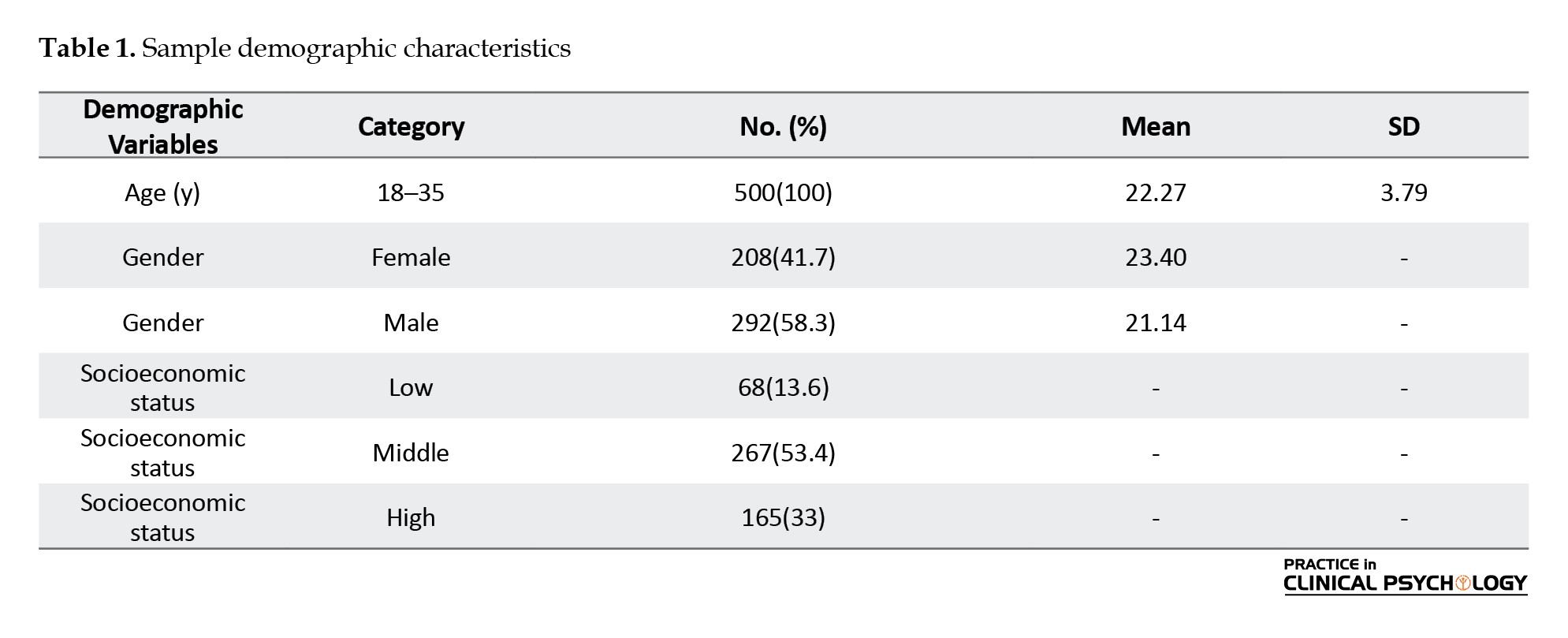
Participants ranged in age from 18 to 35 years (Mean±SD, 22.27±3.79), of whom 58.3% were men and 41.7% were women. The demographic characteristics of the participants are presented in Table 1.
Descriptive statistics and reliability
Descriptive analyses indicated Mean±SD scores of 6.47±4.26 (theoretical range=0–24) for PSS, 37.59±9.07 (theoretical range=16–64) for TPS, and 7.24±3.7; theoretical range=0–15) for death anxiety scale (DAS). Based on the theoretical score ranges, these values may be interpreted as reflecting moderate levels across the sample (Table 2).
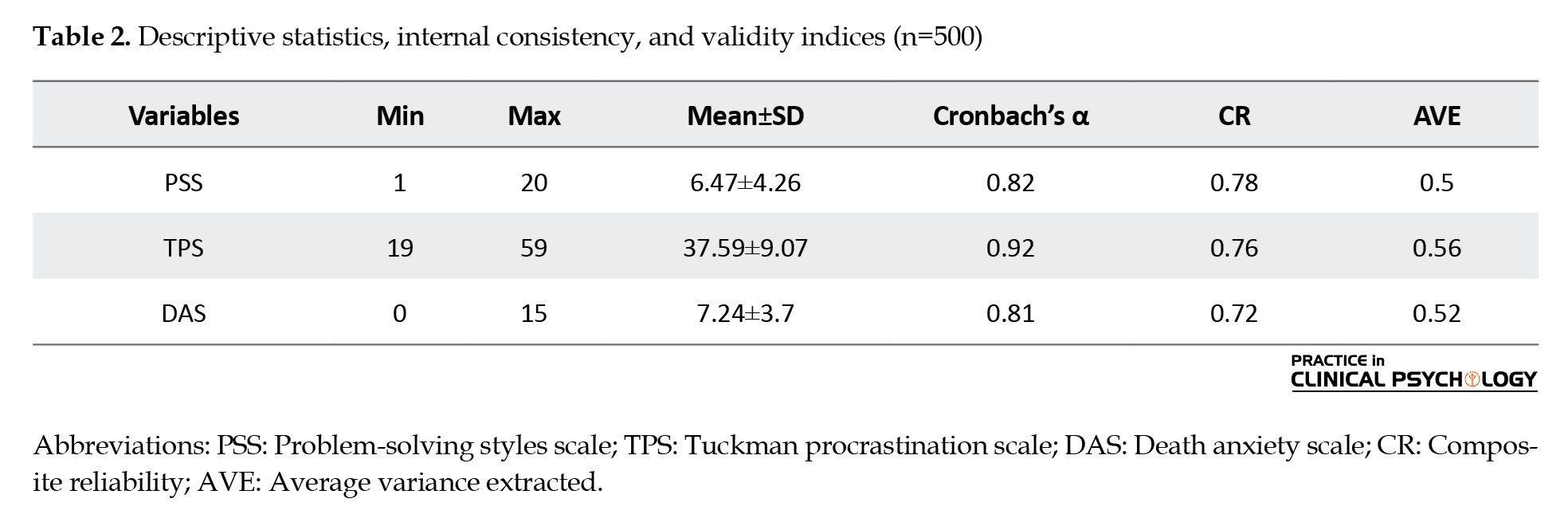
Internal consistency estimates were acceptable to excellent, with Cronbach’s α coefficients ranging from 0.81 to 0.92. Separate CFAs were conducted for each instrument prior to structural modeling to evaluate measurement adequacy. All standardized factor loadings for the measurement model were statistically significant (P<0.001) and ranged from 0.58 to 0.73. As presented in Table 2, CR and average variance extracted (AVE) values supported construct reliability and convergent validity. Discriminant validity was also supported, and the heterotrait–monotrait ratio (HTMT) remained well below recommended thresholds (HTMT=0.43). Furthermore, Harman’s single-factor test indicated that the first unrotated factor accounted for 36% of the total variance, suggesting that common-method bias was unlikely to substantially influence the observed associations.
Model fit
SEM (path analysis) supported the proposed mediation model. The final model demonstrated good fit to the data, with χ²/df=1.25, CFI=0.97, TLI=0.96, RMSEA=0.030, and SRMR=0.028 (Table 3).
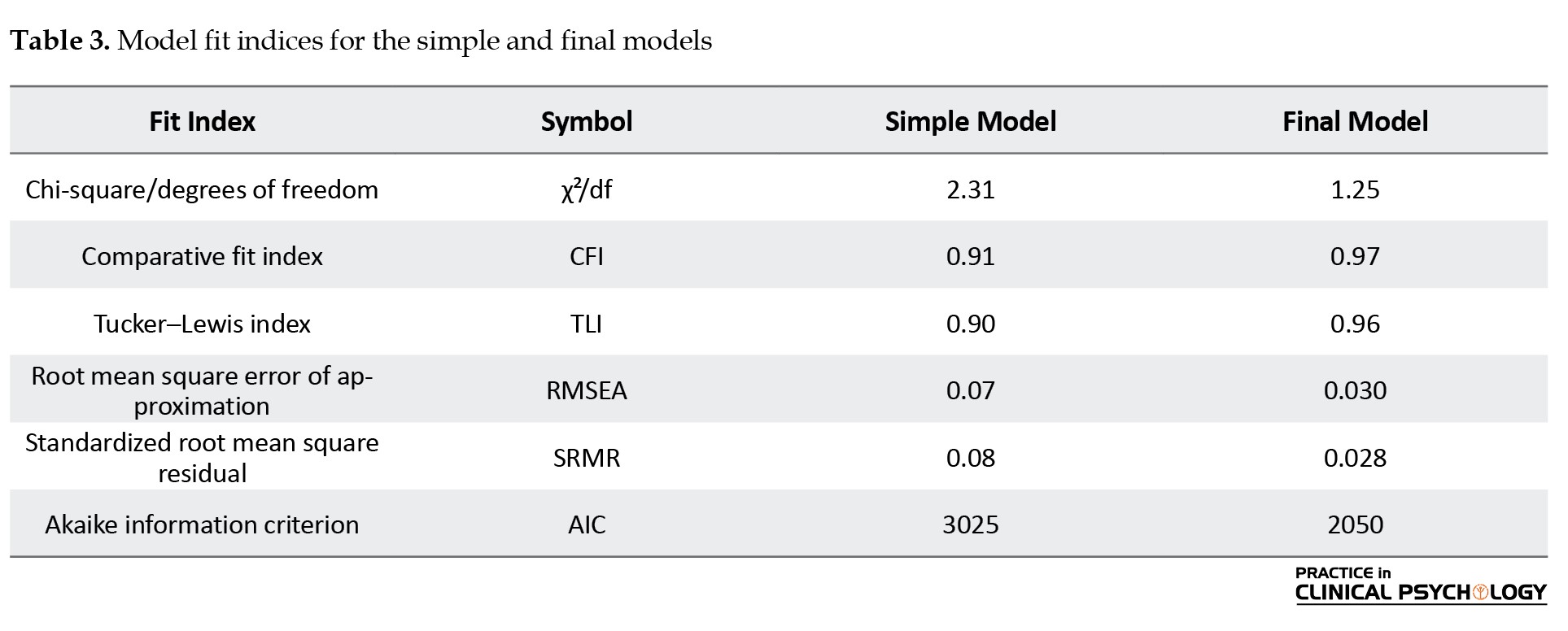
Comparative fit indices suggested that the final mediation model provided a better representation of the data than a simpler alternative model, as reflected in improved global fit indices and lower AIC values (Table 3).
Structural paths and mediation
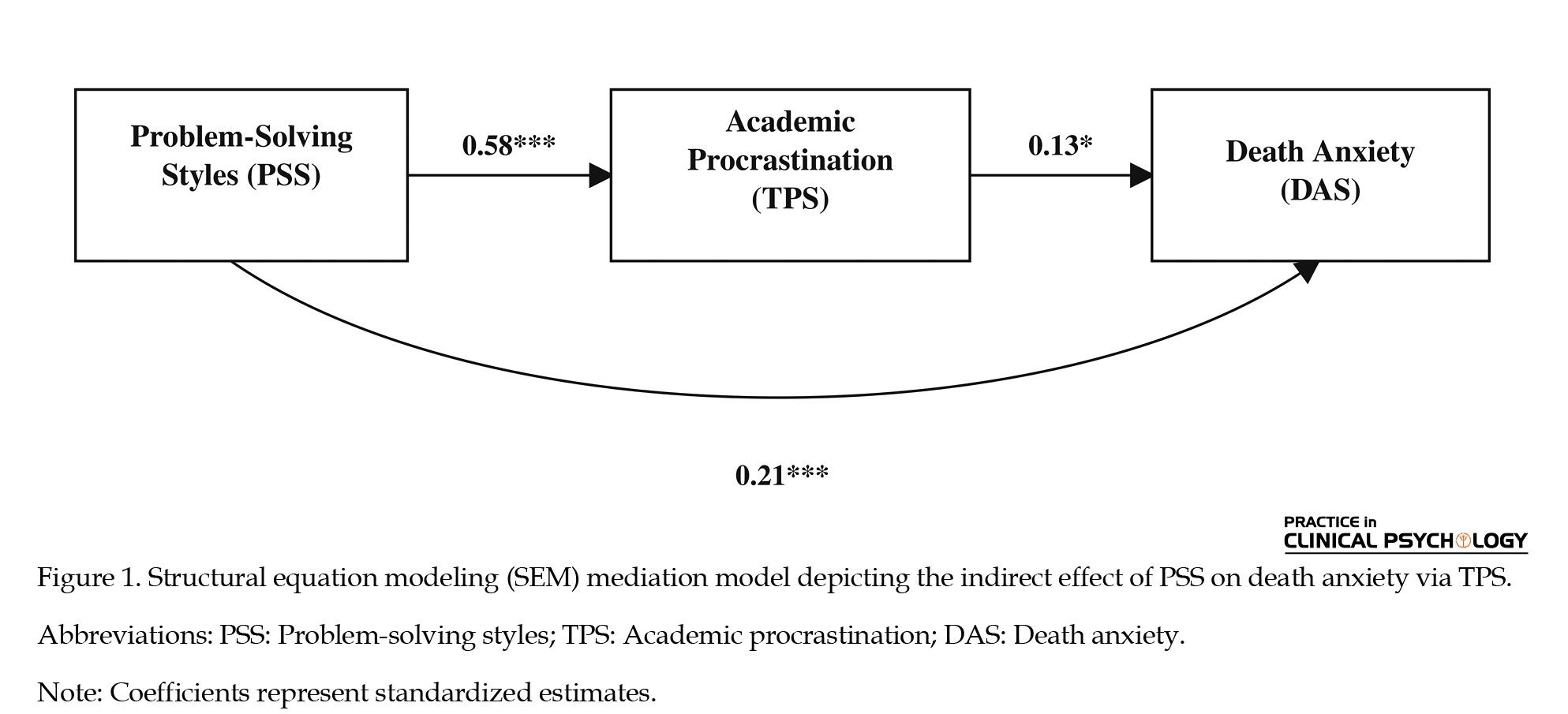
As presented in Table 4, maladaptive PSS positively predicted TPS (β=0.58, P<0.001).
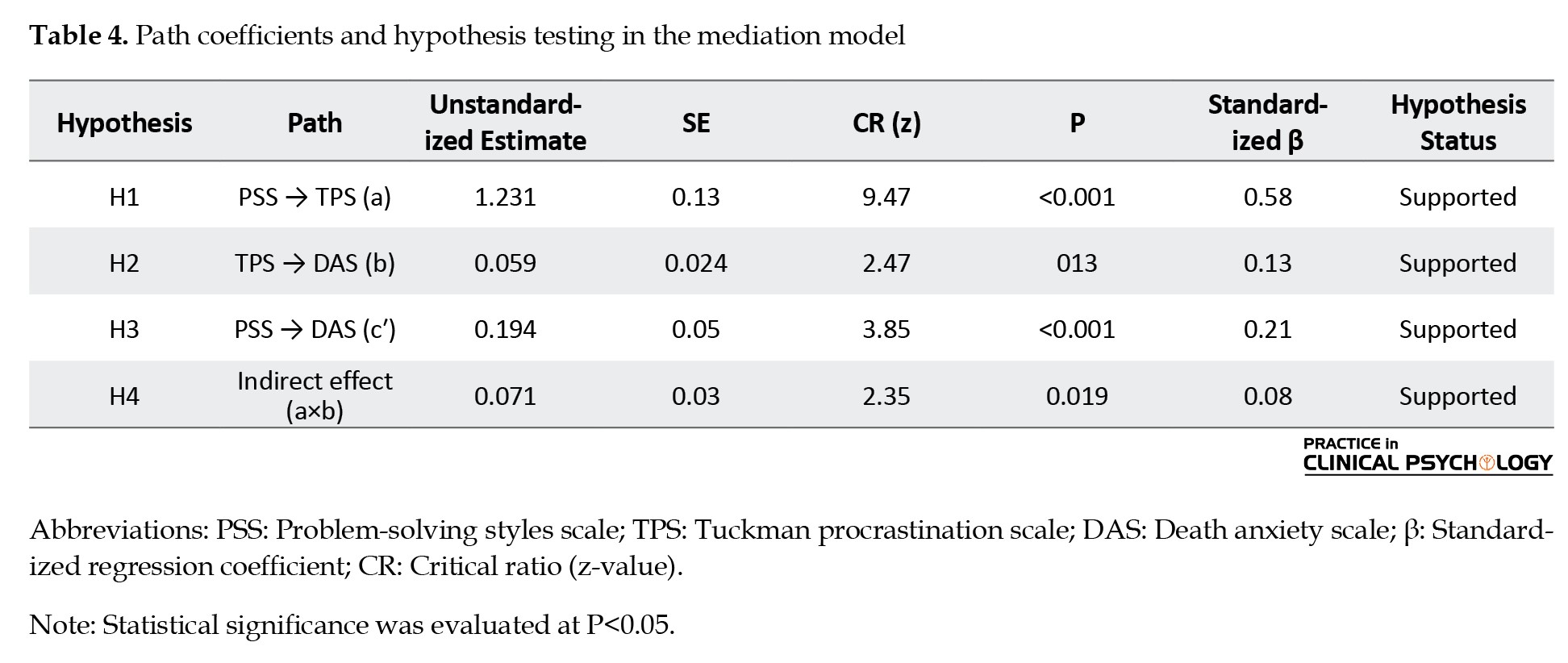
It is important to note that higher scores on the PSS denote a more maladaptive/ineffective problem-solving style; thus, this positive coefficient indicates that poorer problem-solving skills are associated with greater procrastination. TPS also positively predicted death anxiety (β=0.13, P=0.013). In addition, the direct path from PSS to death anxiety remained significant after including the mediator (β=0.21, P<0.001), supporting a pattern consistent with partial mediation.
Bootstrapping results provided evidence for the indirect effect of PSS on death anxiety via TPS. The indirect effect was significant (estimate=0.071, SE=0.030, P=0.019), and the 95% bootstrap confidence interval did not include zero (0.018 to 0.148), confirming the mediating role of TPS (Table 5).

Death anxiety refers to distress elicited by awareness of one’s own mortality and the psychological consequences of that awareness (Templer, 1970; Yalom, 1980). From an existential perspective, mortality awareness can generate tension between self-preservation and the certainty of death. When coping resources are insufficient, it may intensify existential concerns, undermine perceived control, and contribute to broader psychological distress (Yalom, 1980). Terror management theory (TMT) similarly proposes that individuals regulate mortality-related anxiety through protective resources, such as meaning, self-esteem, and culturally grounded worldviews; when these buffers are weakened, vulnerability to existential threat increases (Greenberg et al., 1990). University students may be particularly susceptible because academic demands, evaluative pressure, and uncertainty about future roles can amplify distress and make existential concerns more salient.
Academic procrastination (TPS) is commonly defined as the voluntary, unnecessary delay of academic tasks despite anticipating negative consequences (Solomon & Rothblum, 1984; Steel, 2007). In clinical and mental health terms, procrastination can be conceptualized as an avoidance behavior or a form of emotion regulation in which individuals postpone tasks to reduce immediate discomfort (e.g. fear of failure, boredom, uncertainty), even though this strategy tends to sustain distress over time (Sirois, 2014). Empirical work links TPS with anxiety, chronic worry, and poorer academic functioning, suggesting that the short-term relief gained through delaying may be offset by accumulating stress, self-criticism, and perceived inadequacy (Pychyl & Sirois, 2016). In student populations, repeated cycles of avoidance and deadline pressure may therefore represent a clinically relevant pathway through which academic stressors contribute to broader mental health difficulties.
Drawing on the theoretical framework of problem-solving therapy (PST) (D’Zurilla & Goldfried, 1971), problem-solving is conceptualized as a conscious, goal-directed coping process. Within this framework, maladaptive styles are marked by helplessness, limited planning, and avoidant decision-making when obstacles arise (Cassidy & Long, 1996). Unlike general avoidance, TPS leaves tasks unfinished, thereby compounding guilt, reducing self-efficacy, and undermining perceived competence (Pychyl & Sirois, 2016).
This reduction in perceived competence may partly help explain why persistent academic delay is associated with elevated existential distress. According to TMT, self-esteem, meaning, and perceived agency function as psychological buffers against mortality awareness (Greenberg et al., 1990). When procrastination interferes with academic mastery and perceived competence, these psychological resources may become weakened, potentially making death-related concerns more salient. Thus, procrastination may represent not only a marker of general distress but also a behavioral pathway through which students’ coping resources are depleted and mortality-related concerns may become more difficult to regulate psychologically, consistent with findings linking avoidance-based behavior to existential threat sensitivity (Türkarslan et al., 2020; Campbell & Bridges, 2022).
The socio-cultural context of Iranian university students provides a highly relevant backdrop for examining this model. In Iran, academic achievement is deeply intertwined with familial expectations, social status, and future economic viability in a challenging job market. These high-stakes evaluative pressures elevate academic performance from a normative developmental task to a critical determinant of socio-economic survival. In such a collectivistic environment, chronic TPS may threaten not only academic functioning but also students’ overarching sense of meaning and value. Although previous Iranian studies have explored isolated correlates of procrastination (Elmi-Manesh, 2018; Abbaspour et al., 2020), integrative models that mechanistically link problem-solving deficits and procrastination to existential concerns such as death anxiety remain underexplored.
Accordingly, the present study examined whether TPS statistically accounts for part of the association between problem-solving styles (PSS) and death anxiety among university students. By clarifying how maladaptive problem orientation and avoidant coping tendencies may relate to mortality-related distress, the findings may inform prevention and intervention efforts in university counseling services.
Study aims and hypotheses
The present study aimed to test a mediation model in a large sample of university students, in which TPS accounts for part of the association between PSS and death anxiety. Based on the theoretical and empirical literature, the following hypotheses were formulated:
H1: More maladaptive PSS are positively associated with higher levels of TPS. H2: Higher TPS is positively associated with greater death anxiety. H3: More maladaptive PSS are positively associated with higher levels of death anxiety (direct effect). H4: TPS partially mediates the relationship between PSS and death anxiety.
Materials and Methods
Design and setting
This study employed a descriptive–correlational, cross-sectional design to test a structural equation model (SEM) in which TPS mediated the association between PSS and death anxiety. The target population comprised undergraduate students at the University of Isfahan (Iran) during the 2024–2025 academic year. Data were collected from February 2024to May 2025 exclusively through online distribution via university communication platforms. Because the study relied on a single online administration format, equivalence testing between paper-and-pencil and online administration modes was not applicable.
Participants
A total of 856 students were invited to participate, and 546 completed the online questionnaire package, yielding an initial response rate of 63.8%. After applying predefined data-quality criteria, including incomplete responses, implausible or uniform response patterns, and multivariate outliers identified using Mahalanobis distance (P<0.001), 46 questionnaires were excluded. The final analytic sample therefore consisted of 500 undergraduate students (usable response rate=58.4%). Participants ranged in age from 18 to 35 years (Mean±SD, 22.27±3.79), of whom 58.3% were men and 41.7% were women. Participants were recruited using convenience sampling through university communication platforms; therefore, the findings should be generalized cautiously. Because participation was voluntary and online, the sample may have been affected by self-selection bias, such that students experiencing greater academic stress or procrastination-related difficulties may have been more likely to participate. An a priori power analysis based on anticipated medium effect sizes and SEM sample-size recommendations indicated that the final sample size would provide adequate statistical power for detecting structural associations within the proposed model (estimated power=0.86).
Instruments
Cassidy and long problem-solving styles questionnaire
Problem-solving styles (PSS) were assessed using the Cassidy and Long PSS questionnaire, which consists of 24 dichotomous (yes/no) items. Although the instrument was originally conceptualized as multidimensional, the total score was used in the present study to represent a broader maladaptive problem-solving orientation, consistent with prior research using the scale as a general indicator of ineffective or avoidant coping tendencies in non-clinical populations. Higher scores indicate more maladaptive PSS, with theoretical scores ranging from 0 to 24. Previous Iranian studies have supported the scale’s psychometric adequacy in student populations (Azizi, 2018). In the present sample, internal consistency was acceptable (Cronbach’s α=0.82). Confirmatory factor analysis further supported the adequacy of the measurement model, and indices of composite reliability (CR) and convergent validity were within acceptable ranges.
Tuckman procrastination scale
Academic procrastination was measured using the TPS, which includes 16 items rated on a 4-point Likert scale. Higher scores reflect greater academic procrastination, with theoretical scores ranging from 16 to 64. The Persian literature has also provided evidence for the assessment of academic procrastination, including the development and validation of an academic procrastination test (Moghadas-Bayat, 2003). Internal consistency in the present sample was excellent (Cronbach’s α=0.92).
Templer death anxiety scale
Death anxiety was assessed using the 15-item DAS with yes/no response options. Higher scores reflect higher death anxiety, with theoretical scores ranging from 0 to 15. The scale has been widely validated in Iran (Rajabi & Bahrani, 2001). Internal consistency in the current sample was acceptable (Cronbach’s α=0.81).
Procedure
After obtaining necessary permissions, the survey link was distributed through university communication platforms. Before participation, the study purpose and confidentiality principles were explained, and informed consent was obtained. Participation was voluntary and responses were anonymous. Several procedural steps were used to reduce the likelihood of common-method bias, including anonymous participation, confidentiality assurances, and the use of standardized instructions to reduce social desirability bias.
Data analysis
Descriptive statistics and reliability analyses were conducted using SPSS. Prior to SEM analyses, assumptions were evaluated, including inspection of skewness and kurtosis values, multicollinearity indices, and multivariate outliers using Mahalanobis distance. Missing data were handled using listwise deletion because the proportion of missing responses was minimal.
Analyses were conducted in R using the lavaan package. A two-step SEM procedure was employed (Anderson & Gerbing, 1988). Confirmatory factor analyses (CFAs) were conducted separately to evaluate the adequacy of the measurement properties of the study instruments. Given the dichotomous nature of the PSS items, the robust weighted least squares (WLSMV) estimator was used for the measurement analyses. Second, the hypothesized mediation model was tested using structural path analysis with robust maximum likelihood estimation (MLR). Structural analyses were conducted using observed composite scores rather than a fully latent SEM framework. No item parceling procedures were applied.
Model fit was evaluated using χ²/df, comparative fit index (CFI), Tucker–Lewis INDEX (TLI), root mean square error of approximation (RMSEA), and standardized root mean square residual (SRMR). Indirect effects were tested using bootstrapping with 5,000 resamples and 95% confidence intervals. Harman’s single-factor test was additionally conducted to evaluate the potential influence of common-method variance.
Results
Participants ranged in age from 18 to 35 years (Mean±SD, 22.27±3.79), of whom 58.3% were men and 41.7% were women. The demographic characteristics of the participants are presented in Table 1.
Descriptive statistics and reliability
Descriptive analyses indicated Mean±SD scores of 6.47±4.26 (theoretical range=0–24) for PSS, 37.59±9.07 (theoretical range=16–64) for TPS, and 7.24±3.7; theoretical range=0–15) for death anxiety scale (DAS). Based on the theoretical score ranges, these values may be interpreted as reflecting moderate levels across the sample (Table 2).
Internal consistency estimates were acceptable to excellent, with Cronbach’s α coefficients ranging from 0.81 to 0.92. Separate CFAs were conducted for each instrument prior to structural modeling to evaluate measurement adequacy. All standardized factor loadings for the measurement model were statistically significant (P<0.001) and ranged from 0.58 to 0.73. As presented in Table 2, CR and average variance extracted (AVE) values supported construct reliability and convergent validity. Discriminant validity was also supported, and the heterotrait–monotrait ratio (HTMT) remained well below recommended thresholds (HTMT=0.43). Furthermore, Harman’s single-factor test indicated that the first unrotated factor accounted for 36% of the total variance, suggesting that common-method bias was unlikely to substantially influence the observed associations.
Model fit
SEM (path analysis) supported the proposed mediation model. The final model demonstrated good fit to the data, with χ²/df=1.25, CFI=0.97, TLI=0.96, RMSEA=0.030, and SRMR=0.028 (Table 3).
Comparative fit indices suggested that the final mediation model provided a better representation of the data than a simpler alternative model, as reflected in improved global fit indices and lower AIC values (Table 3).
Structural paths and mediation
As presented in Table 4, maladaptive PSS positively predicted TPS (β=0.58, P<0.001).
It is important to note that higher scores on the PSS denote a more maladaptive/ineffective problem-solving style; thus, this positive coefficient indicates that poorer problem-solving skills are associated with greater procrastination. TPS also positively predicted death anxiety (β=0.13, P=0.013). In addition, the direct path from PSS to death anxiety remained significant after including the mediator (β=0.21, P<0.001), supporting a pattern consistent with partial mediation.
Bootstrapping results provided evidence for the indirect effect of PSS on death anxiety via TPS. The indirect effect was significant (estimate=0.071, SE=0.030, P=0.019), and the 95% bootstrap confidence interval did not include zero (0.018 to 0.148), confirming the mediating role of TPS (Table 5).
The model accounted for 35% of the variance in TPS and 12% of the variance in death anxiety.
Discussion
The present findings are consistent with a cognitive–behavioral–existential model in which maladaptive PSS are associated with higher death anxiety partly through increased TPS. Ineffective problem-solving appears to coincide with greater TPS, and procrastination, in turn, relates to elevated existential distress. The remaining direct association between PSS and death anxiety suggests that problem-solving orientations may be linked to death-related concerns beyond procrastination alone.
From a cognitive–behavioral perspective, the link between maladaptive problem-solving and procrastination is theoretically coherent. Helpless and avoidant styles are typically characterized by difficulties in problem definition and weaker decision-making, increasing task avoidance (Cassidy & Long, 1996; Kim et al., 2017). Procrastination often functions as avoidance of task-related negative affect, consistent with formulations framing procrastination as an emotion-regulation response (Steel, 2007; Pychyl & Sirois, 2016).
While these constructs conceptually overlap, it is crucial to differentiate them: helplessness is a cognitive appraisal of lacking control, generalized avoidance is a broad emotion-regulation strategy, whereas TPS is a specific, task-based behavioral avoidance that directly impairs performance and self-competence.
An existential reading clarifies why TPS relates to death anxiety. When procrastination accumulates unfinished tasks, it erodes a person’s sense of competence and agency. According to TMT, when sources of meaning, value, and self-worth are weakened, defenses against mortality awareness become less effective, and death-related anxiety may intensify (Greenberg et al., 1990). Procrastination may reflect an avoidance-based self-regulation pattern that generalizes across domains and may co-occur with heightened anxiety and sensitivity to existential threat (Campbell & Bridges, 2022; Türkarslan et al., 2020). The present framework focused specifically on death anxiety because existential theories suggest that threats to meaning and personal agency are particularly relevant to mortality-related concerns, extending beyond generalized anxiety alone.
Within the Iranian socio-cultural context, these findings carry specific weight. Given the collectivistic emphasis on educational prestige and family honor, academic success in Iran is often viewed as a primary pathway for social mobility and economic survival in a highly competitive job market. Consequently, severe academic delay does not just result in poor grades; it jeopardizes the student’s social identity and familial expectations. When culturally grounded sources of meaning and security are jeopardized by chronic task delay, vulnerability to existential concerns may be amplified. However, the variance in death anxiety explained by our model was relatively modest (12%). This suggests that while procrastination is a significant correlate, death anxiety is a multifaceted construct. Unmeasured factors, such as trait neuroticism or clinical depression might independently drive both procrastination and susceptibility to existential dread, warranting future investigation.
The persistence of the direct path from maladaptive problem-solving to death anxiety aligns with evidence connecting decision-making impairments to difficulty facing consequences (Bechara, 2005). Maladaptive problem-solving is often accompanied by helplessness, which can maintain a chronic threat mode. Taken together, the findings are compatible with a dual-pathway account in which PSS relate to death anxiety both indirectly (via behavioral avoidance) and directly (via threat-related cognitions).
Practical implications
Given the correlational nature of the findings, the following implications should be interpreted cautiously and viewed primarily as directions for future intervention-oriented research:
1) Enhancing approach-oriented problem-solving: Counseling centers may benefit from offering workshops focused on systematic problem-solving steps to reduce reliance on helpless coping. 2) Addressing procrastination as emotion regulation: Practitioners using CBT- or ACT-informed approaches could conceptualize procrastination as experiential avoidance, targeting distress tolerance. 3) Culturally responsive existential support: In high-stakes academic environments, like Iran, counselors must be sensitive to how academic delays trigger deeper existential fears. Rebuilding culturally relevant, meaning-based resources could serve as a buffer against death anxiety. 4) Holistic screening: When students present with severe procrastination, professionals may also screen for broader psychological distress, including existential or death-related anxieties.
Limitations and future directions
Several methodological limitations must be acknowledged. First, the cross-sectional design precludes any definitive causal inferences. Second, reliance on self-report measures introduces the risk of common method variance. Third, the convenience sample drawn from a single Iranian university limits generalizability. Fourth, while a two-step modeling approach was employed, the structural model utilized observed composite scores rather than a full latent variable modeling technique, which does not account for measurement error within the structural paths. Finally, potential confounding variables—such as trait neuroticism or clinical depression—were not controlled for. Future research should employ longitudinal designs, incorporate multidimensional assessments of problem-solving, and control for baseline psychological distress.
Conclusion
Maladaptive problem-solving styles were associated with greater academic procrastination, which, in turn, was associated with higher death anxiety among university students. Academic procrastination partially mediated this relationship, although a significant direct association between maladaptive problem-solving styles and death anxiety remained. These findings indicate that maladaptive problem-solving patterns and task-avoidant behaviors may constitute relevant targets for psychological and academic interventions. However, because of the cross-sectional design, these relationships should not be interpreted as causal.
Ethical Considerations
Compliance with ethical guidelines
The study was conducted in accordance with the Declaration of Helsinki. This study was approved by the Ethics Committee of the University of Isfahan, Isfahan, Iran (Code: IR.UI.REC.1404.181). Informed consent was obtained prior to data collection, and participant privacy was protected.
Funding
This research did not receive any specific grant from funding agencies in the public, commercial, or not-for-profit sectors.
Authors' contributions
Conceptualization, investigation, data curation, and writing the original draft: Erfan Ghaderian; Methodology: Erfan Ghaderian and Saba Kaviani; Formal analysis: Saba Kaviani; Review and editing: Erfan Ghaderian, Saba Kaviani, and Mohammad Bagher Kajbaf; Supervision and project administration: Mohammad Bagher Kajbaf.
Conflict of interest
The authors declared no conflict of interest.
References
Abbaspour, A., Farrokhi, N. A., Delavar, A., & Savari, K. (2020). [Comparing the effectiveness of time management skills training and behavior management training in reducing academic procrastination among Payame Noor University students (Ahvaz) (Persian)]. Educational Psychology Skills Quarterly, 11(1). [Link]
Anderson, J. C., & Gerbing, D. W. (1988). Structural equation modeling in practice: A review and recommended two-step approach. Psychological Bulletin, 103(3), 411-423. [DOI:10.1037/0033-2909.103.3.411]
Azizi, M., Sedaghat, Z., & Direkvand-Moghadam, A. (2018). Effect of critical thinking education on problem solving skills and self-esteem in Iranian female students. Journal of Clinical and Diagnostic Research, 12(1), VC04–VC07. [DOI:10.7860/JCDR/2018/27993.11128]
Bechara, A. (2005). Decision making, impulse control, and loss of willpower to resist drugs: A neurocognitive perspective. Nature Neuroscience, 8(11), 1458-1463. [DOI:10.1038/nn1584] [PMID]
Campbell, R. L., & Bridges, A. J. (2023). Bedtime procrastination mediates the relation between anxiety and sleep problems. Journal of Clinical Psychology, 79(3), 803–817. [DOI:10.1002/jclp.23440] [PMID]
Cassidy, T., & Long, C. (1996). Problem-solving style, stress, and psychological illness: Development of a multifactorial measure. The British Journal of Clinical Psychology, 35(2), 265–277.[DOI:10.1111/j.2044-8260.1996.tb01181.x] [PMID]
D’Zurilla, T. J., & Goldfried, M. R. (1971). Problem solving and behavior modification. Journal of Abnormal Psychology, 78(1), 107-126. [DOI:10.1037/h0031360] [PMID]
Elmi-Manesh, N. (2018). [The effectiveness of the psychological capital intervention (PCI) model on academic and organizational procrastination (Persian)]. Social Cognition, 7(2), 159-172. [DOI:10.30473/sc.2018.5302]
Greenberg, J., Pyszczynski, T., Solomon, S., Rosenblatt, A., Veeder, M., & Kirkland, S., et al. (1990). Evidence for terror management theory II: The effects of mortality salience on reactions to those who threaten or bolster the cultural worldview. Journal of Personality and Social Psychology, 58(2), 308-318. [Link]
Kim, S., Fernandez, S., & Terrier, L. (2017). Procrastination, personality traits, and academic performance: When active and passive procrastination tell a different story. Personality and Individual Differences, 108, 154-160. [DOI:10.1016/j.paid.2016.12.021]
Moghadas-Bayat, M. R. (2003). [Reliability and validity of Tuckman procrastination scale (Persian)]. [MA thesis]. Roudehen: Islamic Azad University, Roudehen Branch.
Pychyl, T. A., & Sirois, F. M. (2016). Procrastination, emotion regulation, and well-being. In F. M. Sirois & T. A. Pychyl (Eds.), Procrastination, health, and well-being (pp. 163–188). New York City: Academic Press. [DOI: 10.1016/B978-0-12-802862-9.00008-6]
Rajabi, G. R., & Bahrani, M. (2002). [Item factor analysis of the death anxiety scale (Persian)]. Journal of Psychology, 5(4), 331-344. [Link]
Sirois, F. M. (2014). Procrastination and stress: Exploring the role of self-compassion. Self and Identity, 13(2), 128–145. [DOI:10.1080/15298868.2013.763404]
Solomon, L. J., & Rothblum, E. D. (1984). Academic procrastination: Frequency and cognitive-behavioral correlates. Journal of Counseling Psychology, 31(4), 503-509. [Link]
Steel, P. (2007). The nature of procrastination: A meta-analytic and theoretical review of quintessential self-regulatory failure. Psychological Bulletin, 133(1), 65-94. [DOI:10.1037/0033-2909.133.1.65] [PMID]
Templer, D. I. (1970). The construction and validation of a death anxiety scale. The Journal of General Psychology, 82(2), 165-177. [DOI:10.1080/00221309.1970.9920634] [PMID]
Türkarslan, K. K., Okay, D., Çevrim, M., & Bozo, Ö. (2020). Life is short, stay awake: Death anxiety and bedtime procrastination. The Journal of General Psychology, 147(1), 43-61. [DOI:10.1080/00221309.2019.1633994] [PMID]
Tuckman, B. W. (1991). The development and concurrent validity of the procrastination scale. Educational and Psychological Measurement, 51(2), 473-480. [DOI:10.1177/0013164491512022]
Yalom, I. D. (1980). Existential psychotherapy. New York: Basic Books. [Link]
Discussion
The present findings are consistent with a cognitive–behavioral–existential model in which maladaptive PSS are associated with higher death anxiety partly through increased TPS. Ineffective problem-solving appears to coincide with greater TPS, and procrastination, in turn, relates to elevated existential distress. The remaining direct association between PSS and death anxiety suggests that problem-solving orientations may be linked to death-related concerns beyond procrastination alone.
From a cognitive–behavioral perspective, the link between maladaptive problem-solving and procrastination is theoretically coherent. Helpless and avoidant styles are typically characterized by difficulties in problem definition and weaker decision-making, increasing task avoidance (Cassidy & Long, 1996; Kim et al., 2017). Procrastination often functions as avoidance of task-related negative affect, consistent with formulations framing procrastination as an emotion-regulation response (Steel, 2007; Pychyl & Sirois, 2016).
While these constructs conceptually overlap, it is crucial to differentiate them: helplessness is a cognitive appraisal of lacking control, generalized avoidance is a broad emotion-regulation strategy, whereas TPS is a specific, task-based behavioral avoidance that directly impairs performance and self-competence.
An existential reading clarifies why TPS relates to death anxiety. When procrastination accumulates unfinished tasks, it erodes a person’s sense of competence and agency. According to TMT, when sources of meaning, value, and self-worth are weakened, defenses against mortality awareness become less effective, and death-related anxiety may intensify (Greenberg et al., 1990). Procrastination may reflect an avoidance-based self-regulation pattern that generalizes across domains and may co-occur with heightened anxiety and sensitivity to existential threat (Campbell & Bridges, 2022; Türkarslan et al., 2020). The present framework focused specifically on death anxiety because existential theories suggest that threats to meaning and personal agency are particularly relevant to mortality-related concerns, extending beyond generalized anxiety alone.
Within the Iranian socio-cultural context, these findings carry specific weight. Given the collectivistic emphasis on educational prestige and family honor, academic success in Iran is often viewed as a primary pathway for social mobility and economic survival in a highly competitive job market. Consequently, severe academic delay does not just result in poor grades; it jeopardizes the student’s social identity and familial expectations. When culturally grounded sources of meaning and security are jeopardized by chronic task delay, vulnerability to existential concerns may be amplified. However, the variance in death anxiety explained by our model was relatively modest (12%). This suggests that while procrastination is a significant correlate, death anxiety is a multifaceted construct. Unmeasured factors, such as trait neuroticism or clinical depression might independently drive both procrastination and susceptibility to existential dread, warranting future investigation.
The persistence of the direct path from maladaptive problem-solving to death anxiety aligns with evidence connecting decision-making impairments to difficulty facing consequences (Bechara, 2005). Maladaptive problem-solving is often accompanied by helplessness, which can maintain a chronic threat mode. Taken together, the findings are compatible with a dual-pathway account in which PSS relate to death anxiety both indirectly (via behavioral avoidance) and directly (via threat-related cognitions).
Practical implications
Given the correlational nature of the findings, the following implications should be interpreted cautiously and viewed primarily as directions for future intervention-oriented research:
1) Enhancing approach-oriented problem-solving: Counseling centers may benefit from offering workshops focused on systematic problem-solving steps to reduce reliance on helpless coping. 2) Addressing procrastination as emotion regulation: Practitioners using CBT- or ACT-informed approaches could conceptualize procrastination as experiential avoidance, targeting distress tolerance. 3) Culturally responsive existential support: In high-stakes academic environments, like Iran, counselors must be sensitive to how academic delays trigger deeper existential fears. Rebuilding culturally relevant, meaning-based resources could serve as a buffer against death anxiety. 4) Holistic screening: When students present with severe procrastination, professionals may also screen for broader psychological distress, including existential or death-related anxieties.
Limitations and future directions
Several methodological limitations must be acknowledged. First, the cross-sectional design precludes any definitive causal inferences. Second, reliance on self-report measures introduces the risk of common method variance. Third, the convenience sample drawn from a single Iranian university limits generalizability. Fourth, while a two-step modeling approach was employed, the structural model utilized observed composite scores rather than a full latent variable modeling technique, which does not account for measurement error within the structural paths. Finally, potential confounding variables—such as trait neuroticism or clinical depression—were not controlled for. Future research should employ longitudinal designs, incorporate multidimensional assessments of problem-solving, and control for baseline psychological distress.
Conclusion
Maladaptive problem-solving styles were associated with greater academic procrastination, which, in turn, was associated with higher death anxiety among university students. Academic procrastination partially mediated this relationship, although a significant direct association between maladaptive problem-solving styles and death anxiety remained. These findings indicate that maladaptive problem-solving patterns and task-avoidant behaviors may constitute relevant targets for psychological and academic interventions. However, because of the cross-sectional design, these relationships should not be interpreted as causal.
Ethical Considerations
Compliance with ethical guidelines
The study was conducted in accordance with the Declaration of Helsinki. This study was approved by the Ethics Committee of the University of Isfahan, Isfahan, Iran (Code: IR.UI.REC.1404.181). Informed consent was obtained prior to data collection, and participant privacy was protected.
Funding
This research did not receive any specific grant from funding agencies in the public, commercial, or not-for-profit sectors.
Authors' contributions
Conceptualization, investigation, data curation, and writing the original draft: Erfan Ghaderian; Methodology: Erfan Ghaderian and Saba Kaviani; Formal analysis: Saba Kaviani; Review and editing: Erfan Ghaderian, Saba Kaviani, and Mohammad Bagher Kajbaf; Supervision and project administration: Mohammad Bagher Kajbaf.
Conflict of interest
The authors declared no conflict of interest.
References
Abbaspour, A., Farrokhi, N. A., Delavar, A., & Savari, K. (2020). [Comparing the effectiveness of time management skills training and behavior management training in reducing academic procrastination among Payame Noor University students (Ahvaz) (Persian)]. Educational Psychology Skills Quarterly, 11(1). [Link]
Anderson, J. C., & Gerbing, D. W. (1988). Structural equation modeling in practice: A review and recommended two-step approach. Psychological Bulletin, 103(3), 411-423. [DOI:10.1037/0033-2909.103.3.411]
Azizi, M., Sedaghat, Z., & Direkvand-Moghadam, A. (2018). Effect of critical thinking education on problem solving skills and self-esteem in Iranian female students. Journal of Clinical and Diagnostic Research, 12(1), VC04–VC07. [DOI:10.7860/JCDR/2018/27993.11128]
Bechara, A. (2005). Decision making, impulse control, and loss of willpower to resist drugs: A neurocognitive perspective. Nature Neuroscience, 8(11), 1458-1463. [DOI:10.1038/nn1584] [PMID]
Campbell, R. L., & Bridges, A. J. (2023). Bedtime procrastination mediates the relation between anxiety and sleep problems. Journal of Clinical Psychology, 79(3), 803–817. [DOI:10.1002/jclp.23440] [PMID]
Cassidy, T., & Long, C. (1996). Problem-solving style, stress, and psychological illness: Development of a multifactorial measure. The British Journal of Clinical Psychology, 35(2), 265–277.[DOI:10.1111/j.2044-8260.1996.tb01181.x] [PMID]
D’Zurilla, T. J., & Goldfried, M. R. (1971). Problem solving and behavior modification. Journal of Abnormal Psychology, 78(1), 107-126. [DOI:10.1037/h0031360] [PMID]
Elmi-Manesh, N. (2018). [The effectiveness of the psychological capital intervention (PCI) model on academic and organizational procrastination (Persian)]. Social Cognition, 7(2), 159-172. [DOI:10.30473/sc.2018.5302]
Greenberg, J., Pyszczynski, T., Solomon, S., Rosenblatt, A., Veeder, M., & Kirkland, S., et al. (1990). Evidence for terror management theory II: The effects of mortality salience on reactions to those who threaten or bolster the cultural worldview. Journal of Personality and Social Psychology, 58(2), 308-318. [Link]
Kim, S., Fernandez, S., & Terrier, L. (2017). Procrastination, personality traits, and academic performance: When active and passive procrastination tell a different story. Personality and Individual Differences, 108, 154-160. [DOI:10.1016/j.paid.2016.12.021]
Moghadas-Bayat, M. R. (2003). [Reliability and validity of Tuckman procrastination scale (Persian)]. [MA thesis]. Roudehen: Islamic Azad University, Roudehen Branch.
Pychyl, T. A., & Sirois, F. M. (2016). Procrastination, emotion regulation, and well-being. In F. M. Sirois & T. A. Pychyl (Eds.), Procrastination, health, and well-being (pp. 163–188). New York City: Academic Press. [DOI: 10.1016/B978-0-12-802862-9.00008-6]
Rajabi, G. R., & Bahrani, M. (2002). [Item factor analysis of the death anxiety scale (Persian)]. Journal of Psychology, 5(4), 331-344. [Link]
Sirois, F. M. (2014). Procrastination and stress: Exploring the role of self-compassion. Self and Identity, 13(2), 128–145. [DOI:10.1080/15298868.2013.763404]
Solomon, L. J., & Rothblum, E. D. (1984). Academic procrastination: Frequency and cognitive-behavioral correlates. Journal of Counseling Psychology, 31(4), 503-509. [Link]
Steel, P. (2007). The nature of procrastination: A meta-analytic and theoretical review of quintessential self-regulatory failure. Psychological Bulletin, 133(1), 65-94. [DOI:10.1037/0033-2909.133.1.65] [PMID]
Templer, D. I. (1970). The construction and validation of a death anxiety scale. The Journal of General Psychology, 82(2), 165-177. [DOI:10.1080/00221309.1970.9920634] [PMID]
Türkarslan, K. K., Okay, D., Çevrim, M., & Bozo, Ö. (2020). Life is short, stay awake: Death anxiety and bedtime procrastination. The Journal of General Psychology, 147(1), 43-61. [DOI:10.1080/00221309.2019.1633994] [PMID]
Tuckman, B. W. (1991). The development and concurrent validity of the procrastination scale. Educational and Psychological Measurement, 51(2), 473-480. [DOI:10.1177/0013164491512022]
Yalom, I. D. (1980). Existential psychotherapy. New York: Basic Books. [Link]
Type of Study: Original Research Article |
Subject:
Cognitive behavioral
| Rights and permissions | |
 |
This work is licensed under a Creative Commons Attribution-NonCommercial 4.0 International License. |

This is an open access article distributed under the terms of the Creative Commons Attribution-NonCommercial 4.0 (CC-By-NC 4.0), which permits use, distribution, and reproduction in any medium, provided the original work is properly cited and is not used for commercial purposes.
Contact Information