
Volume 14, Issue 2 (Spring 2026)
PCP 2026, 14(2): 167-174 |
Back to browse issues page



Download citation:
BibTeX | RIS | EndNote | Medlars | ProCite | Reference Manager | RefWorks
Send citation to:


BibTeX | RIS | EndNote | Medlars | ProCite | Reference Manager | RefWorks
Send citation to:
Hardani R, Bavi S. The Effectiveness of Problem-solving Skills Training on Aggression and Academic Self-efficacy Among Aggressive Students. PCP 2026; 14 (2) :167-174
URL: http://jpcp.uswr.ac.ir/article-1-1079-en.html
URL: http://jpcp.uswr.ac.ir/article-1-1079-en.html


1- Department of Psychology, Ahv.C., Islamic Azad University, Ahvaz, Iran.
2- Department of Psychology, Ahv.C., Islamic Azad University, Ahvaz, Iran ,sassanbavi@gmail.com
2- Department of Psychology, Ahv.C., Islamic Azad University, Ahvaz, Iran ,
Full-Text [PDF 569 kb]
(94 Downloads)
| Abstract (HTML) (586 Views)
Full-Text: (61 Views)
Introduction
Adolescence is a pivotal developmental stage marked by profound physiological, cognitive, and socio-emotional changes. During this period, high school students frequently face a range of interpersonal and academic stressors that may give rise to maladaptive behavioral patterns (Mastorci et al., 2024). Aggression emerges as a particularly prominent issue in educational environments, often resulting in disciplinary actions, social exclusion, and enduring psychological distress (Yu et al., 2025). Aggressive students typically experience difficulties with emotional regulation, impulse control, and social information processing, manifesting in verbal, physical, or relational forms that disrupt classroom dynamics and reflect underlying cognitive distortions, such as hostile attribution biases (Gao et al., 2023; Rieffe et al., 2016; Syasyila et al., 2024). Untreated aggressive tendencies have been shown to progress into persistent antisocial behaviors and significant academic underachievement, perpetuating a cycle of failure that extends into adulthood (Sudmand et al., 2020; Almeida et al., 2024). Accordingly, addressing the needs of this at-risk group remains a key priority for educational psychologists and school counselors (Aghajari et al., 2017).
Academic self-efficacy, rooted in social cognitive theory, denotes students’ perceived capability to organize and execute the actions necessary to achieve designated educational outcomes (Loveimi et al., 2026). This construct serves as a powerful determinant of academic motivation, effort, and resilience, with higher levels associated with deeper learning approaches and better recovery from setbacks (Yokoyama, 2024). In contrast, aggressive students often exhibit diminished academic self-efficacy due to recurrent negative feedback, reinforcing perceptions of incompetence and framing academic tasks as overwhelming (Chen et al., 2019; Pérez-Marco et al., 2024).
Problem-solving skills training is a structured cognitive-behavioral approach that equips individuals with systematic methods for identifying problems, generating alternatives, and implementing effective solutions (Hasani Rad et al., 2025). Empirical evidence supports its efficacy in reducing impulsivity, enhancing emotional regulation, and decreasing externalizing behaviors in youth by promoting deliberate cognitive processing over reactive responses (Khoshneshan et al., 2023; Ezeddine et al., 2022; Zhang et al., 2025; Günaydın, 2022; Wang et al., 2025). Furthermore, it yields benefits for academic self-perceptions, as improved conflict resolution and obstacle management correlate with heightened self-efficacy and engagement (Babazadeh et al., 2021; Shahgholy Ghahfarokhi et al., 2015; Nicoară et al., 2024).
Notwithstanding the established advantages of cognitive-behavioral approaches, there is a paucity of targeted research examining the concurrent effects of problem-solving skills training on both aggression and academic self-efficacy in high school populations within specific sociocultural contexts, such as Iran. Although an inverse relationship between aggression and academic self-efficacy is well-documented, limited studies have investigated the potential of structured problem-solving training as an integrated remedy in the Iranian school system. In light of rising classroom disruptions and the critical influence of self-efficacy on adolescent achievement, further investigation is warranted to inform evidence-based counseling initiatives. Therefore, this study aimed to evaluate the effectiveness of problem-solving skills training in reducing aggression and enhancing academic self-efficacy among aggressive male high school students.
Materials and Methods
Design
The present study employed a randomized controlled trial design with a pre-test, post-test, and a three-month follow-up assessment.
Participants
The statistical population comprised all male high school students exhibiting aggressive behaviors in Ahvaz City, Iran, during the 2024-2025 academic year. Using a multi-stage cluster random sampling technique, 40 students were selected based on their scores on the Ahvaz aggression inventory (AAI)—specifically those scoring one standard deviation above the mean—and subsequent clinical interviews conducted by a clinical psychologist. An a priori power analysis was conducted using G*Power software, version 3.1 for a mixed-design analysis of variance (ANOVA) (2 groups×3 time points), assuming a large effect size (partial η²=0.40, corresponding to Cohen’s f≈0.67), α=0.05, and power=0.80, which indicated a minimum required sample of 34 participants. The final sample of 40 (n=20 per group) was selected to account for potential attrition. Participants were then randomly assigned to either the experimental group (n=20) or the control group (n=20). Randomization was performed using a simple random allocation method via a computer-generated random number sequence prepared by an independent researcher not involved in the study. Group assignments were placed in sealed opaque envelopes to ensure concealment until assignment. The inclusion criteria included being a full-time high school student, obtaining a high aggression score, and providing informed consent for participation. The exclusion criteria consisted of concurrent participation in other psychological interventions, presence of severe psychiatric disorders requiring medication, and missing more than two intervention sessions. Written informed consent was obtained from all participants and their guardians after a full explanation of the study objectives, procedures, voluntary nature of participation, and the right to withdraw at any time without consequence. Confidentiality of data was strictly maintained, with identifying information stored separately from study data. Participants in the control group were offered the intervention after completion of the follow-up phase.
Procedure
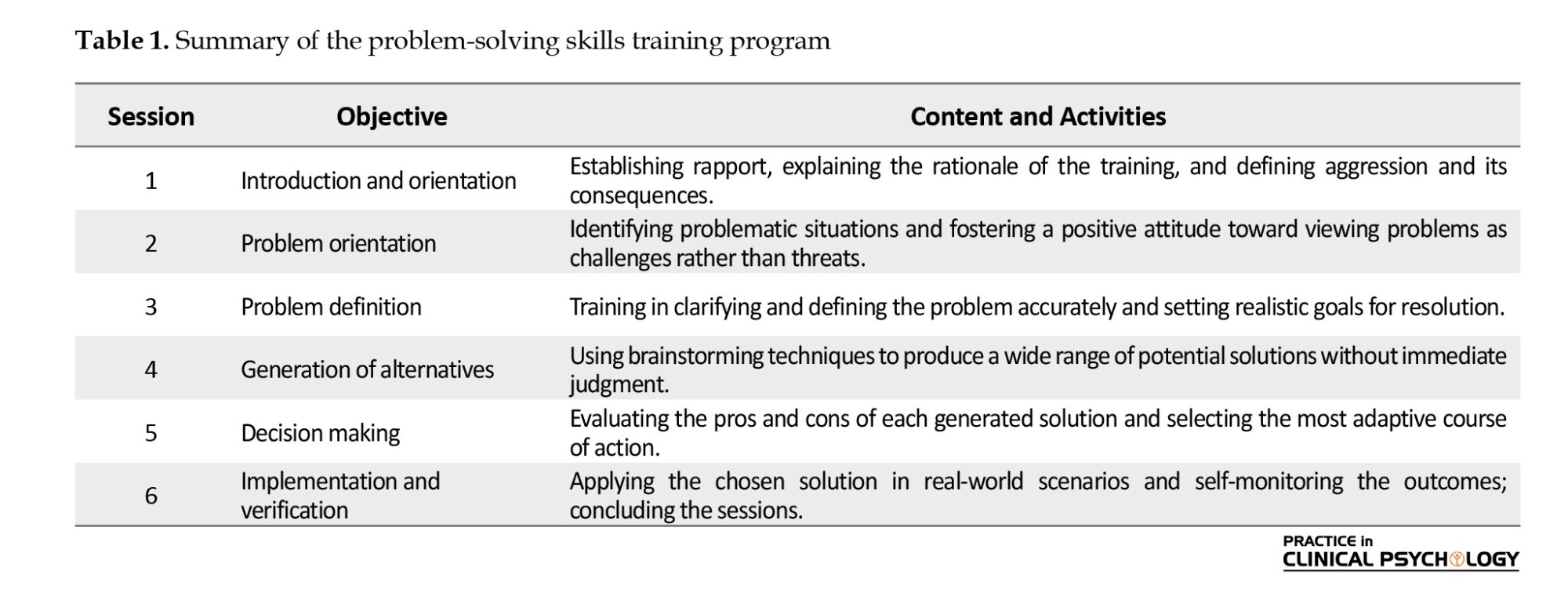
Following the random assignment and the administration of pre-tests to both groups, the experimental group underwent six 90-minute sessions of problem-solving skills training, conducted twice weekly. The sessions were based on the cognitive-behavioral model of social problem-solving. The intervention was delivered by a trained clinical psychologist with over 10 years of experience in cognitive-behavioral interventions. To ensure fidelity, all sessions followed a detailed manualized protocol, were audio-recorded with participant consent, and 30% of sessions were randomly selected and rated for adherence by an independent supervisor using a structured checklist covering key components (e.g. coverage of session objectives, use of role-plays, and homework assignment). Adherence ratings exceeded 90% across checked sessions. During this period, the control group remained on a waiting list and received no training. The use of a no-intervention waiting-list control, while allowing for assessment of change over time, limits attribution of effects solely to the specific intervention components, as non-specific factors (e.g. attention or expectancy) cannot be fully ruled out. Post-tests were administered immediately after the final session, followed by a follow-up assessment three months later to evaluate the temporal stability of the intervention’s effects. Table 1 presents the structure of the intervention sessions.
Instruments
AAI: The AAI was developed by Zahedifar et al. (2000) to measure aggression levels in Iranian populations. It consists of 30 items, scored on a 4-point Likert scale (never=0 to always=3), with total scores ranging from 0 to 90. Higher scores indicate a higher propensity for aggression. The inventory assesses three dimensions: anger and hostility, physical aggression, and verbal aggression. In previous Iranian studies, the Cronbach’s α coefficient was reported at 0.87, demonstrating high internal consistency (Zahedifar et al., 2000). In the present study, the Cronbach’s α was calculated to be 0.84, confirming its reliability for this sample.
Academic self-efficacy scale (ASES): Developed by Zajacova et al. (2005), the ASES evaluates a student’s confidence in their ability to perform various academic tasks. It contains 27 items, which are scored on a Likert scale ranging from 1 (not at all confident) to 5 (extremely confident). The total score ranges from 27 to 135, where higher scores reflect superior academic self-efficacy. The scale covers domains, such as classroom performance and time management. Reliability in prior research using Persian versions has shown alpha coefficients above 0.80 (Kooshki et al., 2024). In this study, the internal consistency was validated with a Cronbach’s alpha of 0.89.
Data analysis
Statistical analysis was performed using SPSS software, version 26. Descriptive statistics (Mean±SD) were used to summarize the data. For the inferential analysis, a mixed-design ANOVA was employed to examine the within-subject effect of time (pre-test, post-test, follow-up) and the between-subject effect of the intervention group, ensuring all statistical assumptions were met.
Results
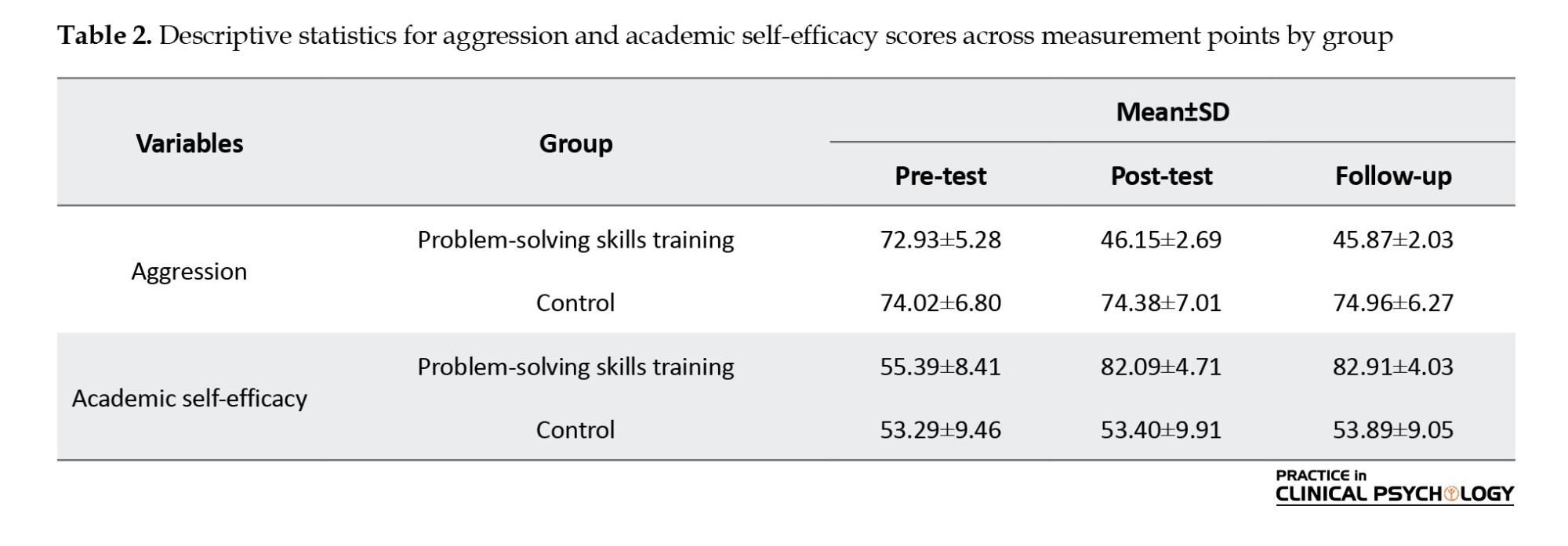
The study sample comprised 40 aggressive male high school students, aged between 13 and 15 years, with a Mean±SD age of 14.2±0.82 years. As presented in Table 2, at baseline, the experimental and control groups exhibited comparable mean scores on both aggression (approximately 73–74) and academic self-efficacy (approximately 53–55), indicating successful randomization. Following the intervention, the experimental group demonstrated a marked decline in aggression scores to around 46 at post-test, with further slight stabilization at follow-up. In contrast, the control group showed negligible changes, with scores remaining elevated. For academic self-efficacy, the experimental group displayed a substantial increase to over 82 by post-test, maintained at follow-up, whereas the control group exhibited minimal variation around the baseline level of approximately 53.
Prior to conducting the primary inferential analyses, the assumptions underlying mixed-design ANOVA were examined. The Kolmogorov-Smirnov test confirmed normality of score distributions for both aggression and academic self-efficacy at all measurement points (P>0.05). Levene’s test verified homogeneity of variances across groups (P>0.05). Mauchly’s test indicated a violation of sphericity for both variables (P<0.05); therefore, degrees of freedom were corrected using Greenhouse-Geisser estimates.
Mixed-design ANOVA revealed a significant group-by-time interaction for aggression (F=77.03, P<0.001, partial η²=0.69), indicating large effect size, as well as significant main effects of time (F=54.82, P<0.001, partial η²=0.71), and group (F=33.47, P<0.001, partial η²=0.69). For academic self-efficacy, the group-by-time interaction was also significant (F=67.10, P<0.001, partial η²=0.70), with significant main effects of time (F=49.03, P<0.001, partial η²=0.69), and group (F=43.96, P<0.001, partial η²=0.71). These results demonstrate that changes over time differed substantially between groups, with large effect sizes supporting the efficacy of the intervention.
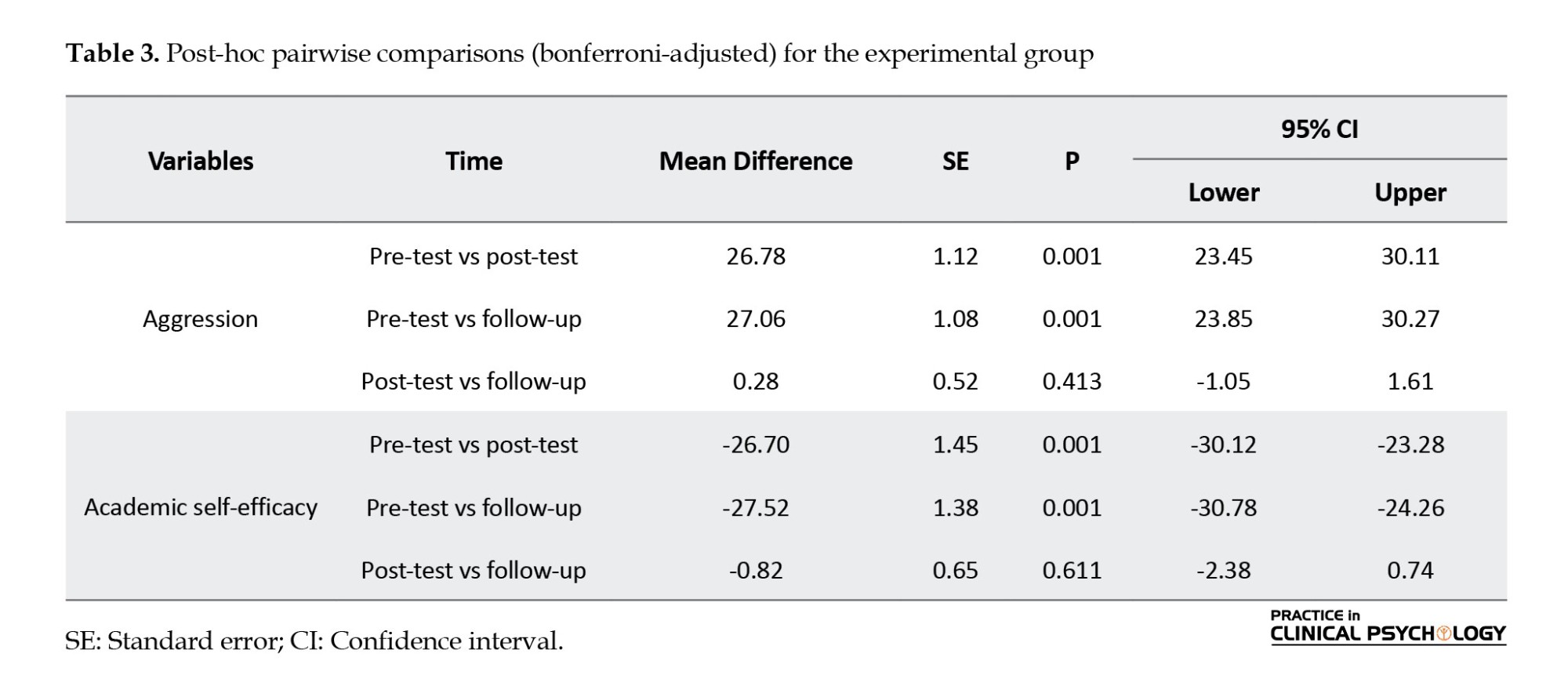
Post-hoc pairwise comparisons with Bonferroni correction for the experimental group confirmed significant reductions in aggression from pre-test to post-test (mean difference=26.78, SE=1.12, P<0.001, 95% CI, 23.45%, 30.11%) and from pre-test to follow-up (mean difference=27.06, SE=1.08, P<0.001, 95% CI, 23.85%, 30.27%), with no significant difference between post-test and follow-up (P=0.413). Similarly, academic self-efficacy showed significant increases from pre-test to posttest (mean difference=-26.70, SE=1.45, P<0.001, 95% CI, -30.12%, -23.28%) and from pre-test to follow-up (mean difference=-27.52, SE=1.38, P<0.001, 95% CI, -30.78%, -24.26%), with stability between post-test and follow-up (P=0.611). These findings indicate sustained intervention effects at three-month follow-up (Table 3).
Discussion
This study aimed to investigate the effectiveness of problem-solving skills training in mitigating aggression and enhancing academic self-efficacy among aggressive high school students. The findings derived from the mixed-design ANOVA provided robust evidence that the intervention significantly reduced aggression and improved academic self-efficacy in the experimental group compared to the control group. Furthermore, these therapeutic gains were found to be stable during the three-month follow-up period, suggesting that the cognitive-behavioral techniques acquired during the sessions were internalized and maintained by the participants.
The significant reduction in aggression scores can be attributed to the cognitive restructuring and behavioral modification inherent in the problem-solving model. Aggressive students often suffer from “hostile attribution bias,” where they misinterpret neutral social cues as threatening, leading to impulsive and violent reactions (Dodge, 2006). Problem-solving skills training addresses this deficit by teaching students to pause, evaluate the situation objectively, and consider multiple non-violent alternatives before acting (Shahgholy Ghahfarokhi et al., 2015). By fostering a “problem-oriented” mindset rather than an “emotion-oriented” one, students learn to view interpersonal conflicts as tasks to be solved rather than threats to be neutralized (Dabaghi et al., 2019). This transition from reactive impulsivity to reflective reasoning effectively lowers the intensity and frequency of aggressive outbursts.
The results regarding aggression are consistent with the findings of previous studies. For instance, Kolla et al. (2021) demonstrated that cognitive-behavioral interventions focused on social problem-solving led to a significant decrease in externalizing behaviors and physical aggression among youth. Similarly, Mahvar et al. (2018) emphasized that teaching students how to generate and evaluate alternative solutions in conflict-ridden scenarios serves as a powerful buffer against aggressive tendencies. These studies support the notion that enhancing cognitive flexibility and decision-making skills is fundamental to behavioral stabilization in educational settings. However, while the present findings align with this body of evidence, they also highlight the need for greater critical scrutiny of effect durability beyond three months and the potential moderating role of intervention dosage, as some prior trials have reported partial relapse in aggression when follow-up periods extend to six or twelve months.
Regarding academic self-efficacy, the intervention led to a substantial increase in students’ confidence in their academic capabilities. This improvement can be explained through Bandura’s social cognitive framework, which posits that mastery experiences and cognitive self-regulation are key drivers of self-efficacy (Wang et al., 2024). When students master problem-solving techniques, they acquire a generalized sense of competence that extends beyond social interactions and into their academic life. As students become more capable of managing their emotions and resolving obstacles, their anxiety decreases, allowing them to focus more effectively on pedagogical tasks (Zhang et al., 2025). This shift in focus, coupled with the positive feedback they receive for their improved behavior, reinforces their belief in their ability to succeed academically.
The findings concerning academic self-efficacy align with the results of prior investigations. Specifically, Khodaei et al. (2021) indicated that social-cognitive training programs not only improve social conduct but also lead to a noticeable rise in academic persistence and self-belief among high-risk youths. Moreover, Orakci (2023) suggested that structured problem-solving curricula enable students to navigate academic challenges with greater autonomy, thereby fostering a stronger sense of academic self-efficacy. These consistent findings highlight the synergistic relationship between behavioral self-control and academic confidence, suggesting that problem-solving skills training serves as a bridge between these two critical domains of adolescent development. Nevertheless, the observed gains in self-efficacy should be interpreted cautiously in light of the exclusive reliance on self-report measures and the absence of objective academic performance indicators, which limits direct comparison with studies that have documented corresponding improvements in grades or task persistence.
Despite the significant findings, this study has several crucial limitations that warrant consideration. The sample was restricted to male high school students from a single city in Iran, which substantially limits the generalizability of the results to female students, other age groups, or different cultural and educational contexts. The deliberate focus on male participants was based on prior evidence indicating higher prevalence and expression of overt aggression among adolescent males in Iranian school settings; however, this exclusion precludes understanding of potential gender differences in response to the intervention. Cultural factors, such as collectivist norms, gender-specific socialization practices, and the structure of the Iranian educational system—which often emphasizes rote learning and authority—may have influenced both the baseline levels of aggression and the receptivity to cognitive-behavioral techniques. Additionally, the modest sample size (n=40) further constrains statistical power and the broader applicability of the findings. The use of a waiting-list control, while ethically appropriate, introduces potential confounds related to non-specific factors (e.g. expectancy effects), and the lack of intervention fidelity data beyond basic protocol adherence or multi-informant outcome assessment further tempers confidence in the specificity and robustness of the observed effects. Future research should incorporate larger, more diverse samples, including female students, multiple regions, and potentially mixed-gender groups to examine moderating effects of gender and sociocultural variables. Moreover, studies with longer follow-up periods, active control conditions, objective behavioral measures, and direct assessment of academic outcomes are needed to establish the clinical significance and mechanisms of change more conclusively.
These findings have several implications for clinical and educational practice beyond curriculum integration. School-based mental health professionals may consider delivering brief, manualized problem-solving training in small-group formats as a targeted early intervention for students identified as aggressive through screening or referral. Such programs could be embedded within existing counseling services or tiered support systems to address both behavioral and motivational difficulties concurrently. In clinical settings, these techniques offer a cost-effective adjunct to individual therapy for adolescents presenting with externalizing problems, potentially enhancing treatment engagement by linking skill acquisition to tangible academic benefits. Finally, training teachers and staff in basic problem-solving facilitation could promote a proactive, skill-building approach to classroom management, fostering a more supportive school climate overall.
Conclusion
The findings of this study provide empirical evidence for the therapeutic value of problem-solving skills training in the educational context. By shifting students’ cognitive focus from impulsive reactivity to analytical reasoning, this intervention successfully mitigated aggressive behaviors and significantly bolstered academic self-efficacy among high school students. The sustainability of these results over a three-month follow-up period highlights the potential of cognitive-behavioral strategies to foster long-term behavioral stability and psychological resilience. From a pedagogical perspective, the results suggest that academic success is inextricably linked to socio-emotional competence. Therefore, integrating structured problem-solving curricula into school counseling programs is not merely a behavioral management tool but a vital strategy for enhancing students’ belief in their academic capabilities. Ultimately, empowering adolescents with adaptive coping mechanisms serves as a cornerstone for creating a conducive learning environment, promoting mental health, and ensuring better educational outcomes for students struggling with behavioral challenges.
Ethical Considerations
Compliance with ethical guidelines
This study was approved by the Ethics Committee of Islamic Azad University, Ahvaz Branch, Ahvaz, Iran (Code: IR.IAU.AHVAZ.REC.1404.119). Additionally, the trial was prospectively registered with the Iranian Registry of Clinical Trials (Code: IRCT20250712066455N1).
Funding
This research did not receive any grant from funding agencies in the public, commercial, or non-profit sectors.
Authors' contributions
All authors contributed equally to the conception and design of the study, data collection and analysis, interpretation of the results, and drafting of the manuscript. Each author approved the final version of the manuscript for submission.
Conflict of interest
The authors declared no conflict of interest.
Acknowledgments
The authors expressed their gratitude to the Department of Education in Ahvaz, as well as the principals, counselors, and students of the participating high schools for their valuable cooperation throughout this study. We also extend our thanks to all the participants who made this research possible.
References
Adolescence is a pivotal developmental stage marked by profound physiological, cognitive, and socio-emotional changes. During this period, high school students frequently face a range of interpersonal and academic stressors that may give rise to maladaptive behavioral patterns (Mastorci et al., 2024). Aggression emerges as a particularly prominent issue in educational environments, often resulting in disciplinary actions, social exclusion, and enduring psychological distress (Yu et al., 2025). Aggressive students typically experience difficulties with emotional regulation, impulse control, and social information processing, manifesting in verbal, physical, or relational forms that disrupt classroom dynamics and reflect underlying cognitive distortions, such as hostile attribution biases (Gao et al., 2023; Rieffe et al., 2016; Syasyila et al., 2024). Untreated aggressive tendencies have been shown to progress into persistent antisocial behaviors and significant academic underachievement, perpetuating a cycle of failure that extends into adulthood (Sudmand et al., 2020; Almeida et al., 2024). Accordingly, addressing the needs of this at-risk group remains a key priority for educational psychologists and school counselors (Aghajari et al., 2017).
Academic self-efficacy, rooted in social cognitive theory, denotes students’ perceived capability to organize and execute the actions necessary to achieve designated educational outcomes (Loveimi et al., 2026). This construct serves as a powerful determinant of academic motivation, effort, and resilience, with higher levels associated with deeper learning approaches and better recovery from setbacks (Yokoyama, 2024). In contrast, aggressive students often exhibit diminished academic self-efficacy due to recurrent negative feedback, reinforcing perceptions of incompetence and framing academic tasks as overwhelming (Chen et al., 2019; Pérez-Marco et al., 2024).
Problem-solving skills training is a structured cognitive-behavioral approach that equips individuals with systematic methods for identifying problems, generating alternatives, and implementing effective solutions (Hasani Rad et al., 2025). Empirical evidence supports its efficacy in reducing impulsivity, enhancing emotional regulation, and decreasing externalizing behaviors in youth by promoting deliberate cognitive processing over reactive responses (Khoshneshan et al., 2023; Ezeddine et al., 2022; Zhang et al., 2025; Günaydın, 2022; Wang et al., 2025). Furthermore, it yields benefits for academic self-perceptions, as improved conflict resolution and obstacle management correlate with heightened self-efficacy and engagement (Babazadeh et al., 2021; Shahgholy Ghahfarokhi et al., 2015; Nicoară et al., 2024).
Notwithstanding the established advantages of cognitive-behavioral approaches, there is a paucity of targeted research examining the concurrent effects of problem-solving skills training on both aggression and academic self-efficacy in high school populations within specific sociocultural contexts, such as Iran. Although an inverse relationship between aggression and academic self-efficacy is well-documented, limited studies have investigated the potential of structured problem-solving training as an integrated remedy in the Iranian school system. In light of rising classroom disruptions and the critical influence of self-efficacy on adolescent achievement, further investigation is warranted to inform evidence-based counseling initiatives. Therefore, this study aimed to evaluate the effectiveness of problem-solving skills training in reducing aggression and enhancing academic self-efficacy among aggressive male high school students.
Materials and Methods
Design
The present study employed a randomized controlled trial design with a pre-test, post-test, and a three-month follow-up assessment.
Participants
The statistical population comprised all male high school students exhibiting aggressive behaviors in Ahvaz City, Iran, during the 2024-2025 academic year. Using a multi-stage cluster random sampling technique, 40 students were selected based on their scores on the Ahvaz aggression inventory (AAI)—specifically those scoring one standard deviation above the mean—and subsequent clinical interviews conducted by a clinical psychologist. An a priori power analysis was conducted using G*Power software, version 3.1 for a mixed-design analysis of variance (ANOVA) (2 groups×3 time points), assuming a large effect size (partial η²=0.40, corresponding to Cohen’s f≈0.67), α=0.05, and power=0.80, which indicated a minimum required sample of 34 participants. The final sample of 40 (n=20 per group) was selected to account for potential attrition. Participants were then randomly assigned to either the experimental group (n=20) or the control group (n=20). Randomization was performed using a simple random allocation method via a computer-generated random number sequence prepared by an independent researcher not involved in the study. Group assignments were placed in sealed opaque envelopes to ensure concealment until assignment. The inclusion criteria included being a full-time high school student, obtaining a high aggression score, and providing informed consent for participation. The exclusion criteria consisted of concurrent participation in other psychological interventions, presence of severe psychiatric disorders requiring medication, and missing more than two intervention sessions. Written informed consent was obtained from all participants and their guardians after a full explanation of the study objectives, procedures, voluntary nature of participation, and the right to withdraw at any time without consequence. Confidentiality of data was strictly maintained, with identifying information stored separately from study data. Participants in the control group were offered the intervention after completion of the follow-up phase.
Procedure
Following the random assignment and the administration of pre-tests to both groups, the experimental group underwent six 90-minute sessions of problem-solving skills training, conducted twice weekly. The sessions were based on the cognitive-behavioral model of social problem-solving. The intervention was delivered by a trained clinical psychologist with over 10 years of experience in cognitive-behavioral interventions. To ensure fidelity, all sessions followed a detailed manualized protocol, were audio-recorded with participant consent, and 30% of sessions were randomly selected and rated for adherence by an independent supervisor using a structured checklist covering key components (e.g. coverage of session objectives, use of role-plays, and homework assignment). Adherence ratings exceeded 90% across checked sessions. During this period, the control group remained on a waiting list and received no training. The use of a no-intervention waiting-list control, while allowing for assessment of change over time, limits attribution of effects solely to the specific intervention components, as non-specific factors (e.g. attention or expectancy) cannot be fully ruled out. Post-tests were administered immediately after the final session, followed by a follow-up assessment three months later to evaluate the temporal stability of the intervention’s effects. Table 1 presents the structure of the intervention sessions.
Instruments
AAI: The AAI was developed by Zahedifar et al. (2000) to measure aggression levels in Iranian populations. It consists of 30 items, scored on a 4-point Likert scale (never=0 to always=3), with total scores ranging from 0 to 90. Higher scores indicate a higher propensity for aggression. The inventory assesses three dimensions: anger and hostility, physical aggression, and verbal aggression. In previous Iranian studies, the Cronbach’s α coefficient was reported at 0.87, demonstrating high internal consistency (Zahedifar et al., 2000). In the present study, the Cronbach’s α was calculated to be 0.84, confirming its reliability for this sample.
Academic self-efficacy scale (ASES): Developed by Zajacova et al. (2005), the ASES evaluates a student’s confidence in their ability to perform various academic tasks. It contains 27 items, which are scored on a Likert scale ranging from 1 (not at all confident) to 5 (extremely confident). The total score ranges from 27 to 135, where higher scores reflect superior academic self-efficacy. The scale covers domains, such as classroom performance and time management. Reliability in prior research using Persian versions has shown alpha coefficients above 0.80 (Kooshki et al., 2024). In this study, the internal consistency was validated with a Cronbach’s alpha of 0.89.
Data analysis
Statistical analysis was performed using SPSS software, version 26. Descriptive statistics (Mean±SD) were used to summarize the data. For the inferential analysis, a mixed-design ANOVA was employed to examine the within-subject effect of time (pre-test, post-test, follow-up) and the between-subject effect of the intervention group, ensuring all statistical assumptions were met.
Results
The study sample comprised 40 aggressive male high school students, aged between 13 and 15 years, with a Mean±SD age of 14.2±0.82 years. As presented in Table 2, at baseline, the experimental and control groups exhibited comparable mean scores on both aggression (approximately 73–74) and academic self-efficacy (approximately 53–55), indicating successful randomization. Following the intervention, the experimental group demonstrated a marked decline in aggression scores to around 46 at post-test, with further slight stabilization at follow-up. In contrast, the control group showed negligible changes, with scores remaining elevated. For academic self-efficacy, the experimental group displayed a substantial increase to over 82 by post-test, maintained at follow-up, whereas the control group exhibited minimal variation around the baseline level of approximately 53.
Prior to conducting the primary inferential analyses, the assumptions underlying mixed-design ANOVA were examined. The Kolmogorov-Smirnov test confirmed normality of score distributions for both aggression and academic self-efficacy at all measurement points (P>0.05). Levene’s test verified homogeneity of variances across groups (P>0.05). Mauchly’s test indicated a violation of sphericity for both variables (P<0.05); therefore, degrees of freedom were corrected using Greenhouse-Geisser estimates.
Mixed-design ANOVA revealed a significant group-by-time interaction for aggression (F=77.03, P<0.001, partial η²=0.69), indicating large effect size, as well as significant main effects of time (F=54.82, P<0.001, partial η²=0.71), and group (F=33.47, P<0.001, partial η²=0.69). For academic self-efficacy, the group-by-time interaction was also significant (F=67.10, P<0.001, partial η²=0.70), with significant main effects of time (F=49.03, P<0.001, partial η²=0.69), and group (F=43.96, P<0.001, partial η²=0.71). These results demonstrate that changes over time differed substantially between groups, with large effect sizes supporting the efficacy of the intervention.
Post-hoc pairwise comparisons with Bonferroni correction for the experimental group confirmed significant reductions in aggression from pre-test to post-test (mean difference=26.78, SE=1.12, P<0.001, 95% CI, 23.45%, 30.11%) and from pre-test to follow-up (mean difference=27.06, SE=1.08, P<0.001, 95% CI, 23.85%, 30.27%), with no significant difference between post-test and follow-up (P=0.413). Similarly, academic self-efficacy showed significant increases from pre-test to posttest (mean difference=-26.70, SE=1.45, P<0.001, 95% CI, -30.12%, -23.28%) and from pre-test to follow-up (mean difference=-27.52, SE=1.38, P<0.001, 95% CI, -30.78%, -24.26%), with stability between post-test and follow-up (P=0.611). These findings indicate sustained intervention effects at three-month follow-up (Table 3).
Discussion
This study aimed to investigate the effectiveness of problem-solving skills training in mitigating aggression and enhancing academic self-efficacy among aggressive high school students. The findings derived from the mixed-design ANOVA provided robust evidence that the intervention significantly reduced aggression and improved academic self-efficacy in the experimental group compared to the control group. Furthermore, these therapeutic gains were found to be stable during the three-month follow-up period, suggesting that the cognitive-behavioral techniques acquired during the sessions were internalized and maintained by the participants.
The significant reduction in aggression scores can be attributed to the cognitive restructuring and behavioral modification inherent in the problem-solving model. Aggressive students often suffer from “hostile attribution bias,” where they misinterpret neutral social cues as threatening, leading to impulsive and violent reactions (Dodge, 2006). Problem-solving skills training addresses this deficit by teaching students to pause, evaluate the situation objectively, and consider multiple non-violent alternatives before acting (Shahgholy Ghahfarokhi et al., 2015). By fostering a “problem-oriented” mindset rather than an “emotion-oriented” one, students learn to view interpersonal conflicts as tasks to be solved rather than threats to be neutralized (Dabaghi et al., 2019). This transition from reactive impulsivity to reflective reasoning effectively lowers the intensity and frequency of aggressive outbursts.
The results regarding aggression are consistent with the findings of previous studies. For instance, Kolla et al. (2021) demonstrated that cognitive-behavioral interventions focused on social problem-solving led to a significant decrease in externalizing behaviors and physical aggression among youth. Similarly, Mahvar et al. (2018) emphasized that teaching students how to generate and evaluate alternative solutions in conflict-ridden scenarios serves as a powerful buffer against aggressive tendencies. These studies support the notion that enhancing cognitive flexibility and decision-making skills is fundamental to behavioral stabilization in educational settings. However, while the present findings align with this body of evidence, they also highlight the need for greater critical scrutiny of effect durability beyond three months and the potential moderating role of intervention dosage, as some prior trials have reported partial relapse in aggression when follow-up periods extend to six or twelve months.
Regarding academic self-efficacy, the intervention led to a substantial increase in students’ confidence in their academic capabilities. This improvement can be explained through Bandura’s social cognitive framework, which posits that mastery experiences and cognitive self-regulation are key drivers of self-efficacy (Wang et al., 2024). When students master problem-solving techniques, they acquire a generalized sense of competence that extends beyond social interactions and into their academic life. As students become more capable of managing their emotions and resolving obstacles, their anxiety decreases, allowing them to focus more effectively on pedagogical tasks (Zhang et al., 2025). This shift in focus, coupled with the positive feedback they receive for their improved behavior, reinforces their belief in their ability to succeed academically.
The findings concerning academic self-efficacy align with the results of prior investigations. Specifically, Khodaei et al. (2021) indicated that social-cognitive training programs not only improve social conduct but also lead to a noticeable rise in academic persistence and self-belief among high-risk youths. Moreover, Orakci (2023) suggested that structured problem-solving curricula enable students to navigate academic challenges with greater autonomy, thereby fostering a stronger sense of academic self-efficacy. These consistent findings highlight the synergistic relationship between behavioral self-control and academic confidence, suggesting that problem-solving skills training serves as a bridge between these two critical domains of adolescent development. Nevertheless, the observed gains in self-efficacy should be interpreted cautiously in light of the exclusive reliance on self-report measures and the absence of objective academic performance indicators, which limits direct comparison with studies that have documented corresponding improvements in grades or task persistence.
Despite the significant findings, this study has several crucial limitations that warrant consideration. The sample was restricted to male high school students from a single city in Iran, which substantially limits the generalizability of the results to female students, other age groups, or different cultural and educational contexts. The deliberate focus on male participants was based on prior evidence indicating higher prevalence and expression of overt aggression among adolescent males in Iranian school settings; however, this exclusion precludes understanding of potential gender differences in response to the intervention. Cultural factors, such as collectivist norms, gender-specific socialization practices, and the structure of the Iranian educational system—which often emphasizes rote learning and authority—may have influenced both the baseline levels of aggression and the receptivity to cognitive-behavioral techniques. Additionally, the modest sample size (n=40) further constrains statistical power and the broader applicability of the findings. The use of a waiting-list control, while ethically appropriate, introduces potential confounds related to non-specific factors (e.g. expectancy effects), and the lack of intervention fidelity data beyond basic protocol adherence or multi-informant outcome assessment further tempers confidence in the specificity and robustness of the observed effects. Future research should incorporate larger, more diverse samples, including female students, multiple regions, and potentially mixed-gender groups to examine moderating effects of gender and sociocultural variables. Moreover, studies with longer follow-up periods, active control conditions, objective behavioral measures, and direct assessment of academic outcomes are needed to establish the clinical significance and mechanisms of change more conclusively.
These findings have several implications for clinical and educational practice beyond curriculum integration. School-based mental health professionals may consider delivering brief, manualized problem-solving training in small-group formats as a targeted early intervention for students identified as aggressive through screening or referral. Such programs could be embedded within existing counseling services or tiered support systems to address both behavioral and motivational difficulties concurrently. In clinical settings, these techniques offer a cost-effective adjunct to individual therapy for adolescents presenting with externalizing problems, potentially enhancing treatment engagement by linking skill acquisition to tangible academic benefits. Finally, training teachers and staff in basic problem-solving facilitation could promote a proactive, skill-building approach to classroom management, fostering a more supportive school climate overall.
Conclusion
The findings of this study provide empirical evidence for the therapeutic value of problem-solving skills training in the educational context. By shifting students’ cognitive focus from impulsive reactivity to analytical reasoning, this intervention successfully mitigated aggressive behaviors and significantly bolstered academic self-efficacy among high school students. The sustainability of these results over a three-month follow-up period highlights the potential of cognitive-behavioral strategies to foster long-term behavioral stability and psychological resilience. From a pedagogical perspective, the results suggest that academic success is inextricably linked to socio-emotional competence. Therefore, integrating structured problem-solving curricula into school counseling programs is not merely a behavioral management tool but a vital strategy for enhancing students’ belief in their academic capabilities. Ultimately, empowering adolescents with adaptive coping mechanisms serves as a cornerstone for creating a conducive learning environment, promoting mental health, and ensuring better educational outcomes for students struggling with behavioral challenges.
Ethical Considerations
Compliance with ethical guidelines
This study was approved by the Ethics Committee of Islamic Azad University, Ahvaz Branch, Ahvaz, Iran (Code: IR.IAU.AHVAZ.REC.1404.119). Additionally, the trial was prospectively registered with the Iranian Registry of Clinical Trials (Code: IRCT20250712066455N1).
Funding
This research did not receive any grant from funding agencies in the public, commercial, or non-profit sectors.
Authors' contributions
All authors contributed equally to the conception and design of the study, data collection and analysis, interpretation of the results, and drafting of the manuscript. Each author approved the final version of the manuscript for submission.
Conflict of interest
The authors declared no conflict of interest.
Acknowledgments
The authors expressed their gratitude to the Department of Education in Ahvaz, as well as the principals, counselors, and students of the participating high schools for their valuable cooperation throughout this study. We also extend our thanks to all the participants who made this research possible.
References
Aghajari, G., Golestaneh, S. M., & Pakizeh, A. (2017). Treatment of Children’s Aggression by Behavioral Therapy Techniques. Practice in Clinical Psychology, 5(1), 17. [DOI:10.18869/acadpub.jpcp.5.1.17]
Almeida, T. C., Cardoso, J., Matos, A. F., Murça, A., & Cunha, O. (2024). Adverse childhood experiences and aggression in adulthood: The moderating role of positive childhood experiences. Child Abuse & Neglect, 154, 106929. [DOI:10.1016/j.chiabu.2024.106929] [PMID]
Babazadeh, Z., Mojaver, S., & Fati, K. (2021). Investigating the effect of problem-solving training on students’ self-concept, self-esteem and self-regulation with learning disabilities. Journal of Learning Disabilities, 11(1), 6-19. [DOI:10.22098/jld.2021.7340.1786]
Chen, X., Zhang, G., Yin, X., Li, Y., Cao, G., Gutiérrez-García, C., & Guo, L. (2019). The relationship between self-efficacy and aggressive behavior in boxers: The mediating role of self-control. Frontiers in Psychology, 10, 212. [DOI:10.3389/fpsyg.2019.00212] [PMID]
Dabaghi, Z., Hashemi, z., & Khademi Ashkzari, M. (2019). The effect of social problem-solving skills training on the educational resilience of children in labour. Iranian Journal of Learning and Memory, 1(4), 7-15. [DOI:10.22034/iepa.2019.89166]
Dodge, K. A. (2006). Translational science in action: hostile attributional style and the development of aggressive behavior problems. Development and Psychopathology, 18(3), 791-814. [DOI:10.1017/s0954579406060391] [PMID]
Ezeddine, G., Souissi, N., Masmoudi, L., Trabelsi, K., Puce, L., & Clark, C. C. T., et al. (2022). The problem-solving method: Efficacy for learning and motivation in the field of physical education. Frontiers in Psychology, 13, 1041252. [DOI:10.3389/fpsyg.2022.1041252] [PMID]
Gao, Q., Tang, W., Yang, Y., & Fu, E. (2023). Children’s emotional intelligence and aggressive behavior: The mediating roles of positive affect and negative affect. Heliyon, 9(10), e20366. [DOI:10.1016/j.heliyon.2023.e20366] [PMID]
Ghahfarokhi, F. S., Moradi, N., Alborzkouh, P., Radmehr, S., & Zainali, M. (2015). The impact of training problem-solving skills on self-esteem and behavioral adjustment in teenage girls who have irresponsible parents or no parents. Journal of Medicine and Life, 8(Spec Iss 4), 125. [PMID]
Günaydın, H. D. (2022). The impact of social problem skills on academic motivation by means of Covid-19 fear: A SEM model: Social problem solving, Covid-19, academic motivation. Current Psychology, 41(1), 427-436. [DOI:10.1007/s12144-021-01665-z] [PMID]
Hasani Rad, S., Bavi, S., & Heidari, A. (2025). The impact of problem-solving skills training on rumination and anxiety sensitivity in students with clinical levels of aggression. International Journal of School Health, 12(2), 129-137. [DOI:10.30476/intjsh.2025.104601.1455]
Khodaei, H., Fathi, A., & Alipour, R. (2021). Effectiveness of social skills training in the high-risk behaviors and communication skills of secondary school students. Journal of Research and Health, 11(3), 175. [DOI:10.32598/JRH.11.3.1713.1]
Khoshneshan, S., Taghvaee, D., & Pirani, Z. (2023). Comparison of the Effectiveness of Training Problem-Solving Skills Based on Gestalt and Bandura Theories on Problem-Solving Styles among High School Students. Avicenna Journal of Neuropsychophysiology, 10(3), 89. [DOI:10.32592/ajnpp.2023.10.3.101]
Kolla, N. J., Smaragdi, A., Gainham, G., Karas, K. H., Hawco, C., Haas, J., & Skilling, T. A., et al. (2021). Psychosocial Intervention for Youth with High Externalizing Behaviors and Aggression Is Associated with Improvement in Impulsivity and Brain Gray Matter Volume Changes. Frontier and Psychiatry, 12, 788240. [DOI:10.3389/fpsyt.2021.788240] [PMID]
Kooshki E, Shokri O, Almasi F. Construct validity and psychometric properties of Persian version of the motivational persistence scale in university students. Journal of Educational Psychology Studies. 2024; 20(52):119-37. [DOI:10.22111/jeps.2024.44170.5265]
Loveimi, K., Bavi, S., & Fard, R. J. (2026). AI-assisted Intervention and ACT-based intervention: Boosting self-efficacy and self-regulation in bilingual students. Practice in Clinical Psychology, 14(1), 47-56. [DOI:10.32598/jpcp.14.1.1059.1]
Mahvar, T., Farahani, M. A., & Aryankhesal, A. (2018). Conflict management strategies in coping with students’ disruptive behaviors in the classroom: Systematized review. Journal of Advances In Medical Education & Professionalism, 6(3), 102. [PMID]
Mastorci F, Lazzeri MF, Vassalle C, Pingitore A. The transition from childhood to adolescence: Between health and vulnerability. Children. 2024; 11(8):989. [DOI:10.3390/children11080989] [PMID]
Nicoară, R., Tegzeșiu, A., & Popescu, C. (2024). Systematic review of CBT techniques and their alignment with the transtheoretical model stages of change. BRAIN. Broad Research in Artificial Intelligence and Neuroscience, 15, 253. [DOI:10.70594/brain/15.4/17]
Orakci, Ş. (2023). Structural relationship among academic motivation, academic self-efficacy, problem solving skills, creative thinking skills, and critical thinking skills. Psychology in the Schools, 60(7), 2173-2194. [DOI:10.1002/pits.22851]
Pérez-Marco, M., Gonzálvez, C., Fuster-Rico, A., Vicent, M., Fernández-Sogorb, A., & Aparicio-Flores, M. D. P. (2024). Adolescent school refusal and academic self-efficacy: A latent profile and regression analysis. Psychology in the Schools, 61(10), 4041-4056. [DOI:10.1002/pits.23263]
Rieffe, C., Broekhof, E., Kouwenberg, M., Faber, J., Tsutsui, M. M., & Güroğlu, B. (2016). Disentangling proactive and reactive aggression in children using self-report. European Journal of Developmental Psychology, 13(4), 439-451. [DOI:10.1080/17405629.2015.1109506] [PMID]
Sudmand, N., Movallali, G., Abedi, A., Dadkhah, A., Rostami, M., & Reza Soltan, P. (2020). Improving the self-esteem and aggression control of deaf adolescent girls: The effectiveness of life skills training. Practice in Clinical Psychology, 8(3), 163. [DOI:10.32598/jpcp.8.3.401.1]
Syasyila, K., Gin, L. L., Abdullah Mohd Nor, H., & Kamaluddin, M. R. (2024). The role of cognitive distortion in criminal behavior: A systematic literature review. BMC Psychology, 12(1), 741. [DOI:10.1186/s40359-024-02228-0] [PMID]
Wang, L., Sitthiworachart, J., & Morris, J. (2025). Enhancing problem-solving and autonomous learning in mature students through Tech-Blended PBL. International Journal of Lifelong Education, 44(6), 744-764. [DOI:10.1080/02601370.2025.2505430]
Wang, X. M., Huang, X. T., & Zhou, W. Q. (2024). The effect of university students’ self-efficacy on problem-solving disposition: The chained dual mediating role of metacognition disposition and critical thinking disposition. Thinking Skills and Creativity, 54, 101658. [DOI:10.1016/j.tsc.2024.101658]
Yokoyama, S. (2024). Impact of academic self-efficacy on online learning outcomes: A recent literature review. Excli Journal, 23, 960-966. [DOI:10.17179/excli2024-7502]
Yu, J., Fan, X., Liu, W., & Du, Y. (2025). The impact of social exclusion and interpersonal trust on aggressive behavior among left-behind middle school students. BMC Psychology, 13(1), 1353. [DOI:10.1186/s40359-025-03590-3] [PMID]
Zahedifar, S., Najarian, B., & Shokrkon, H. (2000). Construction and Validation of a Scale for the Measurement of Aggression. Journal of Educational Sciences, 7(1), 73-102. [DOI:10.22055/edus.2000.16084]
Zajacova, A., Lynch, S. M., & Espenshade, T. J. (2005). Self-Efficacy, Stress, and Academic Success in College. Research in Higher Education, 46(6), 677-706. [DOI:10.1007/s11162-004-4139-z]
Zhang, C., Wang, P., Zeng, X., & Wang, X. (2025). A case study on developing students’ problem-solving skills through interdisciplinary thematic learning. Frontiers in Psychology, 16, 1447089. [DOI:10.3389/fpsyg.2025.1447089] [PMID]
Type of Study: Original Research Article |
Subject:
Cognitive behavioral
Received: 2025/12/21 | Accepted: 2026/01/26 | Published: 2026/04/27
Received: 2025/12/21 | Accepted: 2026/01/26 | Published: 2026/04/27
| Rights and permissions | |
 |
This work is licensed under a Creative Commons Attribution-NonCommercial 4.0 International License. |

This is an open access article distributed under the terms of the Creative Commons Attribution License (CC-By-NC), which permits use, distribution, and reproduction in any medium, provided the original work is properly cited and is not used for commercial purposes.
Contact Information