

Volume 14, Issue 4 (Autumn 2026)
Pract Clin Psychol 2026, 14(4): 377-386 |
Back to browse issues page




Download citation:
BibTeX | RIS | EndNote | Medlars | ProCite | Reference Manager | RefWorks
Send citation to:


BibTeX | RIS | EndNote | Medlars | ProCite | Reference Manager | RefWorks
Send citation to:
Ali S, Azadi F. Assessing the Contribution of Biological (Chronotype and Sleep) and Motivational Factors to Bipolar Disorder Symptom Severity. Pract Clin Psychol 2026; 14 (4) :377-386
URL: http://jpcp.uswr.ac.ir/article-1-1138-en.html
URL: http://jpcp.uswr.ac.ir/article-1-1138-en.html

1- Department of Psychology, Naser Khosrow Institute of Higher Education, Saveh, Iran. , samiraali.135061@gmail.com
2- Department of Psychology, Naser Khosrow Institute of Higher Education, Saveh, Iran.
2- Department of Psychology, Naser Khosrow Institute of Higher Education, Saveh, Iran.
Keywords: Bipolar disorder (BD), Behavioral brain system, Behavioral activation system (BAS), Behavioral inhibition system (BIS), Chronotype, Sleep disturbance, Mania, Depression
Full-Text [PDF 664 kb]
(112 Downloads)
| Abstract (HTML) (488 Views)
Full-Text: (53 Views)
Introduction
Bipolar disorder (BD) is characterized by a chronic and highly relapsing course, posing a significant challenge to clinical management. Estimates suggest that up to 90% of individuals with BD experience at least one recurrence, with approximately half undergoing a new episode within 2 years of clinical remission (Radua, 2017; Scott et al., 2022). This pattern of recurrent episodes imposes a profound functional and socioeconomic burden on both patients and healthcare systems. Consequently, identifying measurable prognostic indicators is paramount to advancing preventive strategies and mitigating relapse (Baquin et al., 2024). Two distinct yet theoretically interconnected domains have emerged as critical predictors of symptomology in BD: circadian dysregulation and behavioral temperament. The first domain pertains to the biological underpinnings of circadian rhythms. Disruptions in sleep-wake patterns are recognized not only as clinical hallmarks of BD but also as precursors and significant risk factors for symptomatic relapse (Zangari et al., 2020; Pancheri et al., 2019; Ng et al., 2015). Within this framework, chronotype—an individual’s innate preference for diurnal or nocturnal activity—serves as a stable biomarker of biological phasing. Existing literature suggests that eveningness is associated with greater symptom severity, whereas morningness may protect against mood oscillations (Manculini et al., 2023; Cruz-Sanabria et al., 2023; McCarthy et al., 2022; Singh et al., 2025). The second domain is grounded in reinforcement sensitivity theory (RST), which defines the behavioral activation system (BAS) and the behavioral inhibition system (BIS) as the neurobiological substrates of goal-directed striving and punishment sensitivity, respectively. According to the BAS dysregulation model, heightened BAS activity is closely linked to the onset of manic phases, whereas increased BIS sensitivity is associated with depressive episodes (Alloy et al., 2008, Alloy et al., 2010; Merchan-Clavellino et al., 2019; Sohner et al., 2023).
Despite this theoretical foundation, a critical review of the existing literature reveals 3 distinct research gaps. First, most previous studies have treated sleep disturbances as secondary symptoms or consequences of mood oscillations, leaving little longitudinal evidence of their role as independent prognostic indicators; recent systematic reviews also emphasize that sleep regularity in bipolar populations remains insufficiently documented (Staller et al., 2023). Second, much of the evidence regarding chronotype has been derived from non-clinical samples, leaving a significant dearth of clinical studies specifically targeting bipolar populations (Kuppili et al., 2018). Third, existing research has largely focused on isolated predictors. To date, very few studies have simultaneously investigated motivational traits (BAS/BIS) and bio-structural factors (sleep disturbance and chronotype) within a longitudinal framework. Consequently, the temporal dynamics of these predictors—specifically, which factors drive early relapse versus those that dominate later stages—remain largely unexplored (Ng et al., 2016; Romo-Nava et al., 2020; Ricka et al., 2023). To address these gaps, the present study employs a 3-month longitudinal correlational design to achieve primary objectives: 1) to examine the predictive roles of chronotype and behavioral sensitivity (BAS and BIS) in the mood oscillations of patients with bipolar I disorder during both manic and depressive phases; 2) to assess the incremental validity of sleep disturbance—controlling for personality traits and chronotype—in predicting symptom severity across both phases. Therefore, existing evidence indicates that sleep disturbances serve as precursors to manic episodes in approximately 77% of patients, whereas they precede depressive episodes in roughly 24% of cases (Basquin et al., 2024). Elucidating these predictive patterns in an Iranian clinical context could significantly enhance relapse prevention strategies. Specifically, these findings could inform the development of accessible screening instruments and tailored therapeutic interventions, from sleep hygiene and circadian stabilization in depressive states to modulating goal-directed behaviors during mania.
Materials and Methods
The present study was purposive and longitudinal-correlational in design. The study population comprised all patients with bipolar I disorder attending the Razi Psychiatric Center in Tehran City, Iran, in 2025. Using G*Power software, version 3.1.9.7 for a multiple regression analysis with an anticipated effect size (f²) of 0.15, an alpha of 0.05, and a statistical power of 0.80, the minimum required sample size was estimated at 150 participants, so 150 patients (90 male and 60 female) were recruited through convenience sampling. Inclusion criteria comprised a definitive diagnosis of bipolar I disorder confirmed via clinical interview by a staff psychiatrist, age ranging from 19 to 58 years, basic literacy, and medication stability for at least one month before enrollment. Exclusion criteria included comorbid severe psychiatric disorders (e.g. active substance use disorders), known neurocognitive impairments, and withdrawal from the study at any stage. Written informed consent was obtained from all participants before their inclusion in the study. Cases were selected from patients who had been hospitalized with a diagnosis of BD in the manic phase, as diagnosed by the ward psychiatrist.
The current study employed a longitudinal assessment design. To ensure clinical stabilization and minimize the influence of the acute phase, we collected demographic data, motivational traits (BAS/BIS), and chronotype (via the Horne-Östberg morningness-eveningness questionnaire [MEQ]) after acute manic symptoms subsided. Subsequently, a 3-month follow-up period was conducted. Sleep disturbance (measured via PROMIS) and manic and depressive symptomology (assessed via Altman self-rating mania scale [ASRM] and patient health questionnaire-9 [PHQ-9], respectively) were evaluated throughout this duration.
PROMIS sleep disturbance short form
We assessed sleep disturbance with the 7-item PROMIS Sleep Disturbance Short Form, scored from 8 to 40, with higher scores indicating more severe sleep disturbance. The Persian version translated and validated by Fayyazi-Bordbar et al. (2014) was used.
Morningness–eveningness questionnaire
Chronotype was measured with the 19-item MEQ, with total scores ranging from 16 to 86. The scale has shown internal consistency of α=0.80 in Larsen (1985), α=0.89 in Smith (1989), and α=0.79 in the Persian validation by Rahafar (2013).
BIS/BAS scales
The 24-item BIS/BAS scales of Carver and White (1994) were used to assess the behavioral inhibition and BAS. The Persian version validated by Abdollahi-Majareshin (2006) was employed. To evaluate symptom severity within manic and depressive phases, the corresponding clinical scales were employed at each assessment interval. Depressive symptoms were evaluated using PHQ-9, while manic symptoms were assessed via the 5-item ASRM. Clinically significant manic symptoms were defined by an ASRM score of ≥6, providing a standardized threshold for phase identification across the longitudinal period.
Patient health questionnaire-9
Depressive symptoms were assessed weekly with the PHQ-9. The Persian version has demonstrated an internal consistency of α=0.87 (Khamseh, 2011).
Altman self-rating mania scale
Manic symptoms were assessed weekly with the 5-item ASRM, scored from 0 to 20, with a cutoff score of ≥6 indicating clinically significant manic symptoms. Statistical analyses were performed using SPSSsoftware, version 26. First, we calculated descriptive statistics, including means, standard deviations, and ranges, for all study variables. The Pearson correlation coefficients were computed to examine the interrelationships between the predictor variables and the primary outcomes. To assess sleep disturbance’s incremental predictive power, we conducted hierarchical multiple regression analyses for manic and depressive symptom severities across three monthly intervals. In each model, step 1 entered motivational factors (BAS, BIS, and chronotype), and step 2 added sleep disturbance (PROMIS) to assess its unique variance. For each regression model, the coefficient of determination (R2), the change in R2 (ΔR2), the F-statistic, standardized regression coefficients (β), 95% confidence intervals (CIs), and P were reported. Statistical significance was set at α=0.05. Before enrollment, all participants provided written informed consent. Participants were explicitly informed that they could withdraw from the study at any time without penalty or prejudice to their ongoing care. To ensure data confidentiality and participant anonymity, we de-identified all data using unique alphanumeric codes and used all information strictly for academic research purposes.
Results
Of the 150 participants, 90(60%) were male, and 60(40%) were female. Age distribution was as follows: 47 participants (31.3%) were aged 19–28 years, 56 (37.3%) were aged 29–38 years, 34(22.7%) were aged 39–48 years, and 13(8.7%) were aged 49–58 years. The Pearson correlations revealed that in the manic phase, mania severity was positively associated with chronotype (r=0.16, P<0.05) and BAS (r=0.29, P<0.01), and BAS was negatively associated with sleep quality (r=−0.23, P<0.01). In the depressive phase, depression severity was positively associated with sleep quality (r=0.17, P<0.05) and BIS (r=0.23, P<0.01), and negatively associated with chronotype (r=−0.17, P<0.05) and BAS (r=−0.27, P<0.01). BAS and BIS were negatively intercorrelated (r=−0.44, P<0.01). These intercorrelations, along with means and standard deviations, are presented in Table 1.
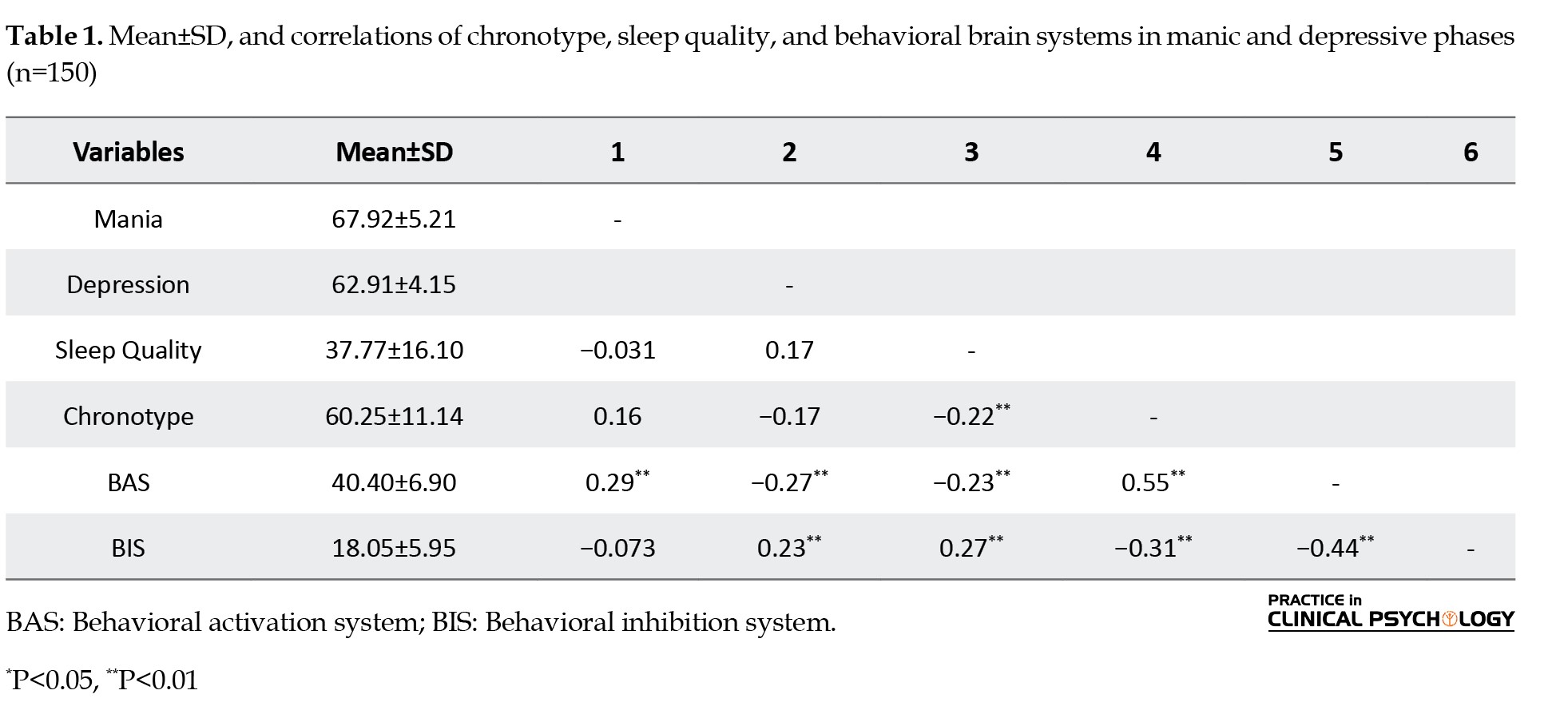
Hierarchical multiple regression was used to identify predictors of mood fluctuations during the manic phase across the 12-week study. In each model, BAS, BIS, and sleep disturbance were entered as primary predictors. Analysis of variance (ANOVA) for model fit in each evaluation month is shown in Table 2.
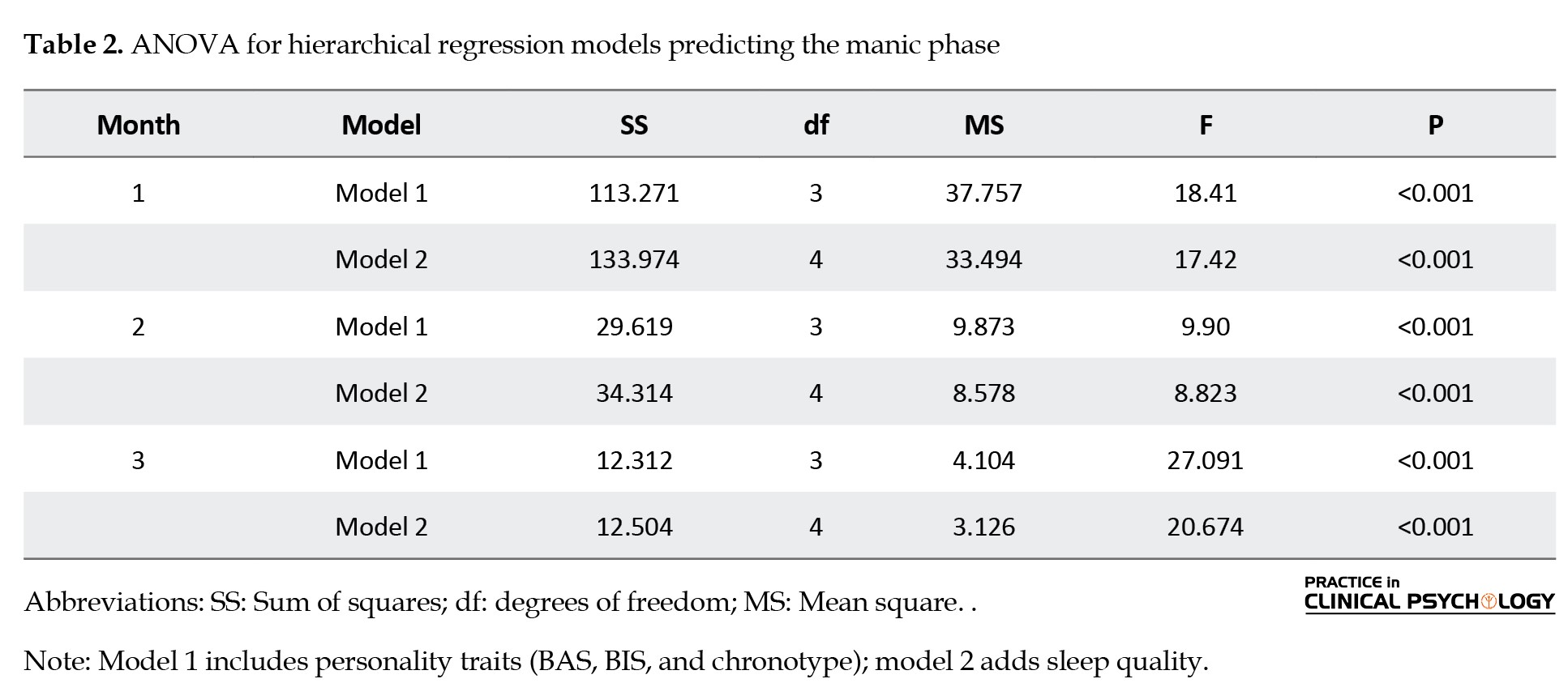
The regression models for the manic phase were significant across the three-month assessment period (P<0.001). As shown in Table 2, model 1, which included motivational traits (BAS and BIS), showed strong fit in the first month (F=18.41, P<0.001), and this held through the second and third months. When sleep disturbance was added in model 2, the models remained significant (F=17.42, P<0.001). However, comparing the F-values suggests that personal motivational traits explain mood fluctuations in the manic phase more than sleep-related factors do.
In the depressive phase, the regression models fit well across all assessment periods (P<0.001), as detailed in Table 3.
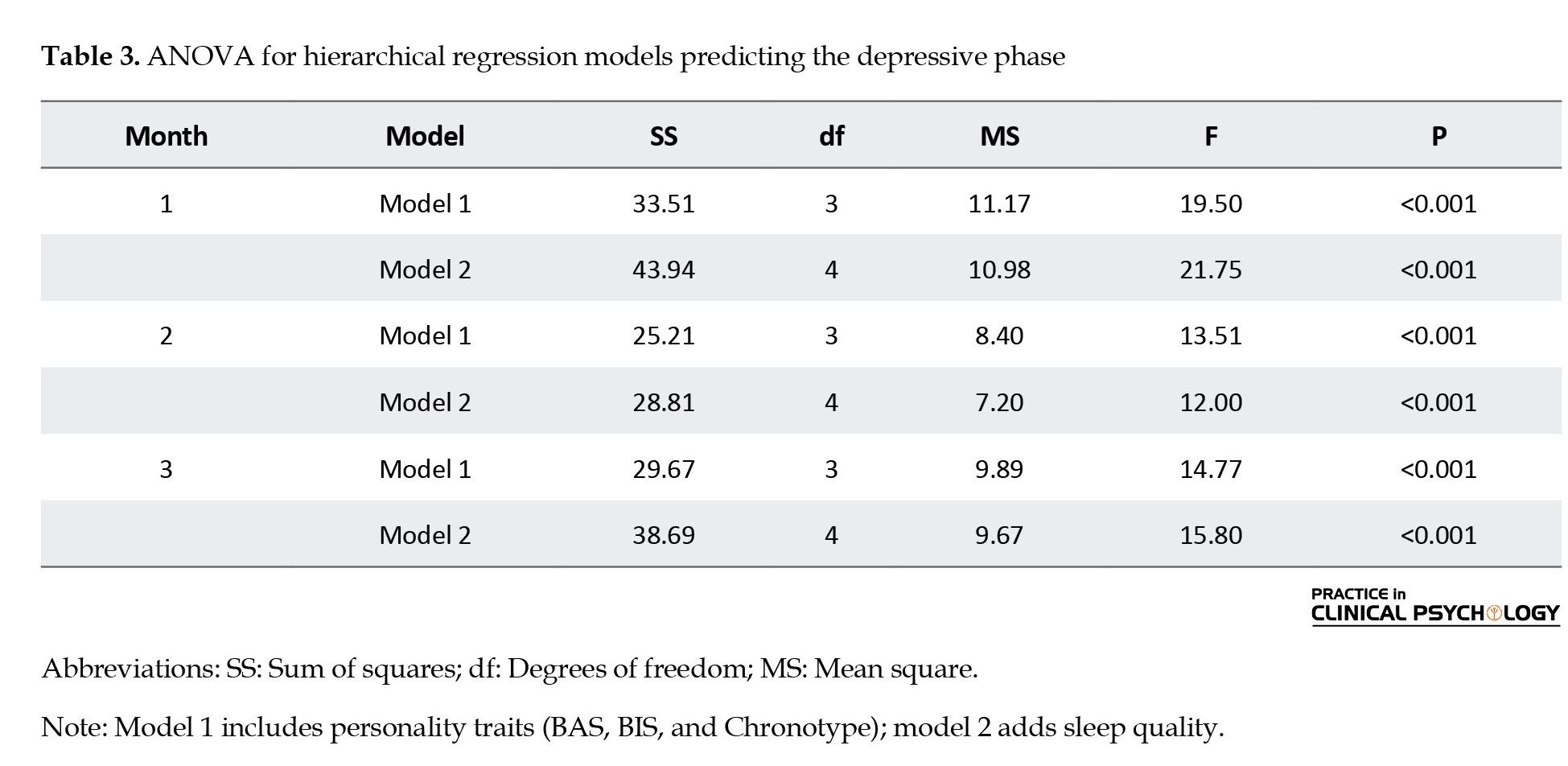
The analyses showed that models including sleep disturbance consistently explained a significant share of the variance in mood fluctuations during the first, second, and third months. In all months of the depressive phase, adding sleep disturbance improved the model fit. This finding points to the role of circadian rhythms and sleep quality in the persistence of depressive symptoms among patients with BD.
Overall, the findings suggest that the predictive structure differs across the two phases of BD. In the manic phase, motivational systems (BAS/BIS) appear dominant. In the depressive phase, sleep disturbance emerges as a critical and structural variable. The ANOVA consistently shows these models’ high explanatory power across both phases. However, the differences in model fit point to distinct mechanisms behind mood fluctuations. While BAS/BIS-based models explain more in the manic phase, adding sleep quality in the depressive phase keeps the model significant and provides a stable, lasting contribution. This issue highlights the role of circadian rhythms in sustaining depressive symptoms. Also, comparing the regression models in Tables 2 and 3 shows that sleep disturbance has a more continuous effect on model improvement throughout the depressive phase.
In the first month, the baseline model (model 1) explained 27.4% of the variance in mania symptom severity. At this stage, chronotype (β=0.248) and BAS (β=0.229) were positively associated with symptom severity, while BIS showed a negative association (β=−0.183). Adding sleep quality in the second step significantly improved model fit (ΔR²=0.050, ΔF=10.770, P<0.01), with sleep disturbance as a significant inverse predictor (β=−0.283). In the second month, the baseline model accounted for 17% of the variance, with BAS (β=0.202) and BIS (β=−0.230) as the only significant predictors. Adding sleep disturbance further improved the model (ΔR²=0.026, ΔF=4.829, P<0.05) and maintained its inverse relationship with symptom severity (β=−0.186). By the third month, the baseline model showed strong predictive power, accounting for 35.8% of the variance (BAS: β=0.467; BIS: β=−0.162). Adding sleep quality did not significantly increase explained variance (ΔR²=0.005, ΔF=1.272, P>0.05). The findings indicate that behavioral systems, especially BAS, strongly predict mood symptom severity over 12 weeks. The path coefficient (β) for BAS rose over time, reaching 0.467 by the third month, which fits with the RST, holding that reward system hyperactivity is a main driver of mood fluctuations in BD. For the depressive phase, hierarchical regression analyses were run to predict symptom severity across the 3 months. The baseline model, with chronotype, BAS, and BIS, accounted for 28.6% of the variance in depressive symptom severity (R²=0.286). Adding sleep disturbance in the second model significantly increased explanatory power, raising total variance explained to 37.5% (ΔR²=0.089, P<0.001). In the final model, BIS (β=0.328) and sleep quality (β=0.377) were the strongest predictors of depressive symptoms. The MEQ showed an inverse relationship with symptom severity (β=−0.183), suggesting that people with a morningness chronotype reported fewer depressive symptoms (Table 4).
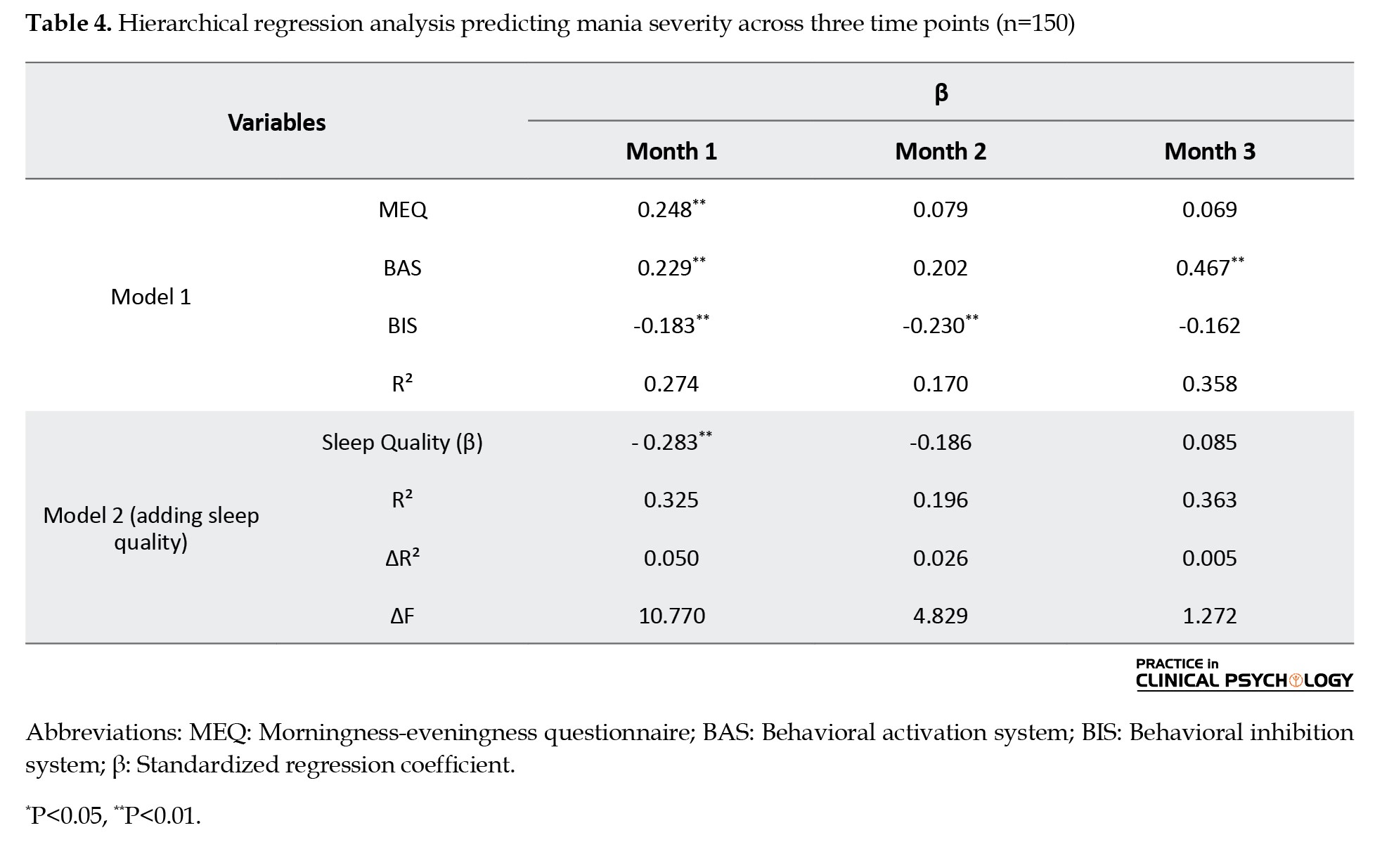
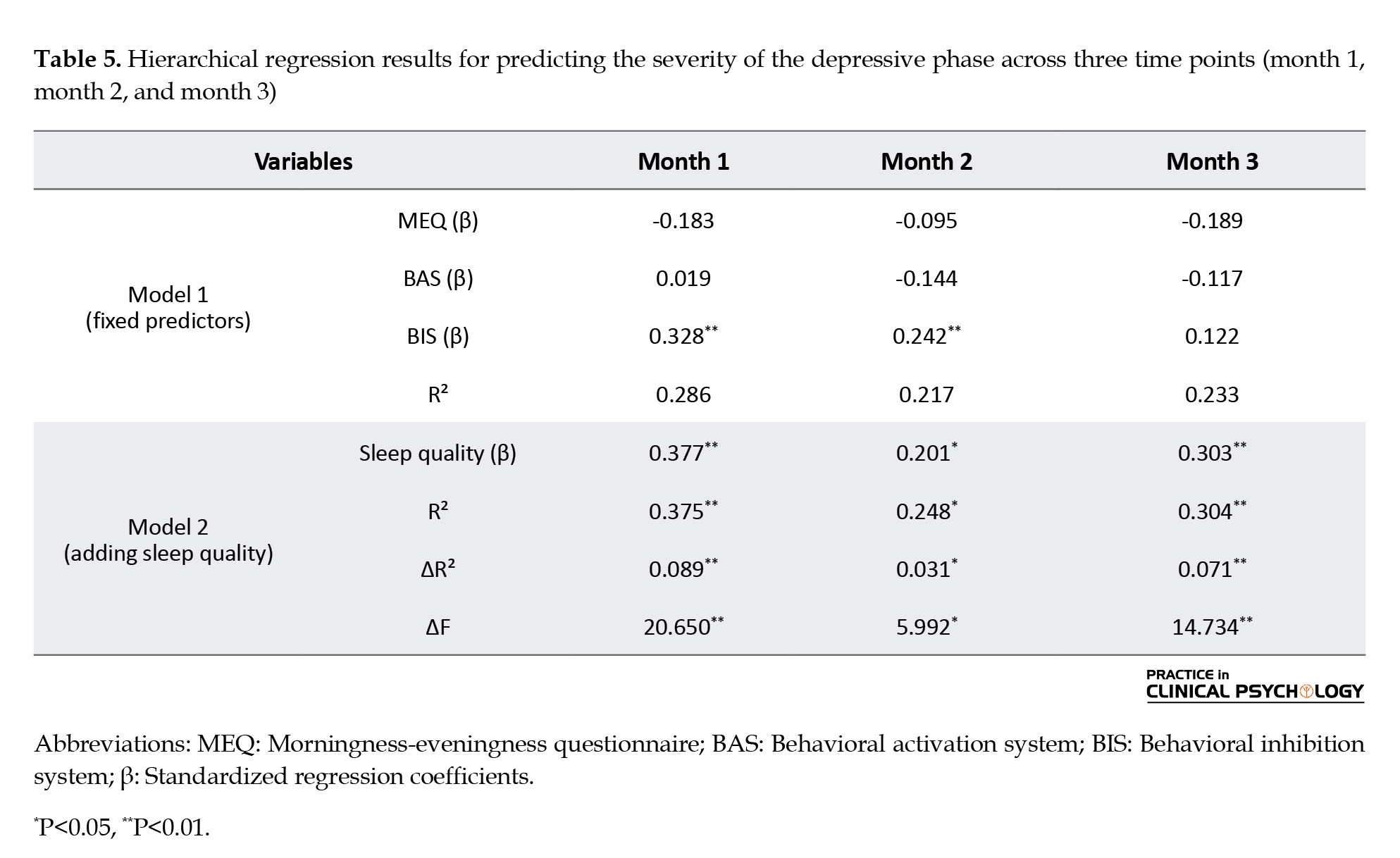
The hierarchical regression analysis for the depressive phase showed a dynamic interaction between motivational traits and physiological markers. In month 1, the model showed that BIS (β=0.328) and sleep disturbance (β=0.377) were the main drivers of depressive symptom severity. Adding sleep quality significantly increased the model’s explanatory power (ΔR2=0.089, P<0.001). In months 2 and 3, sleep quality remained a significant predictor, suggesting a lasting effect on depressive stability. While the influence of BIS declined from month 1 to month 3, the chronotype (MEQ) kept a protective effect in month 1 and month 3, where higher morningness scores were tied to lower symptom severity. This pattern highlights the importance of circadian alignment and inhibitory control in managing BD’s affective fluctuations. In the second month, the initial model (chronotype, BAS, and BIS) accounted for 21.7% of the variance in depressive symptom severity (R²=0.217). Adding sleep disturbance significantly increased explained variance to 24.8% (ΔR²=0.031, P<0.05). In this final model, both BIS (β=0.242) and sleep disturbance (β=0.201) were significant predictors. BAS showed a significant inverse relationship (β=−0.144), suggesting a distinct motivational dynamic during this phase. By the third month, the baseline model explained 23.3% of the variance (R²=0.233). After adding sleep quality, the total explained variance rose to 30.4% (ΔR²=0.071, P<0.001). In the final model, sleep disturbance stayed a strong predictor (β=0.303), but the sensitivity systems (BAS and BIS) lost statistical significance. This shift suggests a possible transition in the predictive landscape, where biological markers (sleep and circadian rhythm) begin to replace stable personality traits in sustaining the depressive episode (Table 5).
The findings support our hypothesis that BD operates through distinct neuro-behavioral mechanisms in its polar phases, rather than a uniform process. In the manic phase, the dominance of BAS suggests that mania is primarily driven by a disruption in reward-processing circuitry. Instead of seeing mania as mere hyperactivity, our results point to a “hyper-sensitivity to motivational stimuli. This implies that the manic phenotype is conceptually anchored in a biological predisposition toward reward-seeking, where the BAS system overrides inhibitory control. In the depressive phase, the interplay between BIS and sleep disturbance shifts the mechanism toward inhibitory dysregulation and circadian instability. The significant increase in explained variance (ΔR2=0.089) when adding sleep metrics confirms that sleep is not just a byproduct of low mood, but a core physiological driver that sustains the depressive state. This divergence necessitates a shift from “one-size-fits-all” treatments to phase-specific precision medicine. Interventions should target reward modulation in mania to dampen BAS reactivity, while focusing on circadian stabilization (e.g. interpersonal and social rhythm therapy [IPSRT]) to mitigate the BIS-driven depressive cycle. The findings reveal a divergence in the longitudinal correlates of manic and depressive symptomatology. In the Manic phase, the escalating predictive weight of BAS (β=0.467 by month 3) aligns with RST, suggesting that hyper-responsivity of the reward system is the motivational core around which manic symptoms organize. In the depressive phase, a trajectory characterized by a transition from personality to biology was observed: BIS reactivity appears critical to the initiation of depressive symptoms, whereas sleep disturbance emerges as the persistent, structural correlate of symptom maintenance. It must be emphasized that, given the correlational and observational design, these findings describe temporal patterns of association and cannot establish causal directionality; experimental and intervention studies are required to test these mechanisms directly.
Discussion
The findings of this study suggest that BD is characterized by distinct bio-behavioral patterns across manic and depressive phases, rather than a single unifying mechanism. This multi-dimensional perspective provides a more nuanced understanding of the associations underlying mood oscillations. Data analysis indicates that the manic phase is closely linked to sensitivity to the BAS. Specifically, BAS emerged as a robust predictor of symptom severity (β=0.40). These findings align with the BAS Reinforcement Cycle Theory (Glas et al., 2024) and previous research emphasizing the association between reward sensitivity and heightened responsiveness to motivational stimuli during manic episodes (Perrault & Johnson, 2023; Song et al., 2020). While some earlier literature (Akbari et al., 2018) has proposed the role of the BIS in mania, our results suggest that BAS dominance is frequently observed in the manic clinical presentation. Discrepancies in the literature may be attributed to methodological variations and the moderating roles of the BAS/BIS systems.
In contrast, the depressive phase exhibits a distinct pattern of associations. Regression results indicate that the BIS (β=0.328) and sleep quality (β=0.377) are key correlates of depressive episodes. Crucially, adding sleep quality significantly increased explained variance (ΔR2=0.089). This result supports the perspective of Zaks et al. (2022), identifying sleep not merely as a concomitant symptom but as a significant predictive correlate for the persistence of bipolar depression. Furthermore, our findings align with research regarding circadian rhythm disruptions (Geo et al., 2019; Wittman & Allmand, 2024), suggesting how sleep disturbances are interrelated with the maintenance of low mood. The observed divergence between the two phases carries significant clinical implications. Traditional therapeutic approaches that use a uniform strategy across the entire illness cycle may be less effective. This study supports phase-specific interventions, such as IPSRT. Based on these findings, clinical management could be tailored according to the current phase: Focusing on reward modulation and managing BAS-related reactivity in mania, and addressing sleep quality and biological-social rhythm stability in depression. Despite the statistical robustness of the models, this study is subject to limitations, including the cross-sectional nature of certain data and the lack of complete control over confounding pharmacological variables. Future longitudinal studies should examine how BAS/BIS change over time interacts with biological sleep markers.
Practical and clinical implications
Tailored interventions: For patients in manic-leaning states, interventions should prioritize regulating motivational sensitivity (e.g. managing goal-directed activity and reward pursuit). For depressive-leaning patients, the stabilization of sleep hygiene and circadian rhythms should be prioritized as a structural intervention, even while personality-focused therapies (e.g. CBT) are in progress.
Early identification: The significant predictive contribution of sleep disturbance in the first month of the depressive phase suggests that sleep complaints may serve as early-warning markers for depressive relapse, warranting systematic monitoring at each follow-up contact.
Maintenance planning: Because sleep disturbance remains a robust predictor of depressive symptom persistence through the third month, sleep regulation should be treated as a maintenance target rather than an acute-phase-only intervention.
Study limitations
Despite its contributions, this study has several limitations. First, the reliance on self-report measures for sleep quality and symptom severity may introduce subjective bias. Second, the absence of detailed pharmacological tracking may have influenced the observed mood oscillations and sleep patterns. Nevertheless, a key strength of this research is its longitudinal design, which captures the temporal dynamics of predictors across distinct mood phases and provides a more robust perspective than cross-sectional studies. However, because the sample was collected within a specific geographic and cultural context, researchers should exercise caution when generalizing these results to populations with different cultural or biological diversities.
Conclusion
In conclusion, the findings of this study demonstrate that Bipolar Disorder is driven by a complex interplay between biological elements and motivational factors that fluctuate across clinical phases. Specifically, our results highlight that manic symptom severity is predominantly associated with heightened BAS sensitivity, whereas depressive severity is closely intertwined with BIS activation, late chronotypes, and sleep disturbances. These findings indicate that a uniform approach to bipolar management is insufficient; rather, clinical interventions must integrate motivational factors alongside circadian and sleep parameters—prioritizing reward-modulation strategies during manic states and chronotype-aligned sleep stabilization during depressive states. Future longitudinal research should continue to elucidate these dynamic bio-behavioral interactions to enhance personalized therapeutic frameworks.
Future directions and clinical implications
Future research should employ objective monitoring tools, such as actigraphy, to minimize self-report bias in sleep assessment. Clinically, these findings underscore the necessity of integrating targeted psychoeducation into treatment protocols. Specifically, patients should be educated on the direct link between sleep disturbances and mood instability—empowering them with self-management strategies to mitigate manic triggers and depressive episodes. Furthermore, we recommend developing phase-specific interventions that prioritize circadian stabilization.
Ethical Considerations
Compliance with ethical guidelines
This study was approved by the Ethics Committee of Arak University of Medical Sciences, Arak, Iran (Code: IR.SAVEHUMS.REC.1404.041).
Funding
This paper was extracted from the MSc. thesis of the Samira Ali, approved by Department of Psychology, Naser Khosrow Institute, Saveh, Iran.
Authors' contributions
Conceptualization, methodology, data collection, and writing the original draft: Samira Ali; Supervision, project administration, review and editing: Fatemeh Azadi; Statistical analysis and data interpretation: Samira Ali; Validation: Fatemeh Azadi; Final approval: All authors.
Conflict of interest
The authors declared no conflict of interest.
Acknowledgments
The authors thank Narges Radman (Psychiatrist, Razi Psychiatric Educational and Medical Center) for her invaluable guidance and clinical consultation throughout this study and also sincerely thank Arsalan Ahmadi (Researcher, Clinical Research Development Unit, Razi Psychiatric Educational and Medical Center) for his dedicated research support and contributions to this work.
References
Abdollahi-Majarshin, R., Bakhshipour, R., & Mahmoodaliloo, M. (2006). [Validity and reliability of behavioral inhibition and activation systems (BIS/BAS) scales among Tabriz University students (Persian)]. Journal of Modern Psychological Researches, 7(28), 123-139. [Link]
Akbari, V., Rahmatinejad, P., Mohammadi, S. D., & Rudhelle, A. (2018). Effects of behavioral activation/inhibition systems as predictors of substance abuse in bipolar patients. Iranian Journal of Psychiatry and Behavioral Sciences, 12(4), e58501. [Link]
Alloy, L. B., Abramson, L. Y., Walshaw, P. D., Cogswell, A., Grandin, L. D., & Hughes, M. E., et al. (2008). Behavioral approach system and behavioral inhibition system sensitivities and bipolar spectrum disorders: Prospective prediction of bipolar mood episodes. Bipolar Disorders, 10(2), 310–322. [DOI:10.1111/j.1399-5618.2007.00547.x] [PMID]
Alloy, L. B., Abramson, L. Y., Walshaw, P. D., Gerstein, R. K., Keyser, J. D., & Whitehouse, W. G., et al. (2009). Behavioral approach system (BAS)-relevant cognitive styles and bipolar spectrum disorders: Concurrent and prospective associations. Journal of Abnormal Psychology, 118(3), 459–471. [DOI:10.1037/a0016604] [PMID]
Basquin, L., Maruani, J., Leseur, J., Mauries, S., Bazin, B., & Pineau, G., et al. (2024). Study of the different sleep disturbances during the prodromal phase of depression and mania in bipolar disorders. Bipolar Disorders, 26(5), 454-467. [DOI:10.1111/bdi.13429] [PMID]
Carver, C. S., & White, T. L. (1994). Behavioral inhibition, behavioral activation, and affective responses to impending reward and punishment: The BIS/BAS scales. Journal of Personality and Social Psychology, 67(2), 319-333. [DOI:10.1037/0022-3514.67.2.319] [PMCID]
Cruz-Sanabria, F., Violi, M., Bazzani, A., Bruno, S., Massoni, L., & Bertelloni, C. A., et al. (2023). Chronotype is differentially associated with lifetime mood and panic-agoraphobic spectrum symptoms in patients with bipolar disorder and healthy controls. CNS Spectrums, 28(6), 726–738. [DOI:10.1017/S1092852923001207] [PMID]
Fayazi-Bordbar, M., Namjoo, M., & Ahrari, S. (2014). Psychiatric assessment tools based on DSM-5. Mashhad: Mashhad University of Medical Sciences Publications.
Gao, Q., Sheng, J., Song, Q., & Zhang, L. (2019). Chronotypes and affective disorders: A clock for mood? Brain Science Advances, 25(7), 608-609. [Link]
Geoffroy, P. A., & Scott, J. (2017). Prodrome or risk syndrome: What’s in a name?. International Journal of Bipolar Disorders, 5(1), 7. [DOI:10.1186/s40345-017-0077-5]
Glas, V. F. J., Koenders, M., Kupka, R., & Regeer, E. J. (2024). How to study psychological mechanisms of mania? A systematic review on the methodology of experimental studies on manic mood dysregulation of leading theories on bipolar disorder. Bipolar Disorders, 26(7), 646-660. [DOI:10.1111/bdi.13463] [PMID]
Khamseh, M. E., Baradaran, H. R., Javanbakht, A., Mirghorbani, M., Yadollahi, Z., & Malek, M. (2011). Comparison of the CES-D and PHQ-9 depression scales in people with type 2 diabetes in Tehran, Iran. BMC Psychiatry, 11, 61. [DOI:10.1186/1471-244X-11-61] [PMID] [PMCID]
Kuppili, P. P., Menon, V., Chandrasekaran, V., & Navin, K. (2018). Biological rhythm impairment in bipolar disorder: A state or trait marker?. Indian Journal of Psychiatry, 60(4), 404–409. [DOI:10.4103/psychiatry.IndianJPsychiatry_110_18] [PMID]
Larsen, R. J. (1985). Individual differences in circadian activity rhythm and personality. Personality and Individual Differences, 6(3), 305-311. [DOI:10.1016/0191-8869(85)90054-6]
McCarthy, M. J., Gottlieb, J. F., Gonzalez, R., et al. (2022). Neurobiological and behavioral mechanisms of circadian rhythm disruption in bipolar disorder: A critical multi-disciplinary literature review and agenda for future research from the ISBD task force on chronobiology. Bipolar Disorders, 24(3), 232-263. [DOI:10.1111/bdi.13165] [PMID]
Merchán-Clavellino, A., Alameda-Bailén, J. R., Zayas García, A., & Guil, R. (2019). Mediating effect of trait emotional intelligence between the behavioral activation system (BAS)/behavioral inhibition system (BIS) and positive and negative affect. Frontiers in Psychology, 10, 424. [DOI:10.3389/fpsyg.2019.00424] [PMID]
Ng, T. H., Chung, K. F., Ho, F. Y., Yeung, W. F., Yung, K. P., & Lam, T. H. (2015). Sleep-wake disturbance in interepisode bipolar disorder and high-risk individuals: A systematic review and meta-analysis. Sleep Medicine Reviews, 20, 46–58. [DOI:10.1016/j.smrv.2014.06.006] [PMID]
Pancheri, C., Verdolini, N., Pacchiarotti, I., Samalin, L., Delle Chiaie, R., & Biondi, M., et al. (2019). A systematic review on sleep alterations anticipating the onset of bipolar disorder. European Psychiatry, 58, 45–53. [DOI:10.1016/j.eurpsy.2019.02.003] [PMID]
Radua, J., Grunze, H., & Amann, B. L. (2017). Meta-Analysis of the Risk of Subsequent Mood Episodes in Bipolar Disorder. Psychotherapy and Psychosomatics, 86(2), 90–98. [DOI:10.1159/000449417] [PMID]
Rahafer, A., Jojili, M., Sadeghpour, A., & Mirzaei, S. (2013). [Psychometric properties of the Persian version of the Morningness-Eveningness Questionnaire (MEQ) (Persian)]. Clinical Psychology and Personality, 2(8), 109-122. [Link]
Ricka, N., Pellegrin, G., Fompeyrine, D. A., Lahutte, B., & Geoffroy, P. A. (2023). Predictive biosignature of major depressive disorder derived from physiological measurements of outpatients using machine learning. Scientific Reports, 13(1), 6332. [DOI:10.1038/s41598-023-33359-w]
Romo-Nava, F., Blom, T. J., Cuellar-Barboza, A. B., Winham, S. J., Colby, C. L., & Nunez, N. A., et al. (2020). Evening chronotype as a discrete clinical subphenotype in bipolar disorder. Journal of Affective Disorders, 266, 556–562. [DOI:10.1016/j.jad.2020.01.151] [PMID]
Scott, J., Graham, A., Yung, A., Morgan, C., Bellivier, F., & Etain, B. (2022). A systematic review and meta-analysis of delayed help-seeking, delayed diagnosis and duration of untreated illness in bipolar disorders. Acta Psychiatrica Scandinavica, 146(5), 389-405. [DOI:10.1111/acps.13490] [PMID]
Singh, R., Deep, R., Patil, V., Bhargava, R., & Mishra, A. K. (2025). Factors associated with chronotype in individuals with bipolar disorder in remission. Indian Journal of Psychiatry, 67(4), 419–427. [PMID]
Smith, C. S., Reilly, C., & Midkiff, K. (1989). Evaluation of three circadian rhythm questionnaires with suggestions for an improved measure of morningness. Journal of Applied Psychology, 74(5), 728-738. [DOI:10.1037/0021-9010.74.5.728] [PMID]
Soehner, A. M., Wallace, M. L., Edmiston, K., Chase, H. W., Lockovich, J., & Aslam, H., et al. (2023). Neurobehavioral reward and sleep-circadian profiles predict present and next-year mania/hypomania symptoms. Biological Psychiatry, 8(12), 1251-1261. [DOI:10.1016/j.bpsc.2023.04.012] [PMID] [PMCID]
Song, Y. M., Jeong, J., de Los Reyes, A. A., Lim, D., Cho, C. H., & Yeom, J. W., et al. (2024). Causal dynamics of sleep, circadian rhythm, and mood symptoms in patients with major depression and bipolar disorder: Insights from longitudinal wearable device data. eBioMedicine, 103, 105094. [DOI:10.1016/j.ebiom.2024.105094] [PMID] [PMCID]
Staller, N., Randler, C., Weigel, M., & Schredl, M. (2023). Chronotype and sensory-processing sensitivity: A cross-sectional survey. Chronobiology International, 40(6), 725-733. [DOI:10.1080/07420528.2023.2204158] [PMID]
Zangani, C., Casetta, C., Saunders, A. S., Donati, F., Maggioni, E., & D'Agostino, A. (2020). Sleep abnormalities across different clinical stages of bipolar disorder: A review of EEG studies. Neuroscience and Biobehavioral Reviews, 118, 247–257. [DOI:10.1016/j.neubiorev.2020.07.031] [PMID]
Zaks, N., Velikonja, T., Parvaz, M. A., Zinberg, J., Done, M., & Mathalon, D. H., et al. (2022). Sleep disturbance in individuals at clinical high risk for psychosis. Schizophrenia Bulletin, 48(1), 111-121. [DOI:10.1093/schbul/sbab104] [PMID] [PMCID]
Bipolar disorder (BD) is characterized by a chronic and highly relapsing course, posing a significant challenge to clinical management. Estimates suggest that up to 90% of individuals with BD experience at least one recurrence, with approximately half undergoing a new episode within 2 years of clinical remission (Radua, 2017; Scott et al., 2022). This pattern of recurrent episodes imposes a profound functional and socioeconomic burden on both patients and healthcare systems. Consequently, identifying measurable prognostic indicators is paramount to advancing preventive strategies and mitigating relapse (Baquin et al., 2024). Two distinct yet theoretically interconnected domains have emerged as critical predictors of symptomology in BD: circadian dysregulation and behavioral temperament. The first domain pertains to the biological underpinnings of circadian rhythms. Disruptions in sleep-wake patterns are recognized not only as clinical hallmarks of BD but also as precursors and significant risk factors for symptomatic relapse (Zangari et al., 2020; Pancheri et al., 2019; Ng et al., 2015). Within this framework, chronotype—an individual’s innate preference for diurnal or nocturnal activity—serves as a stable biomarker of biological phasing. Existing literature suggests that eveningness is associated with greater symptom severity, whereas morningness may protect against mood oscillations (Manculini et al., 2023; Cruz-Sanabria et al., 2023; McCarthy et al., 2022; Singh et al., 2025). The second domain is grounded in reinforcement sensitivity theory (RST), which defines the behavioral activation system (BAS) and the behavioral inhibition system (BIS) as the neurobiological substrates of goal-directed striving and punishment sensitivity, respectively. According to the BAS dysregulation model, heightened BAS activity is closely linked to the onset of manic phases, whereas increased BIS sensitivity is associated with depressive episodes (Alloy et al., 2008, Alloy et al., 2010; Merchan-Clavellino et al., 2019; Sohner et al., 2023).
Despite this theoretical foundation, a critical review of the existing literature reveals 3 distinct research gaps. First, most previous studies have treated sleep disturbances as secondary symptoms or consequences of mood oscillations, leaving little longitudinal evidence of their role as independent prognostic indicators; recent systematic reviews also emphasize that sleep regularity in bipolar populations remains insufficiently documented (Staller et al., 2023). Second, much of the evidence regarding chronotype has been derived from non-clinical samples, leaving a significant dearth of clinical studies specifically targeting bipolar populations (Kuppili et al., 2018). Third, existing research has largely focused on isolated predictors. To date, very few studies have simultaneously investigated motivational traits (BAS/BIS) and bio-structural factors (sleep disturbance and chronotype) within a longitudinal framework. Consequently, the temporal dynamics of these predictors—specifically, which factors drive early relapse versus those that dominate later stages—remain largely unexplored (Ng et al., 2016; Romo-Nava et al., 2020; Ricka et al., 2023). To address these gaps, the present study employs a 3-month longitudinal correlational design to achieve primary objectives: 1) to examine the predictive roles of chronotype and behavioral sensitivity (BAS and BIS) in the mood oscillations of patients with bipolar I disorder during both manic and depressive phases; 2) to assess the incremental validity of sleep disturbance—controlling for personality traits and chronotype—in predicting symptom severity across both phases. Therefore, existing evidence indicates that sleep disturbances serve as precursors to manic episodes in approximately 77% of patients, whereas they precede depressive episodes in roughly 24% of cases (Basquin et al., 2024). Elucidating these predictive patterns in an Iranian clinical context could significantly enhance relapse prevention strategies. Specifically, these findings could inform the development of accessible screening instruments and tailored therapeutic interventions, from sleep hygiene and circadian stabilization in depressive states to modulating goal-directed behaviors during mania.
Materials and Methods
The present study was purposive and longitudinal-correlational in design. The study population comprised all patients with bipolar I disorder attending the Razi Psychiatric Center in Tehran City, Iran, in 2025. Using G*Power software, version 3.1.9.7 for a multiple regression analysis with an anticipated effect size (f²) of 0.15, an alpha of 0.05, and a statistical power of 0.80, the minimum required sample size was estimated at 150 participants, so 150 patients (90 male and 60 female) were recruited through convenience sampling. Inclusion criteria comprised a definitive diagnosis of bipolar I disorder confirmed via clinical interview by a staff psychiatrist, age ranging from 19 to 58 years, basic literacy, and medication stability for at least one month before enrollment. Exclusion criteria included comorbid severe psychiatric disorders (e.g. active substance use disorders), known neurocognitive impairments, and withdrawal from the study at any stage. Written informed consent was obtained from all participants before their inclusion in the study. Cases were selected from patients who had been hospitalized with a diagnosis of BD in the manic phase, as diagnosed by the ward psychiatrist.
The current study employed a longitudinal assessment design. To ensure clinical stabilization and minimize the influence of the acute phase, we collected demographic data, motivational traits (BAS/BIS), and chronotype (via the Horne-Östberg morningness-eveningness questionnaire [MEQ]) after acute manic symptoms subsided. Subsequently, a 3-month follow-up period was conducted. Sleep disturbance (measured via PROMIS) and manic and depressive symptomology (assessed via Altman self-rating mania scale [ASRM] and patient health questionnaire-9 [PHQ-9], respectively) were evaluated throughout this duration.
PROMIS sleep disturbance short form
We assessed sleep disturbance with the 7-item PROMIS Sleep Disturbance Short Form, scored from 8 to 40, with higher scores indicating more severe sleep disturbance. The Persian version translated and validated by Fayyazi-Bordbar et al. (2014) was used.
Morningness–eveningness questionnaire
Chronotype was measured with the 19-item MEQ, with total scores ranging from 16 to 86. The scale has shown internal consistency of α=0.80 in Larsen (1985), α=0.89 in Smith (1989), and α=0.79 in the Persian validation by Rahafar (2013).
BIS/BAS scales
The 24-item BIS/BAS scales of Carver and White (1994) were used to assess the behavioral inhibition and BAS. The Persian version validated by Abdollahi-Majareshin (2006) was employed. To evaluate symptom severity within manic and depressive phases, the corresponding clinical scales were employed at each assessment interval. Depressive symptoms were evaluated using PHQ-9, while manic symptoms were assessed via the 5-item ASRM. Clinically significant manic symptoms were defined by an ASRM score of ≥6, providing a standardized threshold for phase identification across the longitudinal period.
Patient health questionnaire-9
Depressive symptoms were assessed weekly with the PHQ-9. The Persian version has demonstrated an internal consistency of α=0.87 (Khamseh, 2011).
Altman self-rating mania scale
Manic symptoms were assessed weekly with the 5-item ASRM, scored from 0 to 20, with a cutoff score of ≥6 indicating clinically significant manic symptoms. Statistical analyses were performed using SPSSsoftware, version 26. First, we calculated descriptive statistics, including means, standard deviations, and ranges, for all study variables. The Pearson correlation coefficients were computed to examine the interrelationships between the predictor variables and the primary outcomes. To assess sleep disturbance’s incremental predictive power, we conducted hierarchical multiple regression analyses for manic and depressive symptom severities across three monthly intervals. In each model, step 1 entered motivational factors (BAS, BIS, and chronotype), and step 2 added sleep disturbance (PROMIS) to assess its unique variance. For each regression model, the coefficient of determination (R2), the change in R2 (ΔR2), the F-statistic, standardized regression coefficients (β), 95% confidence intervals (CIs), and P were reported. Statistical significance was set at α=0.05. Before enrollment, all participants provided written informed consent. Participants were explicitly informed that they could withdraw from the study at any time without penalty or prejudice to their ongoing care. To ensure data confidentiality and participant anonymity, we de-identified all data using unique alphanumeric codes and used all information strictly for academic research purposes.
Results
Of the 150 participants, 90(60%) were male, and 60(40%) were female. Age distribution was as follows: 47 participants (31.3%) were aged 19–28 years, 56 (37.3%) were aged 29–38 years, 34(22.7%) were aged 39–48 years, and 13(8.7%) were aged 49–58 years. The Pearson correlations revealed that in the manic phase, mania severity was positively associated with chronotype (r=0.16, P<0.05) and BAS (r=0.29, P<0.01), and BAS was negatively associated with sleep quality (r=−0.23, P<0.01). In the depressive phase, depression severity was positively associated with sleep quality (r=0.17, P<0.05) and BIS (r=0.23, P<0.01), and negatively associated with chronotype (r=−0.17, P<0.05) and BAS (r=−0.27, P<0.01). BAS and BIS were negatively intercorrelated (r=−0.44, P<0.01). These intercorrelations, along with means and standard deviations, are presented in Table 1.
Hierarchical multiple regression was used to identify predictors of mood fluctuations during the manic phase across the 12-week study. In each model, BAS, BIS, and sleep disturbance were entered as primary predictors. Analysis of variance (ANOVA) for model fit in each evaluation month is shown in Table 2.
The regression models for the manic phase were significant across the three-month assessment period (P<0.001). As shown in Table 2, model 1, which included motivational traits (BAS and BIS), showed strong fit in the first month (F=18.41, P<0.001), and this held through the second and third months. When sleep disturbance was added in model 2, the models remained significant (F=17.42, P<0.001). However, comparing the F-values suggests that personal motivational traits explain mood fluctuations in the manic phase more than sleep-related factors do.
In the depressive phase, the regression models fit well across all assessment periods (P<0.001), as detailed in Table 3.
The analyses showed that models including sleep disturbance consistently explained a significant share of the variance in mood fluctuations during the first, second, and third months. In all months of the depressive phase, adding sleep disturbance improved the model fit. This finding points to the role of circadian rhythms and sleep quality in the persistence of depressive symptoms among patients with BD.
Overall, the findings suggest that the predictive structure differs across the two phases of BD. In the manic phase, motivational systems (BAS/BIS) appear dominant. In the depressive phase, sleep disturbance emerges as a critical and structural variable. The ANOVA consistently shows these models’ high explanatory power across both phases. However, the differences in model fit point to distinct mechanisms behind mood fluctuations. While BAS/BIS-based models explain more in the manic phase, adding sleep quality in the depressive phase keeps the model significant and provides a stable, lasting contribution. This issue highlights the role of circadian rhythms in sustaining depressive symptoms. Also, comparing the regression models in Tables 2 and 3 shows that sleep disturbance has a more continuous effect on model improvement throughout the depressive phase.
In the first month, the baseline model (model 1) explained 27.4% of the variance in mania symptom severity. At this stage, chronotype (β=0.248) and BAS (β=0.229) were positively associated with symptom severity, while BIS showed a negative association (β=−0.183). Adding sleep quality in the second step significantly improved model fit (ΔR²=0.050, ΔF=10.770, P<0.01), with sleep disturbance as a significant inverse predictor (β=−0.283). In the second month, the baseline model accounted for 17% of the variance, with BAS (β=0.202) and BIS (β=−0.230) as the only significant predictors. Adding sleep disturbance further improved the model (ΔR²=0.026, ΔF=4.829, P<0.05) and maintained its inverse relationship with symptom severity (β=−0.186). By the third month, the baseline model showed strong predictive power, accounting for 35.8% of the variance (BAS: β=0.467; BIS: β=−0.162). Adding sleep quality did not significantly increase explained variance (ΔR²=0.005, ΔF=1.272, P>0.05). The findings indicate that behavioral systems, especially BAS, strongly predict mood symptom severity over 12 weeks. The path coefficient (β) for BAS rose over time, reaching 0.467 by the third month, which fits with the RST, holding that reward system hyperactivity is a main driver of mood fluctuations in BD. For the depressive phase, hierarchical regression analyses were run to predict symptom severity across the 3 months. The baseline model, with chronotype, BAS, and BIS, accounted for 28.6% of the variance in depressive symptom severity (R²=0.286). Adding sleep disturbance in the second model significantly increased explanatory power, raising total variance explained to 37.5% (ΔR²=0.089, P<0.001). In the final model, BIS (β=0.328) and sleep quality (β=0.377) were the strongest predictors of depressive symptoms. The MEQ showed an inverse relationship with symptom severity (β=−0.183), suggesting that people with a morningness chronotype reported fewer depressive symptoms (Table 4).
The hierarchical regression analysis for the depressive phase showed a dynamic interaction between motivational traits and physiological markers. In month 1, the model showed that BIS (β=0.328) and sleep disturbance (β=0.377) were the main drivers of depressive symptom severity. Adding sleep quality significantly increased the model’s explanatory power (ΔR2=0.089, P<0.001). In months 2 and 3, sleep quality remained a significant predictor, suggesting a lasting effect on depressive stability. While the influence of BIS declined from month 1 to month 3, the chronotype (MEQ) kept a protective effect in month 1 and month 3, where higher morningness scores were tied to lower symptom severity. This pattern highlights the importance of circadian alignment and inhibitory control in managing BD’s affective fluctuations. In the second month, the initial model (chronotype, BAS, and BIS) accounted for 21.7% of the variance in depressive symptom severity (R²=0.217). Adding sleep disturbance significantly increased explained variance to 24.8% (ΔR²=0.031, P<0.05). In this final model, both BIS (β=0.242) and sleep disturbance (β=0.201) were significant predictors. BAS showed a significant inverse relationship (β=−0.144), suggesting a distinct motivational dynamic during this phase. By the third month, the baseline model explained 23.3% of the variance (R²=0.233). After adding sleep quality, the total explained variance rose to 30.4% (ΔR²=0.071, P<0.001). In the final model, sleep disturbance stayed a strong predictor (β=0.303), but the sensitivity systems (BAS and BIS) lost statistical significance. This shift suggests a possible transition in the predictive landscape, where biological markers (sleep and circadian rhythm) begin to replace stable personality traits in sustaining the depressive episode (Table 5).
The findings support our hypothesis that BD operates through distinct neuro-behavioral mechanisms in its polar phases, rather than a uniform process. In the manic phase, the dominance of BAS suggests that mania is primarily driven by a disruption in reward-processing circuitry. Instead of seeing mania as mere hyperactivity, our results point to a “hyper-sensitivity to motivational stimuli. This implies that the manic phenotype is conceptually anchored in a biological predisposition toward reward-seeking, where the BAS system overrides inhibitory control. In the depressive phase, the interplay between BIS and sleep disturbance shifts the mechanism toward inhibitory dysregulation and circadian instability. The significant increase in explained variance (ΔR2=0.089) when adding sleep metrics confirms that sleep is not just a byproduct of low mood, but a core physiological driver that sustains the depressive state. This divergence necessitates a shift from “one-size-fits-all” treatments to phase-specific precision medicine. Interventions should target reward modulation in mania to dampen BAS reactivity, while focusing on circadian stabilization (e.g. interpersonal and social rhythm therapy [IPSRT]) to mitigate the BIS-driven depressive cycle. The findings reveal a divergence in the longitudinal correlates of manic and depressive symptomatology. In the Manic phase, the escalating predictive weight of BAS (β=0.467 by month 3) aligns with RST, suggesting that hyper-responsivity of the reward system is the motivational core around which manic symptoms organize. In the depressive phase, a trajectory characterized by a transition from personality to biology was observed: BIS reactivity appears critical to the initiation of depressive symptoms, whereas sleep disturbance emerges as the persistent, structural correlate of symptom maintenance. It must be emphasized that, given the correlational and observational design, these findings describe temporal patterns of association and cannot establish causal directionality; experimental and intervention studies are required to test these mechanisms directly.
Discussion
The findings of this study suggest that BD is characterized by distinct bio-behavioral patterns across manic and depressive phases, rather than a single unifying mechanism. This multi-dimensional perspective provides a more nuanced understanding of the associations underlying mood oscillations. Data analysis indicates that the manic phase is closely linked to sensitivity to the BAS. Specifically, BAS emerged as a robust predictor of symptom severity (β=0.40). These findings align with the BAS Reinforcement Cycle Theory (Glas et al., 2024) and previous research emphasizing the association between reward sensitivity and heightened responsiveness to motivational stimuli during manic episodes (Perrault & Johnson, 2023; Song et al., 2020). While some earlier literature (Akbari et al., 2018) has proposed the role of the BIS in mania, our results suggest that BAS dominance is frequently observed in the manic clinical presentation. Discrepancies in the literature may be attributed to methodological variations and the moderating roles of the BAS/BIS systems.
In contrast, the depressive phase exhibits a distinct pattern of associations. Regression results indicate that the BIS (β=0.328) and sleep quality (β=0.377) are key correlates of depressive episodes. Crucially, adding sleep quality significantly increased explained variance (ΔR2=0.089). This result supports the perspective of Zaks et al. (2022), identifying sleep not merely as a concomitant symptom but as a significant predictive correlate for the persistence of bipolar depression. Furthermore, our findings align with research regarding circadian rhythm disruptions (Geo et al., 2019; Wittman & Allmand, 2024), suggesting how sleep disturbances are interrelated with the maintenance of low mood. The observed divergence between the two phases carries significant clinical implications. Traditional therapeutic approaches that use a uniform strategy across the entire illness cycle may be less effective. This study supports phase-specific interventions, such as IPSRT. Based on these findings, clinical management could be tailored according to the current phase: Focusing on reward modulation and managing BAS-related reactivity in mania, and addressing sleep quality and biological-social rhythm stability in depression. Despite the statistical robustness of the models, this study is subject to limitations, including the cross-sectional nature of certain data and the lack of complete control over confounding pharmacological variables. Future longitudinal studies should examine how BAS/BIS change over time interacts with biological sleep markers.
Practical and clinical implications
Tailored interventions: For patients in manic-leaning states, interventions should prioritize regulating motivational sensitivity (e.g. managing goal-directed activity and reward pursuit). For depressive-leaning patients, the stabilization of sleep hygiene and circadian rhythms should be prioritized as a structural intervention, even while personality-focused therapies (e.g. CBT) are in progress.
Early identification: The significant predictive contribution of sleep disturbance in the first month of the depressive phase suggests that sleep complaints may serve as early-warning markers for depressive relapse, warranting systematic monitoring at each follow-up contact.
Maintenance planning: Because sleep disturbance remains a robust predictor of depressive symptom persistence through the third month, sleep regulation should be treated as a maintenance target rather than an acute-phase-only intervention.
Study limitations
Despite its contributions, this study has several limitations. First, the reliance on self-report measures for sleep quality and symptom severity may introduce subjective bias. Second, the absence of detailed pharmacological tracking may have influenced the observed mood oscillations and sleep patterns. Nevertheless, a key strength of this research is its longitudinal design, which captures the temporal dynamics of predictors across distinct mood phases and provides a more robust perspective than cross-sectional studies. However, because the sample was collected within a specific geographic and cultural context, researchers should exercise caution when generalizing these results to populations with different cultural or biological diversities.
Conclusion
In conclusion, the findings of this study demonstrate that Bipolar Disorder is driven by a complex interplay between biological elements and motivational factors that fluctuate across clinical phases. Specifically, our results highlight that manic symptom severity is predominantly associated with heightened BAS sensitivity, whereas depressive severity is closely intertwined with BIS activation, late chronotypes, and sleep disturbances. These findings indicate that a uniform approach to bipolar management is insufficient; rather, clinical interventions must integrate motivational factors alongside circadian and sleep parameters—prioritizing reward-modulation strategies during manic states and chronotype-aligned sleep stabilization during depressive states. Future longitudinal research should continue to elucidate these dynamic bio-behavioral interactions to enhance personalized therapeutic frameworks.
Future directions and clinical implications
Future research should employ objective monitoring tools, such as actigraphy, to minimize self-report bias in sleep assessment. Clinically, these findings underscore the necessity of integrating targeted psychoeducation into treatment protocols. Specifically, patients should be educated on the direct link between sleep disturbances and mood instability—empowering them with self-management strategies to mitigate manic triggers and depressive episodes. Furthermore, we recommend developing phase-specific interventions that prioritize circadian stabilization.
Ethical Considerations
Compliance with ethical guidelines
This study was approved by the Ethics Committee of Arak University of Medical Sciences, Arak, Iran (Code: IR.SAVEHUMS.REC.1404.041).
Funding
This paper was extracted from the MSc. thesis of the Samira Ali, approved by Department of Psychology, Naser Khosrow Institute, Saveh, Iran.
Authors' contributions
Conceptualization, methodology, data collection, and writing the original draft: Samira Ali; Supervision, project administration, review and editing: Fatemeh Azadi; Statistical analysis and data interpretation: Samira Ali; Validation: Fatemeh Azadi; Final approval: All authors.
Conflict of interest
The authors declared no conflict of interest.
Acknowledgments
The authors thank Narges Radman (Psychiatrist, Razi Psychiatric Educational and Medical Center) for her invaluable guidance and clinical consultation throughout this study and also sincerely thank Arsalan Ahmadi (Researcher, Clinical Research Development Unit, Razi Psychiatric Educational and Medical Center) for his dedicated research support and contributions to this work.
References
Abdollahi-Majarshin, R., Bakhshipour, R., & Mahmoodaliloo, M. (2006). [Validity and reliability of behavioral inhibition and activation systems (BIS/BAS) scales among Tabriz University students (Persian)]. Journal of Modern Psychological Researches, 7(28), 123-139. [Link]
Akbari, V., Rahmatinejad, P., Mohammadi, S. D., & Rudhelle, A. (2018). Effects of behavioral activation/inhibition systems as predictors of substance abuse in bipolar patients. Iranian Journal of Psychiatry and Behavioral Sciences, 12(4), e58501. [Link]
Alloy, L. B., Abramson, L. Y., Walshaw, P. D., Cogswell, A., Grandin, L. D., & Hughes, M. E., et al. (2008). Behavioral approach system and behavioral inhibition system sensitivities and bipolar spectrum disorders: Prospective prediction of bipolar mood episodes. Bipolar Disorders, 10(2), 310–322. [DOI:10.1111/j.1399-5618.2007.00547.x] [PMID]
Alloy, L. B., Abramson, L. Y., Walshaw, P. D., Gerstein, R. K., Keyser, J. D., & Whitehouse, W. G., et al. (2009). Behavioral approach system (BAS)-relevant cognitive styles and bipolar spectrum disorders: Concurrent and prospective associations. Journal of Abnormal Psychology, 118(3), 459–471. [DOI:10.1037/a0016604] [PMID]
Basquin, L., Maruani, J., Leseur, J., Mauries, S., Bazin, B., & Pineau, G., et al. (2024). Study of the different sleep disturbances during the prodromal phase of depression and mania in bipolar disorders. Bipolar Disorders, 26(5), 454-467. [DOI:10.1111/bdi.13429] [PMID]
Carver, C. S., & White, T. L. (1994). Behavioral inhibition, behavioral activation, and affective responses to impending reward and punishment: The BIS/BAS scales. Journal of Personality and Social Psychology, 67(2), 319-333. [DOI:10.1037/0022-3514.67.2.319] [PMCID]
Cruz-Sanabria, F., Violi, M., Bazzani, A., Bruno, S., Massoni, L., & Bertelloni, C. A., et al. (2023). Chronotype is differentially associated with lifetime mood and panic-agoraphobic spectrum symptoms in patients with bipolar disorder and healthy controls. CNS Spectrums, 28(6), 726–738. [DOI:10.1017/S1092852923001207] [PMID]
Fayazi-Bordbar, M., Namjoo, M., & Ahrari, S. (2014). Psychiatric assessment tools based on DSM-5. Mashhad: Mashhad University of Medical Sciences Publications.
Gao, Q., Sheng, J., Song, Q., & Zhang, L. (2019). Chronotypes and affective disorders: A clock for mood? Brain Science Advances, 25(7), 608-609. [Link]
Geoffroy, P. A., & Scott, J. (2017). Prodrome or risk syndrome: What’s in a name?. International Journal of Bipolar Disorders, 5(1), 7. [DOI:10.1186/s40345-017-0077-5]
Glas, V. F. J., Koenders, M., Kupka, R., & Regeer, E. J. (2024). How to study psychological mechanisms of mania? A systematic review on the methodology of experimental studies on manic mood dysregulation of leading theories on bipolar disorder. Bipolar Disorders, 26(7), 646-660. [DOI:10.1111/bdi.13463] [PMID]
Khamseh, M. E., Baradaran, H. R., Javanbakht, A., Mirghorbani, M., Yadollahi, Z., & Malek, M. (2011). Comparison of the CES-D and PHQ-9 depression scales in people with type 2 diabetes in Tehran, Iran. BMC Psychiatry, 11, 61. [DOI:10.1186/1471-244X-11-61] [PMID] [PMCID]
Kuppili, P. P., Menon, V., Chandrasekaran, V., & Navin, K. (2018). Biological rhythm impairment in bipolar disorder: A state or trait marker?. Indian Journal of Psychiatry, 60(4), 404–409. [DOI:10.4103/psychiatry.IndianJPsychiatry_110_18] [PMID]
Larsen, R. J. (1985). Individual differences in circadian activity rhythm and personality. Personality and Individual Differences, 6(3), 305-311. [DOI:10.1016/0191-8869(85)90054-6]
McCarthy, M. J., Gottlieb, J. F., Gonzalez, R., et al. (2022). Neurobiological and behavioral mechanisms of circadian rhythm disruption in bipolar disorder: A critical multi-disciplinary literature review and agenda for future research from the ISBD task force on chronobiology. Bipolar Disorders, 24(3), 232-263. [DOI:10.1111/bdi.13165] [PMID]
Merchán-Clavellino, A., Alameda-Bailén, J. R., Zayas García, A., & Guil, R. (2019). Mediating effect of trait emotional intelligence between the behavioral activation system (BAS)/behavioral inhibition system (BIS) and positive and negative affect. Frontiers in Psychology, 10, 424. [DOI:10.3389/fpsyg.2019.00424] [PMID]
Ng, T. H., Chung, K. F., Ho, F. Y., Yeung, W. F., Yung, K. P., & Lam, T. H. (2015). Sleep-wake disturbance in interepisode bipolar disorder and high-risk individuals: A systematic review and meta-analysis. Sleep Medicine Reviews, 20, 46–58. [DOI:10.1016/j.smrv.2014.06.006] [PMID]
Pancheri, C., Verdolini, N., Pacchiarotti, I., Samalin, L., Delle Chiaie, R., & Biondi, M., et al. (2019). A systematic review on sleep alterations anticipating the onset of bipolar disorder. European Psychiatry, 58, 45–53. [DOI:10.1016/j.eurpsy.2019.02.003] [PMID]
Radua, J., Grunze, H., & Amann, B. L. (2017). Meta-Analysis of the Risk of Subsequent Mood Episodes in Bipolar Disorder. Psychotherapy and Psychosomatics, 86(2), 90–98. [DOI:10.1159/000449417] [PMID]
Rahafer, A., Jojili, M., Sadeghpour, A., & Mirzaei, S. (2013). [Psychometric properties of the Persian version of the Morningness-Eveningness Questionnaire (MEQ) (Persian)]. Clinical Psychology and Personality, 2(8), 109-122. [Link]
Ricka, N., Pellegrin, G., Fompeyrine, D. A., Lahutte, B., & Geoffroy, P. A. (2023). Predictive biosignature of major depressive disorder derived from physiological measurements of outpatients using machine learning. Scientific Reports, 13(1), 6332. [DOI:10.1038/s41598-023-33359-w]
Romo-Nava, F., Blom, T. J., Cuellar-Barboza, A. B., Winham, S. J., Colby, C. L., & Nunez, N. A., et al. (2020). Evening chronotype as a discrete clinical subphenotype in bipolar disorder. Journal of Affective Disorders, 266, 556–562. [DOI:10.1016/j.jad.2020.01.151] [PMID]
Scott, J., Graham, A., Yung, A., Morgan, C., Bellivier, F., & Etain, B. (2022). A systematic review and meta-analysis of delayed help-seeking, delayed diagnosis and duration of untreated illness in bipolar disorders. Acta Psychiatrica Scandinavica, 146(5), 389-405. [DOI:10.1111/acps.13490] [PMID]
Singh, R., Deep, R., Patil, V., Bhargava, R., & Mishra, A. K. (2025). Factors associated with chronotype in individuals with bipolar disorder in remission. Indian Journal of Psychiatry, 67(4), 419–427. [PMID]
Smith, C. S., Reilly, C., & Midkiff, K. (1989). Evaluation of three circadian rhythm questionnaires with suggestions for an improved measure of morningness. Journal of Applied Psychology, 74(5), 728-738. [DOI:10.1037/0021-9010.74.5.728] [PMID]
Soehner, A. M., Wallace, M. L., Edmiston, K., Chase, H. W., Lockovich, J., & Aslam, H., et al. (2023). Neurobehavioral reward and sleep-circadian profiles predict present and next-year mania/hypomania symptoms. Biological Psychiatry, 8(12), 1251-1261. [DOI:10.1016/j.bpsc.2023.04.012] [PMID] [PMCID]
Song, Y. M., Jeong, J., de Los Reyes, A. A., Lim, D., Cho, C. H., & Yeom, J. W., et al. (2024). Causal dynamics of sleep, circadian rhythm, and mood symptoms in patients with major depression and bipolar disorder: Insights from longitudinal wearable device data. eBioMedicine, 103, 105094. [DOI:10.1016/j.ebiom.2024.105094] [PMID] [PMCID]
Staller, N., Randler, C., Weigel, M., & Schredl, M. (2023). Chronotype and sensory-processing sensitivity: A cross-sectional survey. Chronobiology International, 40(6), 725-733. [DOI:10.1080/07420528.2023.2204158] [PMID]
Zangani, C., Casetta, C., Saunders, A. S., Donati, F., Maggioni, E., & D'Agostino, A. (2020). Sleep abnormalities across different clinical stages of bipolar disorder: A review of EEG studies. Neuroscience and Biobehavioral Reviews, 118, 247–257. [DOI:10.1016/j.neubiorev.2020.07.031] [PMID]
Zaks, N., Velikonja, T., Parvaz, M. A., Zinberg, J., Done, M., & Mathalon, D. H., et al. (2022). Sleep disturbance in individuals at clinical high risk for psychosis. Schizophrenia Bulletin, 48(1), 111-121. [DOI:10.1093/schbul/sbab104] [PMID] [PMCID]
Type of Study: Original Research Article |
Subject:
Psychiatry
| Rights and permissions | |
 |
This work is licensed under a Creative Commons Attribution-NonCommercial 4.0 International License. |

This is an open access article distributed under the terms of the Creative Commons Attribution-NonCommercial 4.0 (CC-By-NC 4.0), which permits use, distribution, and reproduction in any medium, provided the original work is properly cited and is not used for commercial purposes.
Contact Information