

Volume 14, Issue 4 (Autumn 2026)
Pract Clin Psychol 2026, 14(4): 339-346 |
Back to browse issues page


Download citation:
BibTeX | RIS | EndNote | Medlars | ProCite | Reference Manager | RefWorks
Send citation to:


BibTeX | RIS | EndNote | Medlars | ProCite | Reference Manager | RefWorks
Send citation to:
Ahmadi Basiri Z, Bayat Asghari A, Yazdani H. The Role of Emotional Exhaustion and Mental Toughness in Predicting Psychological Wellbeing in Adolescents. Pract Clin Psychol 2026; 14 (4) :339-346
URL: http://jpcp.uswr.ac.ir/article-1-1106-en.html
URL: http://jpcp.uswr.ac.ir/article-1-1106-en.html

1- Department of Psychology, Khom.C., Islamic Azad University, Khomein, Iran.
2- Department of Psychology, Khom.C., Islamic Azad University, Khomein, Iran. ,abbas.bayatasghari@iau.ac.ir
3- Department of Psychology, Na.C., Islamic Azad University, Najafabad, Iran.
2- Department of Psychology, Khom.C., Islamic Azad University, Khomein, Iran. ,
3- Department of Psychology, Na.C., Islamic Azad University, Najafabad, Iran.
Keywords: Psychological wellbeing, Emotional exhaustion, Mental toughness, Psychological hardiness, Adolescents
Full-Text [PDF 570 kb]
(173 Downloads)
| Abstract (HTML) (1238 Views)
Full-Text: (106 Views)
Introduction
Adolescence is a critical developmental period marked by rapid biological, cognitive, and psychosocial changes (Sawyer et al., 2018). Adolescents face intense academic pressures, peer relationship challenges, identity formation, and family expectations, which digital environments and post-pandemic adjustments can amplify (Jiang et al., 2022; Pérez-Jorge et al., 2025). While previous studies have documented elevated stress levels among adolescents, the specific interplay between emotional exhaustion as a risk factor and mental toughness (psychological hardiness) as a protective resource in non-Western, particularly Iranian contexts, has remained underexplored.
Psychological wellbeing, as conceptualized in Ryff’s (2014) multidimensional eudaimonic model, encompasses autonomy, self-acceptance, personal growth, purpose in life, environmental mastery, and positive relations. This construct extends beyond the mere absence of psychopathology and is essential for resilient development and long-term adaptive outcomes (Ryff, 1995; Gao & McLellan, 2018). However, empirical syntheses reveal that chronic stressors frequently undermine these dimensions, leading to diminished life satisfaction and increased vulnerability to internalizing problems (Viejo et al., 2018; Huttunen et al., 2024).
A major risk factor is emotional exhaustion, characterized by emotional depletion and cognitive fatigue from prolonged exposure to excessive demands (Gao et al., 2023). Originally rooted in occupational burnout research, this construct has been increasingly applied to academic contexts, where it manifests as school-related fatigue and is consistently linked to lower wellbeing (Chong et al., 2025; Shim & Go, 2025). Critically, most prior studies have examined emotional exhaustion in isolation, with limited attention to protective psychological resources that may buffer its effects.
Mental toughness, often used interchangeably with psychological hardiness in the literature, refers to a personality constellation involving commitment, control, and challenge (Kobasa, 1979). Although related to the broader construct of resilience, mental toughness specifically emphasizes proactive engagement with stressors through an internal locus of control and viewing challenges as growth opportunities (Gerber et al., 2013; Shaw et al., 2023). Despite conceptual overlap, contemporary scholarship distinguishes mental toughness as a more performance-oriented trait, while hardiness is more closely tied to existential personality theory. The present study adopts the psychological hardiness scale while framing findings within the mental toughness literature to reflect common usage in adolescent research (Yuan et al., 2025).
Although researchers have documented associations between these variables, several gaps remain. Most existing research has focused on adult or clinical populations, relied on Western samples, or examined variables in isolation rather than their joint contribution (Wang et al., 2025). Furthermore, few studies have tested these relationships in Iranian adolescents, where cultural emphases on academic achievement and collectivist values may shape how these constructs are expressed. This study addresses these limitations by examining the associations of emotional exhaustion and mental toughness with psychological wellbeing in a sample of Iranian high school students. Based on the literature and conservation of resources (COR) theory, it was hypothesized that 1) emotional exhaustion would be negatively associated with psychological wellbeing and all its sub-dimensions, 2) mental toughness (psychological hardiness) would be positively associated with psychological wellbeing and its sub-dimensions, and 3) mental toughness would emerge as a significant correlate of wellbeing even after accounting for emotional exhaustion. By investigating these relationships, the present study aims to provide a more nuanced understanding of the factors influencing adolescent mental health in an understudied cultural context and offer preliminary insights for targeted school-based interventions.
Materials and Methods
Study design
This study used a cross-sectional correlational design and multiple linear regression to examine associations (rather than causal predictions) between emotional exhaustion, mental toughness (psychological hardiness), and psychological wellbeing.
Study participants
The target population included all high school students (aged 15–18 years) in Isfahan City, Iran, during the 2024–2025 academic year. The statistical population was defined similarly. A priori power analysis using G*Power (version 3.1) indicated that a minimum sample of 146 participants would be required to detect a medium effect size (f²=0.15) with power=0.80 and α=0.05 for multiple regression with 2 predictors. To increase statistical power and account for potential clustering effects, we recruited a final sample of 241 adolescents (Mean±SD age, 16.42±0.91; 53.1% female, 46.9% male). Participants were primarily from public high schools; socioeconomic data were not formally collected, but schools represented a mix of middle to lower-middle socioeconomic backgrounds typical of urban Isfahan. We used multi-stage cluster sampling: educational districts were randomly selected, followed by random selection of schools within districts, and then random selection of classes. Inclusion criteria included enrollment in high school and providing informed assent (adolescents) and parental consent. The exclusion criteria included grossly incomplete questionnaires or self-reported severe psychiatric disorders.
Study measures
Ryff’s psychological wellbeing scale (18-item short form): We evaluated participants’ mental flourishing using the 18-item short form of Ryff’s psychological wellbeing scale. This tool measures 6 facets: self-acceptance, autonomy, environmental mastery, purpose in life, personal growth, and positive relations (Ryff, 1995). Items are scored on a 6-point Likert scale (totaling 18 to 108), with certain items reverse-scored. Higher totals denote better psychological adaptation. The Persian version is well validated, with a cronbach α of 0.85 (Bayani et al., 2008). In the current sample, internal consistency was reliable (α=0.83).
Emotional exhaustion scale (ECE): This 10-item unidimensional scale (Ala et al., 2024) assesses academic-related emotional depletion on a 5-point Likert scale. Although originally developed for university students, prior studies support its applicability to older adolescents (Martínez-Líbano et al., 2022). The Persian adaptation showed acceptable reliability in the present adolescent sample (α=0.84). No formal measurement invariance analysis across gender was conducted in this study.
Psychological hardiness scale: In this study, the scale operationalized mental toughness/psychological hardiness (the terms are used interchangeably in much adolescent literature, though they have nuanced differences). Grounded in Kobasa’s (1979) framework, it assesses three dimensions: control, commitment, and challenge. It contains 20 items rated on a 4-point Likert scale (totaling 20 to 80). Higher scores signify a greater ability to reframe stressors as positive challenges. This adaptation has proven reliable in Iranian demographics (Ghorbani & Watson, 2005), and this study yielded a cronbach α of 0.85.
Study procedure
After obtaining permission from the Isfahan Department of Education, researchers visited selected schools. The researchers obtained written parental consent and adolescent assent before data collection. Participants were informed that participation was voluntary, that they could withdraw at any time, and that their responses would be kept confidential. Questionnaires were administered in quiet classrooms. The response rate was approximately 92%, and we excluded incomplete packets (n=19). Data collection took 25–30 minutes per session. Potential clustering effects due to class-level sampling were not statistically adjusted in the primary analyses.
Data analysis
We analyzed data using SPSS software, version 26. Assumption testing confirmed normality (skewness and kurtosis values between -1 and +1), absence of multicollinearity (variance inflation factor [VIF]<2.0, tolerance >0.50 for both predictors), homoscedasticity, and independence of residuals (Durbin-Watson=1.98). No significant missing data remained after listwise deletion. We computed Pearson correlations and ran multiple linear regression. Because this was a cross-sectional self-report design, common method bias is a potential limitation; we implemented procedural remedies (e.g. anonymity assurance), but did not apply a statistical correction (e.g. Harman’s test). Significance level was set at P<0.05. Effect sizes and confidence intervals are reported where appropriate.
Results
The study evaluated 241 public high school students in Isfahan, Iran, during the 2024–2025 academic year. The cohort aged 15to 18 years (Mean±SD, 16.42±0.91 y) included 128 females (53.1%) and 113 males (46.9%). Preliminary evaluations showed no significant gender disparities regarding the primary variables. According to Table 1, students showed moderate mental toughness (Mean±SD, 53.77±6.56) and psychological wellbeing (Mean±SD, 53.63±6.63), along with moderate-to-high emotional exhaustion (Mean±SD, 28.63Mean±SD, 7.29).
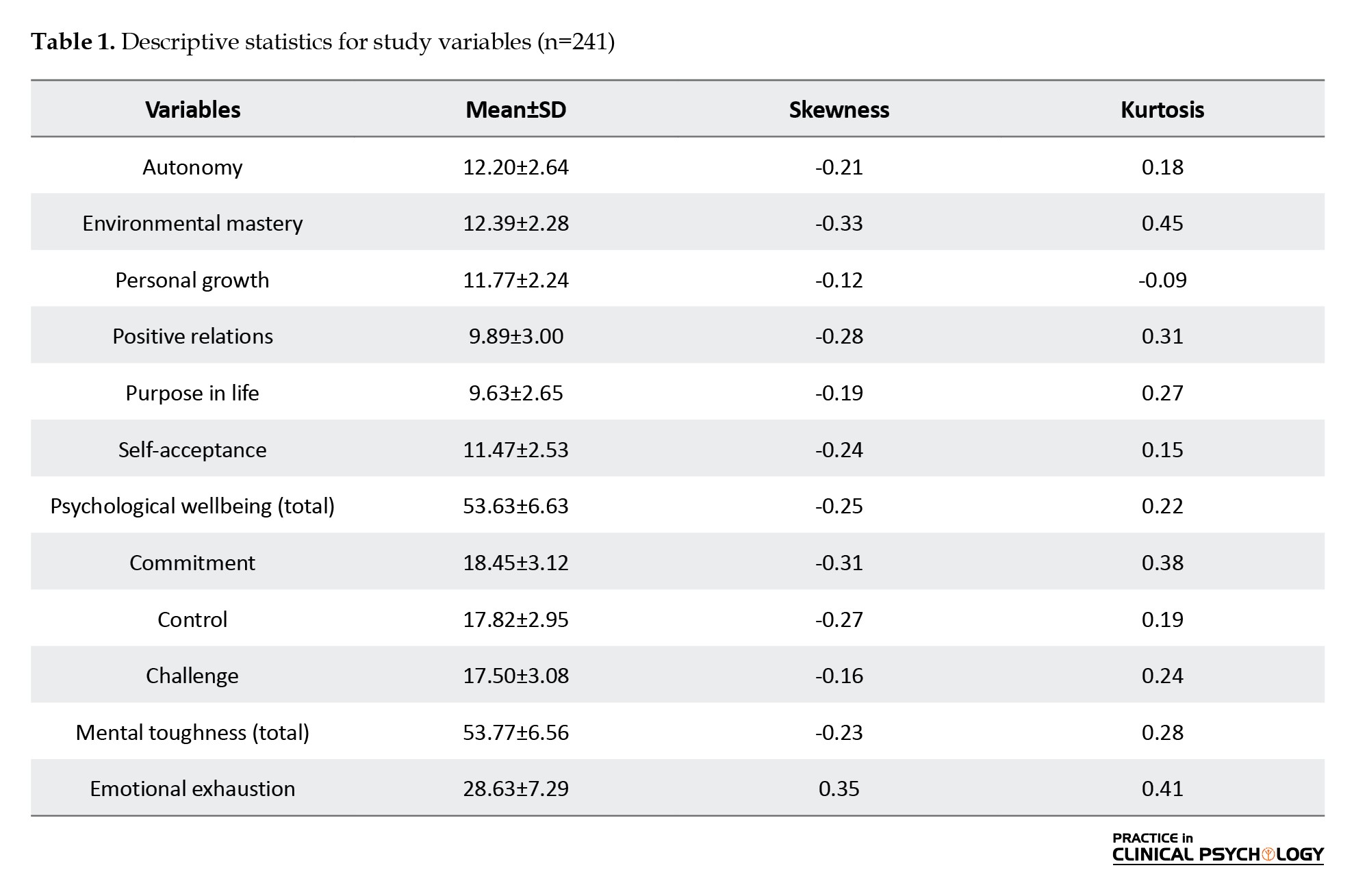
Data were appropriately normally distributed for parametric testing, as all kurtosis and skewness values fell between -1 and +1.
Table 2 presents the intercorrelations among the study variables.
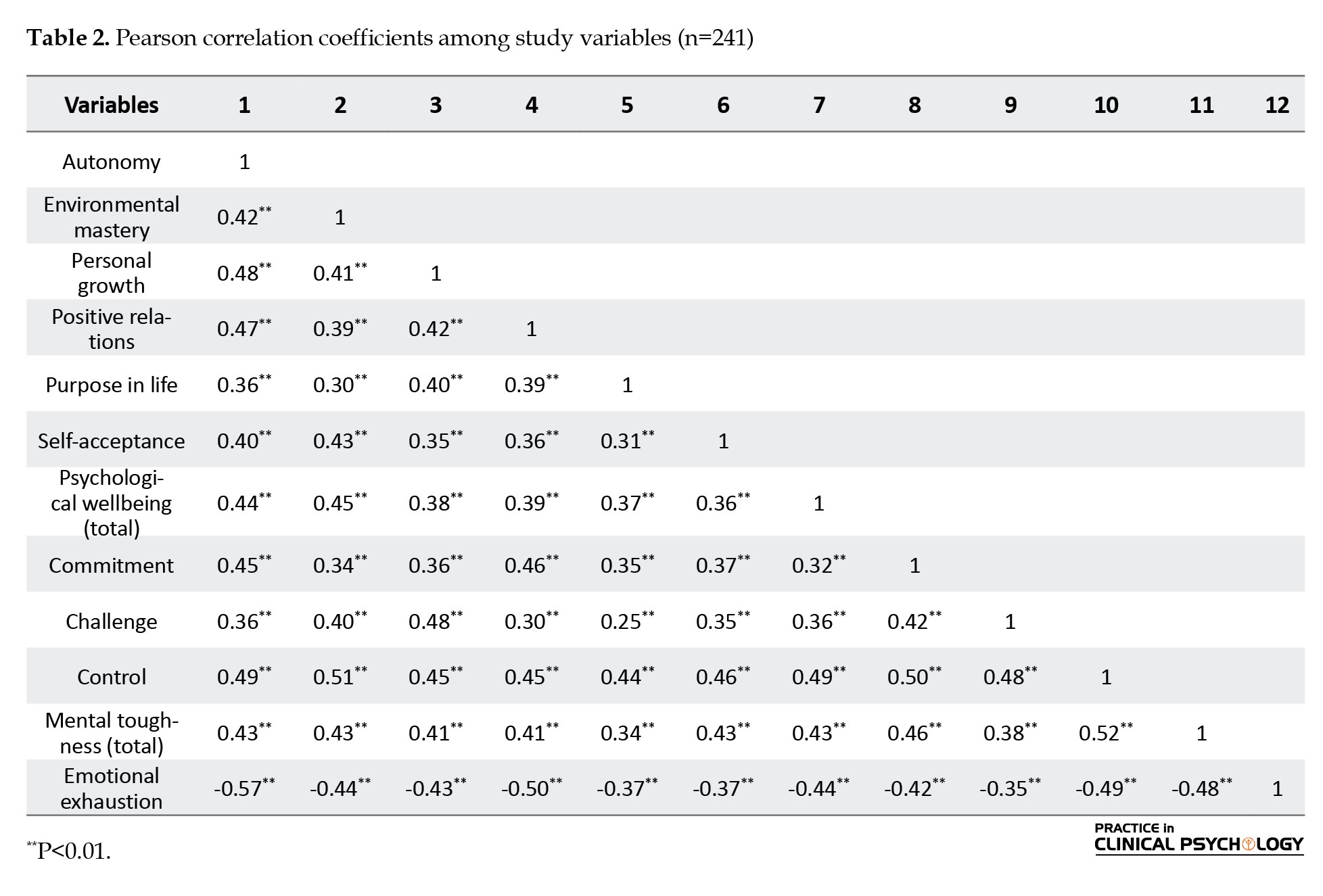
As expected, emotional exhaustion was negatively and moderately correlated with total psychological wellbeing (r=-0.44, P<0.01) and all its subscales. Conversely, mental toughness showed a significant positive correlation with psychological wellbeing (r=0.43, P<0.01). Among the dimensions of mental toughness, the control subscale had the strongest association with wellbeing (r=0.49, P<0.01). These bivariate relationships provide preliminary support for the study hypotheses regarding the associations between emotional exhaustion, mental toughness, and psychological wellbeing.
Table 3 outlines the multiple linear regression outcomes, showing that emotional exhaustion and mental toughness collectively account for 26% of the variance in psychological wellbeing (R2=0.26, F=42.67, P<0.001).
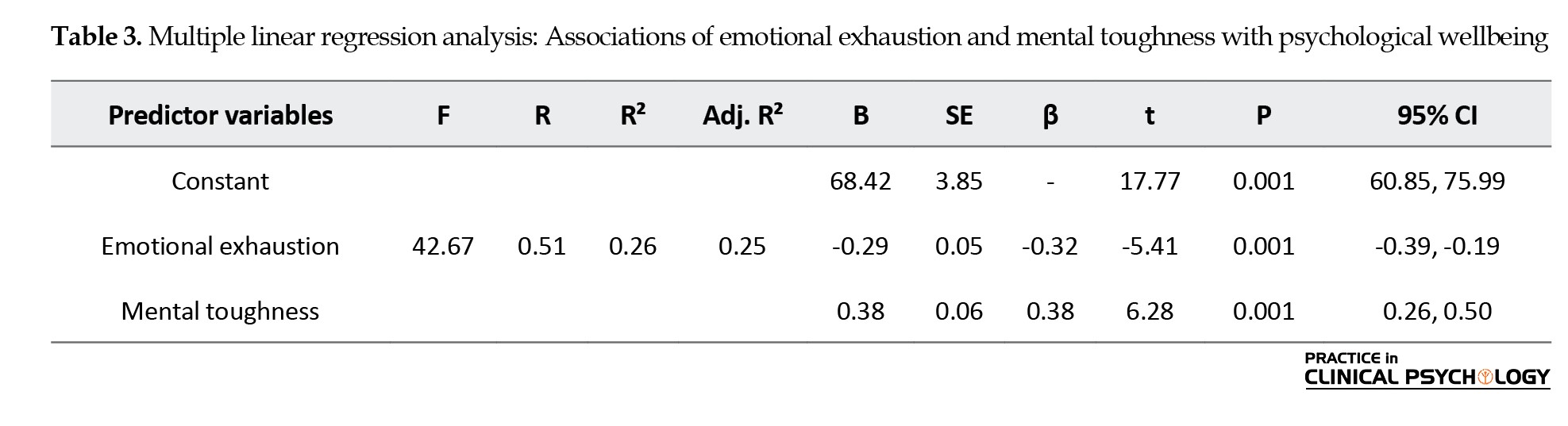
Both factors were significant correlates: mental toughness showed a positive association with wellbeing (β=0.38, P<0.001), whereas emotional exhaustion showed a negative association (β=-0.32, P<0.001). Consequently, adolescents with higher mental hardiness and lower emotional exhaustion reported better overall psychological health in this sample.
Discussion
This cross-sectional correlational study examined the associations between emotional exhaustion and mental toughness (psychological hardiness) and psychological wellbeing among 241 Iranian high school students. Consistent with the study hypotheses, emotional exhaustion showed a moderate negative association with overall psychological wellbeing and all 6 eudaimonic dimensions. In contrast, mental toughness showed a moderate positive association, with the control dimension exhibiting the strongest relationship. Collectively, these two variables accounted for 26% of the variance in wellbeing.
These findings align with COR theory, which posits that chronic depletion of emotional resources through academic and developmental stressors can undermine an individual’s capacity for self-actualization, environmental mastery, and positive social relations (Gao et al., 2023). Emotional exhaustion, a core manifestation of academic burnout, appears to erode the psychological energy needed to maintain purpose in life and personal growth. This pattern is consistent with previous research linking school-related fatigue to diminished life satisfaction and increased internalizing symptoms among adolescents (Shim & Go, 2025; Huttunen et al., 2024). However, the modest R² value of 0.26 indicates that 74% of the variance in psychological wellbeing remains unexplained. This substantial unexplained variance underscores the complex, multifactorial nature of adolescent mental health. It highlights the necessity of including additional predictors in future models, such as family functioning, socioeconomic status, peer relationships, academic achievement, and co-occurring symptoms of anxiety or depression.
On the protective side, mental toughness—operationalized here through the psychological hardiness scale—emerged as a significant positive correlate. The particularly strong role of the control dimension supports the importance of internal locus of control in fostering resilience (Botha & Dahmann, 2023). Adolescents who perceive greater personal agency over their academic and life outcomes appear better equipped to maintain autonomy, self-acceptance, and environmental mastery even in the face of stressors. While the terms “mental toughness” and “psychological hardiness” are often used interchangeably in adolescent literature, they differ. Mental toughness often carries a performance-oriented connotation (e.g. in sports psychology), whereas hardiness is more deeply rooted in existential personality theory (Kobasa, 1979). The present study adopted the hardiness framework for measurement while situating findings within the broader mental toughness discourse, reflecting common practice. This approach, though pragmatic, warrants clearer theoretical integration in future research to avoid conceptual blurring with the wider construct of resilience.
Interpretation of these associations must remain cautious for several reasons. First, the cross-sectional design precludes determining causal directionality. It is equally plausible that lower psychological wellbeing contributes to heightened emotional exhaustion or that unmeasured third variables—such as intense cultural emphasis on academic success in Iran—influence all three constructs simultaneously. Second, common method bias represents a notable threat. All data were collected via self-report questionnaires at a single time point, potentially inflating associations due to shared response biases, social desirability, or measurement error, despite procedural safeguards like anonymity assurances. Third, the absence of control variables (e.g. SES, parental education, or baseline mental health) limits confidence in the unique contribution of the studied predictors.
From a cultural perspective, these results offer valuable insights into the Iranian adolescent context. High academic expectations, collectivist family values, and post-pandemic adjustments may intensify emotional exhaustion while shaping how mental toughness manifests. Nevertheless, the sample was restricted to public high schools in Isfahan, limiting generalizability to other socioeconomic strata, geographic regions, or cultural subgroups within Iran.
Practical implications derived from these correlational findings should be framed conservatively. The results suggest that school-based efforts to reduce unnecessary academic stressors and cultivate a stronger sense of control and hardiness among students may support psychological wellbeing. However, because this study tested no intervention, such recommendations remain speculative. Educators and policymakers should await evidence from well-designed longitudinal and experimental studies before implementing large-scale programs. Dual-factor approaches that simultaneously address distress reduction and strength-building appear particularly worthy of future investigation (Clark et al., 2025).
In comparison with existing literature, the current study extends prior work by jointly examining risk and protective factors in a non-Western adolescent sample. While many previous investigations have focused on Western or university populations (Gerber et al., 2013; Shaw et al., 2023), this research addresses an important gap in the Iranian context. Nonetheless, the relatively modest explained variance and methodological constraints temper enthusiasm and call for more sophisticated designs.
Study limitations
This study has several limitations. The cross-sectional design precludes causal inferences. Reliance on self-report measures introduces risks of common method variance and social desirability bias. The study included no control variables, and the sample was geographically limited. The authors did not formally test measurement invariance of the emotional exhaustion scale across gender. Future research should employ longitudinal designs, multi-informant data, objective measures where possible, and more diverse samples to strengthen conclusions.
Despite these limitations, the study makes a meaningful contribution by documenting culturally relevant associations and providing a foundation for further research on adolescent mental health in Iran.
Conclusion
In conclusion, the present findings indicate that emotional exhaustion is negatively associated and mental toughness (psychological hardiness) is positively associated with psychological wellbeing among Iranian high school students. The sense of control appears particularly important. However, these associations do not imply causation, and the modest explained variance underscores the need to consider additional influencing factors. Future research should employ longitudinal and intervention designs to clarify temporal relationships and test whether strengthening mental toughness can mitigate the negative associations of emotional exhaustion. Such work could ultimately inform more effective support for adolescent mental health in educational settings.
Ethical Considerations
Compliance with ethical guidelines
This study was approved by the Ethics Committee of Islamic Azad University, Arak, Iran, (Code: IR.IAU.ARAK.REC.1403.355).
Funding
This research did not receive any grant from funding agencies in the public, commercial, or non-profit sectors.
Authors' contributions
All authors contributed equally to the conception and design of the study, data collection and analysis, interpretation of the results, and drafting of the manuscript. Each author approved the final version of the manuscript for submission.
Conflict of interest
The authors declared no conflict of interest.
Acknowledgments
The authors would like to express their sincere gratitude to the participants who generously gave their time to contribute to this study.
References
Ala, S., Campos, F. R., & Relva, I. C. (2024). Emotional Exhaustion Scale (ECE): Psychometric Properties in a Sample of Portuguese University Students. European Journal of Investigation in Health, Psychology and Education, 14(4), 1044-1054. [DOI:10.3390/ejihpe14040068] [PMID]
Bayani, A. A., Mohammad Koochekya, A., & Bayani, A. (2008). [Reliability and validity of Ryff’s Psychological Wellbeing Scales (Persian)]. Iranian Journal of Psychiatry and Clinical Psychology, 14(2), 146-151. [Link]
Botha, F., & Dahmann, S. C. (2023). Locus of control, self-control, and health outcomes. SSM - Population Health, 25, 101566. [DOI:10.1016/j.ssmph.2023.101566] [PMID]
Chong, L. Z., Foo, L. K., & Chua, S. L. (2025). Student burnout: a review on factors contributing to burnout across different student populations. Behavioral Sciences, 15(2), 170. [DOI:10.3390/bs15020170]
Clark, K. N., Blyth, G. A., Wilson, K. P., & Plant, M. Z. (2025). A Dual-Factor Examination of Adolescent Mental Health and School Engagement. Contemporary School Psychology, 29(2), 346-359. [DOI:10.1007/s40688-024-00533-4]
Gao X. (2023). Academic stress and academic burnout in adolescents: A moderated mediating model. Frontiers in Psychology, 14, 1133706. [DOI:10.3389/fpsyg.2023.1133706] [PMID]
Gao, J., & McLellan, R. (2018). Using Ryff’s scales of psychological wellbeing in adolescents in mainland China. BMC Psychology, 6(1), 17. [DOI:10.1186/s40359-018-0231-6] [PMID]
Gerber, M., Kalak, N., Lemola, S., Clough, P. J., Perry, J. L., & Pühse, U., et al. (2013). Are adolescents with high mental toughness levels more resilient against stress?. Stress and Health: Journal of The International Society for the Investigation of Stress, 29(2), 164-171. [DOI:10.1002/smi.2447] [PMID]
Ghorbani, N., & Watson, P. J. (2005). Hardiness scales in Iranian managers: evidence of incremental validity in relationships with the five factor model and with organizational and psychological adjustment. Psychological Reports, 96(3 Pt 1), 775–781. [DOI:10.2466/pr0.96.3.775-781] [PMID]
Huttunen, I., Upadyaya, K., & Salmela-Aro, K. (2024). Longitudinal associations between adolescents’ social-emotional skills, school engagement, and school burnout. Learning and Individual Differences, 115, 102537. [DOI:10.1016/j.lindif.2024.102537]
Jiang, M. M., Gao, K., Wu, Z. Y., & Guo, P. P. (2022). The influence of academic pressure on adolescents’ problem behavior: Chain mediating effects of self-control, parent-child conflict, and subjective wellbeing. Frontiers in Psychology, 13, 954330.[DOI:10.3389/fpsyg.2022.954330] [PMID]
Kobasa, S. C. (1979). Stressful life events, personality, and health: An inquiry into hardiness. Journal of Personality and Social Psychology, 37(1), 1–11. [DOI:10.1037/0022-3514.37.1.1] [PMID]
Martínez-Líbano, J., Yeomans, M. M., & Oyanedel, J. C. (2022). Psychometric Properties of the Emotional Exhaustion Scale (ECE) in Chilean Higher Education Students. European Journal of Investigation in Health, Psychology and Education, 12(1), 50-60. [DOI:10.3390/ejihpe12010005] [PMID]
Pérez-Jorge, D., Boutaba-Alehyan, M., González-Contreras, A. I., & Pérez-Pérez, I. (2025). Examining the effects of academic stress on student wellbeing in higher education. Humanities and Social Sciences Communications, 12(1), 449. [DOI:10.1057/s41599-025-04698-y]
Ryff C. D. (2014). Psychological wellbeing revisited: Advances in the science and practice of eudaimonia. Psychotherapy and Psychosomatics, 83(1), 10-28. [DOI:10.1159/000353263] [PMID]
Ryff, C. D. (1995). Psychological wellbeing in adult life. Current Directions in Psychological Science, 4(4), 99-104. [DOI:10.1111/1467-8721.ep10772395]
Sawyer, S. M., Azzopardi, P. S., Wickremarathne, D., & Patton, G. C. (2018). The age of adolescence. The Lancet. Child & Adolescent Health, 2(3), 223-228. [DOI:10.1016/S2352-4642(18)30022-1] [PMID]
Shaw, L., Hansen, H., & St Clair-Thompson, H. (2023). Mental toughness is a mediator of the relationship between positive childhood experiences and wellbeing. European Journal of Developmental Psychology, 20(1), 130-146. [DOI:10.1080/17405629.2022.2058485]
Shim, T., & Go, E. (2025). The Impact of School Burnout on Life Satisfaction Among University Students: The Mediating Effects of Loneliness and Fear of Alienation. Behavioral Sciences, 15(8), 1083. [DOI:10.3390/bs15081083] [PMID]
Viejo, C., Gómez-López, M., & Ortega-Ruiz, R. (2018). Adolescents’ Psychological Wellbeing: A Multidimensional Measure. International Journal of Environmental Research and Public Health, 15(10), 2325. [DOI:10.3390/ijerph15102325] [PMID]
Wang, R., Yang, S., Xu, X., Mi, S., & Hao, N. (2025). Exploring adolescent academic stress in the digital and urban age: A mixed-methods study from CIT to checklist validation. Frontiers in Psychology, 16, 1692113. [DOI:10.3389/fpsyg.2025.1692113] [PMID]
Yuan, W., Wang, G., & Wang, Z. (2025). Physical exercise and adolescent mental toughness: mediating effects of family support and socioeconomic status. Frontiers in Psychology, 16, 1670466. [DOI:10.3389/fpsyg.2025.1670466] [PMID]
Adolescence is a critical developmental period marked by rapid biological, cognitive, and psychosocial changes (Sawyer et al., 2018). Adolescents face intense academic pressures, peer relationship challenges, identity formation, and family expectations, which digital environments and post-pandemic adjustments can amplify (Jiang et al., 2022; Pérez-Jorge et al., 2025). While previous studies have documented elevated stress levels among adolescents, the specific interplay between emotional exhaustion as a risk factor and mental toughness (psychological hardiness) as a protective resource in non-Western, particularly Iranian contexts, has remained underexplored.
Psychological wellbeing, as conceptualized in Ryff’s (2014) multidimensional eudaimonic model, encompasses autonomy, self-acceptance, personal growth, purpose in life, environmental mastery, and positive relations. This construct extends beyond the mere absence of psychopathology and is essential for resilient development and long-term adaptive outcomes (Ryff, 1995; Gao & McLellan, 2018). However, empirical syntheses reveal that chronic stressors frequently undermine these dimensions, leading to diminished life satisfaction and increased vulnerability to internalizing problems (Viejo et al., 2018; Huttunen et al., 2024).
A major risk factor is emotional exhaustion, characterized by emotional depletion and cognitive fatigue from prolonged exposure to excessive demands (Gao et al., 2023). Originally rooted in occupational burnout research, this construct has been increasingly applied to academic contexts, where it manifests as school-related fatigue and is consistently linked to lower wellbeing (Chong et al., 2025; Shim & Go, 2025). Critically, most prior studies have examined emotional exhaustion in isolation, with limited attention to protective psychological resources that may buffer its effects.
Mental toughness, often used interchangeably with psychological hardiness in the literature, refers to a personality constellation involving commitment, control, and challenge (Kobasa, 1979). Although related to the broader construct of resilience, mental toughness specifically emphasizes proactive engagement with stressors through an internal locus of control and viewing challenges as growth opportunities (Gerber et al., 2013; Shaw et al., 2023). Despite conceptual overlap, contemporary scholarship distinguishes mental toughness as a more performance-oriented trait, while hardiness is more closely tied to existential personality theory. The present study adopts the psychological hardiness scale while framing findings within the mental toughness literature to reflect common usage in adolescent research (Yuan et al., 2025).
Although researchers have documented associations between these variables, several gaps remain. Most existing research has focused on adult or clinical populations, relied on Western samples, or examined variables in isolation rather than their joint contribution (Wang et al., 2025). Furthermore, few studies have tested these relationships in Iranian adolescents, where cultural emphases on academic achievement and collectivist values may shape how these constructs are expressed. This study addresses these limitations by examining the associations of emotional exhaustion and mental toughness with psychological wellbeing in a sample of Iranian high school students. Based on the literature and conservation of resources (COR) theory, it was hypothesized that 1) emotional exhaustion would be negatively associated with psychological wellbeing and all its sub-dimensions, 2) mental toughness (psychological hardiness) would be positively associated with psychological wellbeing and its sub-dimensions, and 3) mental toughness would emerge as a significant correlate of wellbeing even after accounting for emotional exhaustion. By investigating these relationships, the present study aims to provide a more nuanced understanding of the factors influencing adolescent mental health in an understudied cultural context and offer preliminary insights for targeted school-based interventions.
Materials and Methods
Study design
This study used a cross-sectional correlational design and multiple linear regression to examine associations (rather than causal predictions) between emotional exhaustion, mental toughness (psychological hardiness), and psychological wellbeing.
Study participants
The target population included all high school students (aged 15–18 years) in Isfahan City, Iran, during the 2024–2025 academic year. The statistical population was defined similarly. A priori power analysis using G*Power (version 3.1) indicated that a minimum sample of 146 participants would be required to detect a medium effect size (f²=0.15) with power=0.80 and α=0.05 for multiple regression with 2 predictors. To increase statistical power and account for potential clustering effects, we recruited a final sample of 241 adolescents (Mean±SD age, 16.42±0.91; 53.1% female, 46.9% male). Participants were primarily from public high schools; socioeconomic data were not formally collected, but schools represented a mix of middle to lower-middle socioeconomic backgrounds typical of urban Isfahan. We used multi-stage cluster sampling: educational districts were randomly selected, followed by random selection of schools within districts, and then random selection of classes. Inclusion criteria included enrollment in high school and providing informed assent (adolescents) and parental consent. The exclusion criteria included grossly incomplete questionnaires or self-reported severe psychiatric disorders.
Study measures
Ryff’s psychological wellbeing scale (18-item short form): We evaluated participants’ mental flourishing using the 18-item short form of Ryff’s psychological wellbeing scale. This tool measures 6 facets: self-acceptance, autonomy, environmental mastery, purpose in life, personal growth, and positive relations (Ryff, 1995). Items are scored on a 6-point Likert scale (totaling 18 to 108), with certain items reverse-scored. Higher totals denote better psychological adaptation. The Persian version is well validated, with a cronbach α of 0.85 (Bayani et al., 2008). In the current sample, internal consistency was reliable (α=0.83).
Emotional exhaustion scale (ECE): This 10-item unidimensional scale (Ala et al., 2024) assesses academic-related emotional depletion on a 5-point Likert scale. Although originally developed for university students, prior studies support its applicability to older adolescents (Martínez-Líbano et al., 2022). The Persian adaptation showed acceptable reliability in the present adolescent sample (α=0.84). No formal measurement invariance analysis across gender was conducted in this study.
Psychological hardiness scale: In this study, the scale operationalized mental toughness/psychological hardiness (the terms are used interchangeably in much adolescent literature, though they have nuanced differences). Grounded in Kobasa’s (1979) framework, it assesses three dimensions: control, commitment, and challenge. It contains 20 items rated on a 4-point Likert scale (totaling 20 to 80). Higher scores signify a greater ability to reframe stressors as positive challenges. This adaptation has proven reliable in Iranian demographics (Ghorbani & Watson, 2005), and this study yielded a cronbach α of 0.85.
Study procedure
After obtaining permission from the Isfahan Department of Education, researchers visited selected schools. The researchers obtained written parental consent and adolescent assent before data collection. Participants were informed that participation was voluntary, that they could withdraw at any time, and that their responses would be kept confidential. Questionnaires were administered in quiet classrooms. The response rate was approximately 92%, and we excluded incomplete packets (n=19). Data collection took 25–30 minutes per session. Potential clustering effects due to class-level sampling were not statistically adjusted in the primary analyses.
Data analysis
We analyzed data using SPSS software, version 26. Assumption testing confirmed normality (skewness and kurtosis values between -1 and +1), absence of multicollinearity (variance inflation factor [VIF]<2.0, tolerance >0.50 for both predictors), homoscedasticity, and independence of residuals (Durbin-Watson=1.98). No significant missing data remained after listwise deletion. We computed Pearson correlations and ran multiple linear regression. Because this was a cross-sectional self-report design, common method bias is a potential limitation; we implemented procedural remedies (e.g. anonymity assurance), but did not apply a statistical correction (e.g. Harman’s test). Significance level was set at P<0.05. Effect sizes and confidence intervals are reported where appropriate.
Results
The study evaluated 241 public high school students in Isfahan, Iran, during the 2024–2025 academic year. The cohort aged 15to 18 years (Mean±SD, 16.42±0.91 y) included 128 females (53.1%) and 113 males (46.9%). Preliminary evaluations showed no significant gender disparities regarding the primary variables. According to Table 1, students showed moderate mental toughness (Mean±SD, 53.77±6.56) and psychological wellbeing (Mean±SD, 53.63±6.63), along with moderate-to-high emotional exhaustion (Mean±SD, 28.63Mean±SD, 7.29).
Data were appropriately normally distributed for parametric testing, as all kurtosis and skewness values fell between -1 and +1.
Table 2 presents the intercorrelations among the study variables.
As expected, emotional exhaustion was negatively and moderately correlated with total psychological wellbeing (r=-0.44, P<0.01) and all its subscales. Conversely, mental toughness showed a significant positive correlation with psychological wellbeing (r=0.43, P<0.01). Among the dimensions of mental toughness, the control subscale had the strongest association with wellbeing (r=0.49, P<0.01). These bivariate relationships provide preliminary support for the study hypotheses regarding the associations between emotional exhaustion, mental toughness, and psychological wellbeing.
Table 3 outlines the multiple linear regression outcomes, showing that emotional exhaustion and mental toughness collectively account for 26% of the variance in psychological wellbeing (R2=0.26, F=42.67, P<0.001).
Both factors were significant correlates: mental toughness showed a positive association with wellbeing (β=0.38, P<0.001), whereas emotional exhaustion showed a negative association (β=-0.32, P<0.001). Consequently, adolescents with higher mental hardiness and lower emotional exhaustion reported better overall psychological health in this sample.
Discussion
This cross-sectional correlational study examined the associations between emotional exhaustion and mental toughness (psychological hardiness) and psychological wellbeing among 241 Iranian high school students. Consistent with the study hypotheses, emotional exhaustion showed a moderate negative association with overall psychological wellbeing and all 6 eudaimonic dimensions. In contrast, mental toughness showed a moderate positive association, with the control dimension exhibiting the strongest relationship. Collectively, these two variables accounted for 26% of the variance in wellbeing.
These findings align with COR theory, which posits that chronic depletion of emotional resources through academic and developmental stressors can undermine an individual’s capacity for self-actualization, environmental mastery, and positive social relations (Gao et al., 2023). Emotional exhaustion, a core manifestation of academic burnout, appears to erode the psychological energy needed to maintain purpose in life and personal growth. This pattern is consistent with previous research linking school-related fatigue to diminished life satisfaction and increased internalizing symptoms among adolescents (Shim & Go, 2025; Huttunen et al., 2024). However, the modest R² value of 0.26 indicates that 74% of the variance in psychological wellbeing remains unexplained. This substantial unexplained variance underscores the complex, multifactorial nature of adolescent mental health. It highlights the necessity of including additional predictors in future models, such as family functioning, socioeconomic status, peer relationships, academic achievement, and co-occurring symptoms of anxiety or depression.
On the protective side, mental toughness—operationalized here through the psychological hardiness scale—emerged as a significant positive correlate. The particularly strong role of the control dimension supports the importance of internal locus of control in fostering resilience (Botha & Dahmann, 2023). Adolescents who perceive greater personal agency over their academic and life outcomes appear better equipped to maintain autonomy, self-acceptance, and environmental mastery even in the face of stressors. While the terms “mental toughness” and “psychological hardiness” are often used interchangeably in adolescent literature, they differ. Mental toughness often carries a performance-oriented connotation (e.g. in sports psychology), whereas hardiness is more deeply rooted in existential personality theory (Kobasa, 1979). The present study adopted the hardiness framework for measurement while situating findings within the broader mental toughness discourse, reflecting common practice. This approach, though pragmatic, warrants clearer theoretical integration in future research to avoid conceptual blurring with the wider construct of resilience.
Interpretation of these associations must remain cautious for several reasons. First, the cross-sectional design precludes determining causal directionality. It is equally plausible that lower psychological wellbeing contributes to heightened emotional exhaustion or that unmeasured third variables—such as intense cultural emphasis on academic success in Iran—influence all three constructs simultaneously. Second, common method bias represents a notable threat. All data were collected via self-report questionnaires at a single time point, potentially inflating associations due to shared response biases, social desirability, or measurement error, despite procedural safeguards like anonymity assurances. Third, the absence of control variables (e.g. SES, parental education, or baseline mental health) limits confidence in the unique contribution of the studied predictors.
From a cultural perspective, these results offer valuable insights into the Iranian adolescent context. High academic expectations, collectivist family values, and post-pandemic adjustments may intensify emotional exhaustion while shaping how mental toughness manifests. Nevertheless, the sample was restricted to public high schools in Isfahan, limiting generalizability to other socioeconomic strata, geographic regions, or cultural subgroups within Iran.
Practical implications derived from these correlational findings should be framed conservatively. The results suggest that school-based efforts to reduce unnecessary academic stressors and cultivate a stronger sense of control and hardiness among students may support psychological wellbeing. However, because this study tested no intervention, such recommendations remain speculative. Educators and policymakers should await evidence from well-designed longitudinal and experimental studies before implementing large-scale programs. Dual-factor approaches that simultaneously address distress reduction and strength-building appear particularly worthy of future investigation (Clark et al., 2025).
In comparison with existing literature, the current study extends prior work by jointly examining risk and protective factors in a non-Western adolescent sample. While many previous investigations have focused on Western or university populations (Gerber et al., 2013; Shaw et al., 2023), this research addresses an important gap in the Iranian context. Nonetheless, the relatively modest explained variance and methodological constraints temper enthusiasm and call for more sophisticated designs.
Study limitations
This study has several limitations. The cross-sectional design precludes causal inferences. Reliance on self-report measures introduces risks of common method variance and social desirability bias. The study included no control variables, and the sample was geographically limited. The authors did not formally test measurement invariance of the emotional exhaustion scale across gender. Future research should employ longitudinal designs, multi-informant data, objective measures where possible, and more diverse samples to strengthen conclusions.
Despite these limitations, the study makes a meaningful contribution by documenting culturally relevant associations and providing a foundation for further research on adolescent mental health in Iran.
Conclusion
In conclusion, the present findings indicate that emotional exhaustion is negatively associated and mental toughness (psychological hardiness) is positively associated with psychological wellbeing among Iranian high school students. The sense of control appears particularly important. However, these associations do not imply causation, and the modest explained variance underscores the need to consider additional influencing factors. Future research should employ longitudinal and intervention designs to clarify temporal relationships and test whether strengthening mental toughness can mitigate the negative associations of emotional exhaustion. Such work could ultimately inform more effective support for adolescent mental health in educational settings.
Ethical Considerations
Compliance with ethical guidelines
This study was approved by the Ethics Committee of Islamic Azad University, Arak, Iran, (Code: IR.IAU.ARAK.REC.1403.355).
Funding
This research did not receive any grant from funding agencies in the public, commercial, or non-profit sectors.
Authors' contributions
All authors contributed equally to the conception and design of the study, data collection and analysis, interpretation of the results, and drafting of the manuscript. Each author approved the final version of the manuscript for submission.
Conflict of interest
The authors declared no conflict of interest.
Acknowledgments
The authors would like to express their sincere gratitude to the participants who generously gave their time to contribute to this study.
References
Ala, S., Campos, F. R., & Relva, I. C. (2024). Emotional Exhaustion Scale (ECE): Psychometric Properties in a Sample of Portuguese University Students. European Journal of Investigation in Health, Psychology and Education, 14(4), 1044-1054. [DOI:10.3390/ejihpe14040068] [PMID]
Bayani, A. A., Mohammad Koochekya, A., & Bayani, A. (2008). [Reliability and validity of Ryff’s Psychological Wellbeing Scales (Persian)]. Iranian Journal of Psychiatry and Clinical Psychology, 14(2), 146-151. [Link]
Botha, F., & Dahmann, S. C. (2023). Locus of control, self-control, and health outcomes. SSM - Population Health, 25, 101566. [DOI:10.1016/j.ssmph.2023.101566] [PMID]
Chong, L. Z., Foo, L. K., & Chua, S. L. (2025). Student burnout: a review on factors contributing to burnout across different student populations. Behavioral Sciences, 15(2), 170. [DOI:10.3390/bs15020170]
Clark, K. N., Blyth, G. A., Wilson, K. P., & Plant, M. Z. (2025). A Dual-Factor Examination of Adolescent Mental Health and School Engagement. Contemporary School Psychology, 29(2), 346-359. [DOI:10.1007/s40688-024-00533-4]
Gao X. (2023). Academic stress and academic burnout in adolescents: A moderated mediating model. Frontiers in Psychology, 14, 1133706. [DOI:10.3389/fpsyg.2023.1133706] [PMID]
Gao, J., & McLellan, R. (2018). Using Ryff’s scales of psychological wellbeing in adolescents in mainland China. BMC Psychology, 6(1), 17. [DOI:10.1186/s40359-018-0231-6] [PMID]
Gerber, M., Kalak, N., Lemola, S., Clough, P. J., Perry, J. L., & Pühse, U., et al. (2013). Are adolescents with high mental toughness levels more resilient against stress?. Stress and Health: Journal of The International Society for the Investigation of Stress, 29(2), 164-171. [DOI:10.1002/smi.2447] [PMID]
Ghorbani, N., & Watson, P. J. (2005). Hardiness scales in Iranian managers: evidence of incremental validity in relationships with the five factor model and with organizational and psychological adjustment. Psychological Reports, 96(3 Pt 1), 775–781. [DOI:10.2466/pr0.96.3.775-781] [PMID]
Huttunen, I., Upadyaya, K., & Salmela-Aro, K. (2024). Longitudinal associations between adolescents’ social-emotional skills, school engagement, and school burnout. Learning and Individual Differences, 115, 102537. [DOI:10.1016/j.lindif.2024.102537]
Jiang, M. M., Gao, K., Wu, Z. Y., & Guo, P. P. (2022). The influence of academic pressure on adolescents’ problem behavior: Chain mediating effects of self-control, parent-child conflict, and subjective wellbeing. Frontiers in Psychology, 13, 954330.[DOI:10.3389/fpsyg.2022.954330] [PMID]
Kobasa, S. C. (1979). Stressful life events, personality, and health: An inquiry into hardiness. Journal of Personality and Social Psychology, 37(1), 1–11. [DOI:10.1037/0022-3514.37.1.1] [PMID]
Martínez-Líbano, J., Yeomans, M. M., & Oyanedel, J. C. (2022). Psychometric Properties of the Emotional Exhaustion Scale (ECE) in Chilean Higher Education Students. European Journal of Investigation in Health, Psychology and Education, 12(1), 50-60. [DOI:10.3390/ejihpe12010005] [PMID]
Pérez-Jorge, D., Boutaba-Alehyan, M., González-Contreras, A. I., & Pérez-Pérez, I. (2025). Examining the effects of academic stress on student wellbeing in higher education. Humanities and Social Sciences Communications, 12(1), 449. [DOI:10.1057/s41599-025-04698-y]
Ryff C. D. (2014). Psychological wellbeing revisited: Advances in the science and practice of eudaimonia. Psychotherapy and Psychosomatics, 83(1), 10-28. [DOI:10.1159/000353263] [PMID]
Ryff, C. D. (1995). Psychological wellbeing in adult life. Current Directions in Psychological Science, 4(4), 99-104. [DOI:10.1111/1467-8721.ep10772395]
Sawyer, S. M., Azzopardi, P. S., Wickremarathne, D., & Patton, G. C. (2018). The age of adolescence. The Lancet. Child & Adolescent Health, 2(3), 223-228. [DOI:10.1016/S2352-4642(18)30022-1] [PMID]
Shaw, L., Hansen, H., & St Clair-Thompson, H. (2023). Mental toughness is a mediator of the relationship between positive childhood experiences and wellbeing. European Journal of Developmental Psychology, 20(1), 130-146. [DOI:10.1080/17405629.2022.2058485]
Shim, T., & Go, E. (2025). The Impact of School Burnout on Life Satisfaction Among University Students: The Mediating Effects of Loneliness and Fear of Alienation. Behavioral Sciences, 15(8), 1083. [DOI:10.3390/bs15081083] [PMID]
Viejo, C., Gómez-López, M., & Ortega-Ruiz, R. (2018). Adolescents’ Psychological Wellbeing: A Multidimensional Measure. International Journal of Environmental Research and Public Health, 15(10), 2325. [DOI:10.3390/ijerph15102325] [PMID]
Wang, R., Yang, S., Xu, X., Mi, S., & Hao, N. (2025). Exploring adolescent academic stress in the digital and urban age: A mixed-methods study from CIT to checklist validation. Frontiers in Psychology, 16, 1692113. [DOI:10.3389/fpsyg.2025.1692113] [PMID]
Yuan, W., Wang, G., & Wang, Z. (2025). Physical exercise and adolescent mental toughness: mediating effects of family support and socioeconomic status. Frontiers in Psychology, 16, 1670466. [DOI:10.3389/fpsyg.2025.1670466] [PMID]
Type of Study: Original Research Article |
Subject:
Analytical approach
| Rights and permissions | |
 |
This work is licensed under a Creative Commons Attribution-NonCommercial 4.0 International License. |

This is an open access article distributed under the terms of the Creative Commons Attribution-NonCommercial 4.0 (CC-By-NC 4.0), which permits use, distribution, and reproduction in any medium, provided the original work is properly cited and is not used for commercial purposes.
Contact Information