

Volume 14, Issue 4 (Autumn 2026)
Pract Clin Psychol 2026, 14(4): 327-338 |
Back to browse issues page


Download citation:
BibTeX | RIS | EndNote | Medlars | ProCite | Reference Manager | RefWorks
Send citation to:


BibTeX | RIS | EndNote | Medlars | ProCite | Reference Manager | RefWorks
Send citation to:
Seyed Abootalebi S S, Shiri E, Kakavand A, Rahimpour M. Childhood Trauma, Mentalization, and Obsessive–compulsive Symptoms: The Mediating Role of Personality Organization in University Students. Pract Clin Psychol 2026; 14 (4) :327-338
URL: http://jpcp.uswr.ac.ir/article-1-1095-en.html
URL: http://jpcp.uswr.ac.ir/article-1-1095-en.html

1- Department of Psychology, Faculty of Social Sciences, Imam Khomeini International University, Qazvin, Iran.
2- Department of Psychology, Faculty of Social Sciences, Imam Khomeini International University, Qazvin, Iran. ,esmaeil.shiri67@yahoo.com
2- Department of Psychology, Faculty of Social Sciences, Imam Khomeini International University, Qazvin, Iran. ,
Full-Text [PDF 990 kb]
(171 Downloads)
| Abstract (HTML) (1323 Views)
Full-Text: (102 Views)
Introduction
Obsessive-compulsive symptoms are among the significant problems that cause considerable impairment in many aspects of individual and social life, including work, education, and emotional relationships, and also lead to relatively severe psychological distress (Mahjani et al., 2021). These symptoms include persistent, distressing, and time-consuming obsessions and compulsions. Obsessions consist of unwanted and intrusive thoughts, images, or impulses that create anxiety and discomfort, while compulsions are repetitive behaviors or mental rituals performed to reduce this distress. Although these actions temporarily alleviate anxiety, they ultimately reinforce the harmful cycle of symptoms over time (Mahjani et al., 2021).
To understand the factors that contribute to the development and maintenance of obsessive-compulsive symptoms, researchers have examined early life experiences and their impact on developmental pathways. Among these, the most important factors that have garnered considerable attention in recent years are childhood traumatic experiences. Many researchers believe that childhood difficulties, problematic parent-child relationships, and adverse or abusive early experiences lay the foundation for later behavioral, psychological, and personality problems (Lyons et al., 2019).
Such unpleasant childhood experiences are associated with numerous physical and mental health disorders, abnormal behaviors, and unhealthy lifestyles in adulthood (Beutel et al., 2017). Trauma refers to actions or omissions that negatively affect health, life, and normal development (Taşören, 2023). Recent evidence suggests that childhood trauma is not only associated with the severity of obsessive-compulsive symptoms but may also operate through specific psychological mechanisms such as impaired mentalization (De Rossi et al., 2024).
In addition to traumatic experiences, an individual’s ability to understand their own and others’ mental states—referred to as mentalization—also plays an important role in the onset and severity of obsessive-compulsive symptoms. Mentalization refers to the capacity to understand and interpret one’s own and others’ intentions, emotional experiences, and psychological states; this capacity is closely linked to empathy and insight into one’s internal processes. This capacity develops through early interactions with primary caregivers, and disruptions in the child-caregiver relationship can hinder its development (Robinson et al., 2018). Research has shown that individuals with obsessive-compulsive symptoms often exhibit deficits in mentalization. Those who demonstrate more severe mentalization deficits typically show lower levels of empathy and insight into their condition, are less likely to seek treatment, and exhibit poorer responses to therapeutic interventions (Kang et al., 2012). Furthermore, deficits in mentalization are closely associated with personality pathology, as impairments in self-other understanding contribute to maladaptive identity formation and immature defensive patterns (Jańczak et al., 2025).
However, the question arises as to why some individuals exhibit more severe symptoms despite experiencing trauma or having mentalization deficits. The answer may lie in the individual’s personality structure. In the present study, we examined personality organization as a mediating variable. Otto Kernberg introduced the term personality organization, which refers to the overall structure and functioning of personality, comprising three main components: identity integration (a coherent sense of self), reality testing (the ability to distinguish between self and others and to perceive reality accurately), and defense mechanisms (unconscious strategies for coping with anxiety) (Kernberg & Caligor, 2005). This construct lies on a continuum from health to severe pathology. It can be assessed either dimensionally (the degree of personality vulnerability) or categorically (neurotic, borderline, or psychotic personality organization) (Bodó et al., 2024).
The theoretical rationale for the mediating role of personality organization in the relationship between childhood trauma and obsessive-compulsive symptoms rests on the assumption that traumatic experiences during childhood can fundamentally alter the developmental trajectory of personality. Such experiences, by disrupting the formation of an integrated identity and weakening adaptive defense mechanisms, lay the groundwork for a disorganized and vulnerable personality organization (De Rossi et al., 2024).
On the other hand, when an individual’s mentalization capacity is reduced, they struggle to understand and manage their own and others’ thoughts, feelings, and motives. This difficulty, in turn, can lead to maladaptive personality patterns, such as problems with emotion regulation, unstable identity formation, and disturbed interpersonal relationships (Jańczak et al., 2025). Research has shown that mentalization and personality organization share considerable conceptual and operational overlap. Individuals with a disorganized personality organization typically exhibit high levels of intolerance of uncertainty, feel a strong need to control their environment, and resort to rigid, repetitive (compulsive) behaviors as a compensatory strategy to reduce their anxiety. In other words, personality organization can serve as a bridging mechanism that channels the impact of childhood trauma and mentalization deficits toward obsessive-compulsive symptoms (De Rossi et al., 2024; Jańczak et al., 2025). A review of the existing research reveals that findings regarding the relationships between trauma, mentalization, and obsessive-compulsive symptoms are sometimes contradictory or limited. Many unaccounted-for variables appear to play a role in this relationship, one of the most important of which is personality organization. However, a few studies have simultaneously examined the role of these three variables together. To our knowledge, no previous study has tested personality organization as a mediator between both childhood trauma and mentalization with obsessive-compulsive disorder (OCD) symptoms in a single structural model using a non‑clinical student sample. The present study extends prior correlational findings by proposing a theory‑driven mediation framework. Therefore, the present study aimed to propose a structural model of the relationships between childhood trauma, mentalization, and obsessive-compulsive symptoms, with personality organization as a mediating variable, in a sample of university students.
Materials and Methods
This study employed a descriptive-correlational design using structural equation modeling (SEM). The statistical population consisted of all students enrolled at Imam Khomeini International University in Qazvin City, Iran, during the 2023–2024 academic year. The target sample size was determined based on the rule of thumb, which recommends at least 200 participants for SEM. Therefore, 260 students were recruited. We used cluster random sampling. We randomly selected five faculties (Social Sciences, Humanities, Basic Sciences, Engineering and Technology, and Islamic Research), then randomly chose 2 classes from each faculty. Within each selected class, the first author briefly explained the study aims and invited all students to participate. We distributed questionnaires during regular class sessions, and students completed them anonymously. Psychiatric history was not formally assessed; however, participants were asked whether they had ever received a psychiatric diagnosis. Those who reported a diagnosis of psychotic disorder were excluded (n=3). This study used a non‑clinical student sample. Therefore, the findings are primarily generalizable to university students with varying levels of OCD symptoms rather than to clinical populations diagnosed with obsessive‑compulsive disorder. The discussion section further addresses this limitation.
Study measures
Yale-brown obsessive-compulsive scale
The Yale-brown obsessive-compulsive scale (Y-BOCS) was developed by Goodman et al. (1989) to assess the severity of obsessive-compulsive symptoms. The scale comprises 10 items, with the first five assessing the severity of obsessions and the remaining five assessing the severity of compulsions. Each item is scored on a 5-point scale ranging from 0 to 4, yielding a total score ranging from 0 to 40. The psychometric properties of the Persian version were evaluated by Esfahani et al. (2012). They reported cronbach’s α coefficients of 0.97 for the symptom checklist and 0.95 for the severity scale, split-half reliability coefficients of 0.93 and 0.89, respectively, and a test–re-test reliability coefficient of 0.99. In the present study, a self-report version of the Y-BOCS was used. Cronbach’s α was 0.85 for the total score, 0.78 for the obsession subscale, and 0.88 for the compulsion subscale.
Childhood trauma questionnaire-short form
The childhood trauma questionnaire–short form (CTQ-SF) was developed by Bernstein et al. (2003) to assess childhood maltreatment. The instrument consists of 28 items, including 25 items measuring five dimensions of childhood maltreatment: emotional abuse, physical abuse, sexual abuse, emotional neglect, and physical neglect, and three items assessing minimization and denial. Each maltreatment subscale comprises five items rated on a 5-point Likert scale. The original version demonstrated satisfactory internal consistency, with cronbach’s alpha coefficients ranging from 0.61 to 0.95 across the subscales. In Iran, the psychometric properties of the Persian version of the childhood trauma questionnaire were examined by Garrusi and Nakhaee (2009). In the present study, Cronbach’s α was 0.87 for the total score, with subscale coefficients ranging from 0.77 to 0.89.
Reflective functioning questionnaire
The reflective functioning questionnaire (RFQ) was developed by Fonagy et al. (2016) to assess individuals’ ability to understand mental states in themselves and others. It evaluates two dimensions: certainty about mental states and uncertainty about mental states. Items are rated on a 7-point Likert scale. The Persian translation of the RFQ was evaluated by Seyed Mousavi et al. (2021) in a sample of Iranian adolescents, and the findings supported its two-factor structure and construct validity. In the present study, cronbach’s α coefficients were 0.89 for the total score, 0.90 for certainty about mental states, and 0.85 for uncertainty about mental states.
Kernberg’s personality organization questionnaire
Kernberg’s inventory of personality organization (IPO) questionnaire was developed by Kernberg (2002) and assesses personality organization using 37 closed-ended items on a 5-point Likert scale (Kernberg & Caligor, 2005). It measures three subscales: Identity integration, reality testing, and defense mechanisms. In Iran, Al Behebahani and Mohammadi (2007) validated the questionnaire. They reported Cronbach α coefficients of 0.90, 0.82, and 0.86 for the subscales, with satisfactory correlations between the subscales and the total score (0.45 to 0.75). In the current study, the overall Cronbach α for the questionnaire was 0.95, with subscale alphas of 0.89 (primitive defenses), 0.85 (identity integration), and 0.91 (reality testing).
Measurement model evaluation
Before testing the structural model, we conducted a confirmatory factor analysis (CFA) to evaluate the measurement model. For childhood trauma, 5 subscale scores (physical abuse, sexual abuse, emotional abuse, physical neglect, and emotional neglect) served as indicators. For mentalization, 2 subscale scores (certainty and uncertainty) were used. For personality organization, we used 3 subscale scores (identity integration, reality testing, and defense mechanisms). For obsessive-compulsive symptoms, 2 subscale scores (obsessions and compulsions) were used.
Standardized factor loadings for all indicators ranged from 0.62 to 0.84 (all P<0.001). Composite reliability (CR) for each latent variable ranged from 0.81 to 0.91, exceeding the recommended threshold of 0.70. Average variance extracted (AVE) ranged from 0.53 to 0.71, exceeding the recommended threshold of 0.50. These values indicate adequate convergent validity. No multivariate outliers were identified based on Mahalanobis distance (critical χ² at P<0.001).
Results
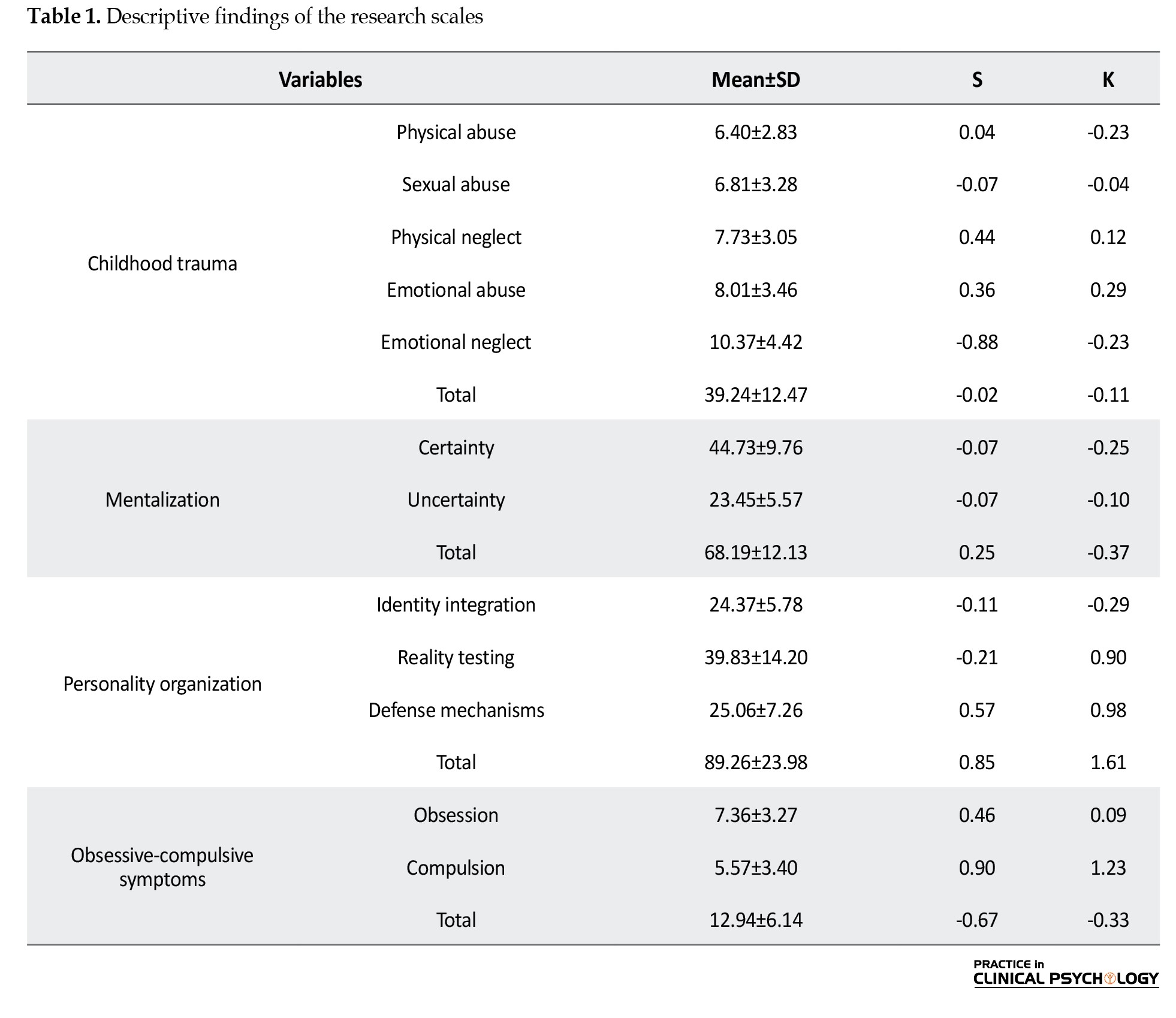
The study included 260 students (52% female, 48% male), predominantly aged 18-30 years (76.5%). Most participants were undergraduates (58.5%) and single (77.3%). Assumptions of normality, multicollinearity, and residual independence were met. Descriptive statistics, including skewness and kurtosis, presented in Table 1, indicated approximate normality, as none of the indicator values fell outside the (2, 2) range.
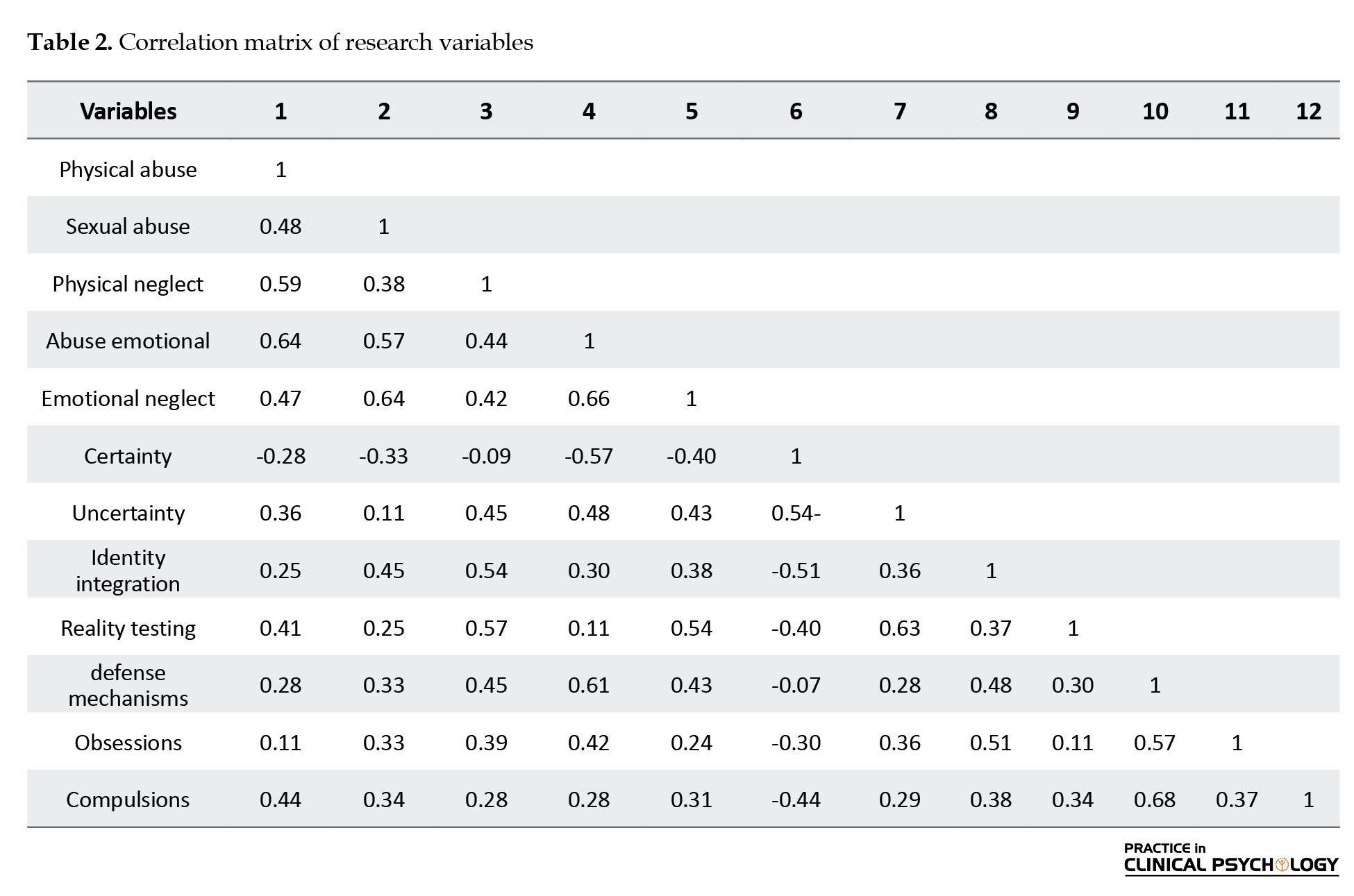
The data distribution meets the assumption of multivariate normality, as indicated by Mardia’s kurtosis coefficient of 3.14 (below the threshold of 5). Multicollinearity among independent variables was also assessed using the tolerance index and VIF; tolerance values above 0.1 and VIF values below 10 confirmed no multicollinearity. Furthermore, Pearson’s correlation coefficient (Table 2) showed significant relationships among all variables at a significance level below 5%.
Structural equation model
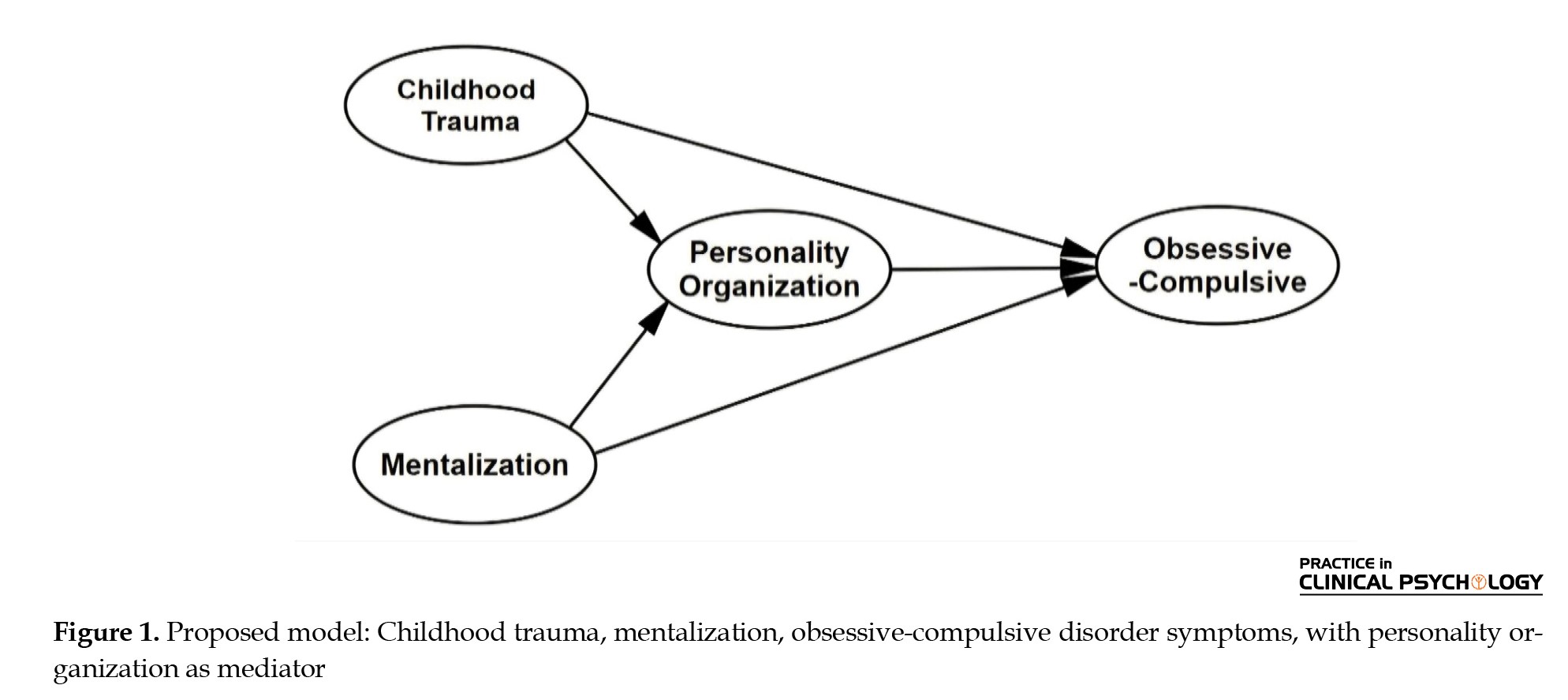
The conceptual model of the study is presented in Figure 1.
Obsessive-compulsive symptoms are among the significant problems that cause considerable impairment in many aspects of individual and social life, including work, education, and emotional relationships, and also lead to relatively severe psychological distress (Mahjani et al., 2021). These symptoms include persistent, distressing, and time-consuming obsessions and compulsions. Obsessions consist of unwanted and intrusive thoughts, images, or impulses that create anxiety and discomfort, while compulsions are repetitive behaviors or mental rituals performed to reduce this distress. Although these actions temporarily alleviate anxiety, they ultimately reinforce the harmful cycle of symptoms over time (Mahjani et al., 2021).
To understand the factors that contribute to the development and maintenance of obsessive-compulsive symptoms, researchers have examined early life experiences and their impact on developmental pathways. Among these, the most important factors that have garnered considerable attention in recent years are childhood traumatic experiences. Many researchers believe that childhood difficulties, problematic parent-child relationships, and adverse or abusive early experiences lay the foundation for later behavioral, psychological, and personality problems (Lyons et al., 2019).
Such unpleasant childhood experiences are associated with numerous physical and mental health disorders, abnormal behaviors, and unhealthy lifestyles in adulthood (Beutel et al., 2017). Trauma refers to actions or omissions that negatively affect health, life, and normal development (Taşören, 2023). Recent evidence suggests that childhood trauma is not only associated with the severity of obsessive-compulsive symptoms but may also operate through specific psychological mechanisms such as impaired mentalization (De Rossi et al., 2024).
In addition to traumatic experiences, an individual’s ability to understand their own and others’ mental states—referred to as mentalization—also plays an important role in the onset and severity of obsessive-compulsive symptoms. Mentalization refers to the capacity to understand and interpret one’s own and others’ intentions, emotional experiences, and psychological states; this capacity is closely linked to empathy and insight into one’s internal processes. This capacity develops through early interactions with primary caregivers, and disruptions in the child-caregiver relationship can hinder its development (Robinson et al., 2018). Research has shown that individuals with obsessive-compulsive symptoms often exhibit deficits in mentalization. Those who demonstrate more severe mentalization deficits typically show lower levels of empathy and insight into their condition, are less likely to seek treatment, and exhibit poorer responses to therapeutic interventions (Kang et al., 2012). Furthermore, deficits in mentalization are closely associated with personality pathology, as impairments in self-other understanding contribute to maladaptive identity formation and immature defensive patterns (Jańczak et al., 2025).
However, the question arises as to why some individuals exhibit more severe symptoms despite experiencing trauma or having mentalization deficits. The answer may lie in the individual’s personality structure. In the present study, we examined personality organization as a mediating variable. Otto Kernberg introduced the term personality organization, which refers to the overall structure and functioning of personality, comprising three main components: identity integration (a coherent sense of self), reality testing (the ability to distinguish between self and others and to perceive reality accurately), and defense mechanisms (unconscious strategies for coping with anxiety) (Kernberg & Caligor, 2005). This construct lies on a continuum from health to severe pathology. It can be assessed either dimensionally (the degree of personality vulnerability) or categorically (neurotic, borderline, or psychotic personality organization) (Bodó et al., 2024).
The theoretical rationale for the mediating role of personality organization in the relationship between childhood trauma and obsessive-compulsive symptoms rests on the assumption that traumatic experiences during childhood can fundamentally alter the developmental trajectory of personality. Such experiences, by disrupting the formation of an integrated identity and weakening adaptive defense mechanisms, lay the groundwork for a disorganized and vulnerable personality organization (De Rossi et al., 2024).
On the other hand, when an individual’s mentalization capacity is reduced, they struggle to understand and manage their own and others’ thoughts, feelings, and motives. This difficulty, in turn, can lead to maladaptive personality patterns, such as problems with emotion regulation, unstable identity formation, and disturbed interpersonal relationships (Jańczak et al., 2025). Research has shown that mentalization and personality organization share considerable conceptual and operational overlap. Individuals with a disorganized personality organization typically exhibit high levels of intolerance of uncertainty, feel a strong need to control their environment, and resort to rigid, repetitive (compulsive) behaviors as a compensatory strategy to reduce their anxiety. In other words, personality organization can serve as a bridging mechanism that channels the impact of childhood trauma and mentalization deficits toward obsessive-compulsive symptoms (De Rossi et al., 2024; Jańczak et al., 2025). A review of the existing research reveals that findings regarding the relationships between trauma, mentalization, and obsessive-compulsive symptoms are sometimes contradictory or limited. Many unaccounted-for variables appear to play a role in this relationship, one of the most important of which is personality organization. However, a few studies have simultaneously examined the role of these three variables together. To our knowledge, no previous study has tested personality organization as a mediator between both childhood trauma and mentalization with obsessive-compulsive disorder (OCD) symptoms in a single structural model using a non‑clinical student sample. The present study extends prior correlational findings by proposing a theory‑driven mediation framework. Therefore, the present study aimed to propose a structural model of the relationships between childhood trauma, mentalization, and obsessive-compulsive symptoms, with personality organization as a mediating variable, in a sample of university students.
Materials and Methods
This study employed a descriptive-correlational design using structural equation modeling (SEM). The statistical population consisted of all students enrolled at Imam Khomeini International University in Qazvin City, Iran, during the 2023–2024 academic year. The target sample size was determined based on the rule of thumb, which recommends at least 200 participants for SEM. Therefore, 260 students were recruited. We used cluster random sampling. We randomly selected five faculties (Social Sciences, Humanities, Basic Sciences, Engineering and Technology, and Islamic Research), then randomly chose 2 classes from each faculty. Within each selected class, the first author briefly explained the study aims and invited all students to participate. We distributed questionnaires during regular class sessions, and students completed them anonymously. Psychiatric history was not formally assessed; however, participants were asked whether they had ever received a psychiatric diagnosis. Those who reported a diagnosis of psychotic disorder were excluded (n=3). This study used a non‑clinical student sample. Therefore, the findings are primarily generalizable to university students with varying levels of OCD symptoms rather than to clinical populations diagnosed with obsessive‑compulsive disorder. The discussion section further addresses this limitation.
Study measures
Yale-brown obsessive-compulsive scale
The Yale-brown obsessive-compulsive scale (Y-BOCS) was developed by Goodman et al. (1989) to assess the severity of obsessive-compulsive symptoms. The scale comprises 10 items, with the first five assessing the severity of obsessions and the remaining five assessing the severity of compulsions. Each item is scored on a 5-point scale ranging from 0 to 4, yielding a total score ranging from 0 to 40. The psychometric properties of the Persian version were evaluated by Esfahani et al. (2012). They reported cronbach’s α coefficients of 0.97 for the symptom checklist and 0.95 for the severity scale, split-half reliability coefficients of 0.93 and 0.89, respectively, and a test–re-test reliability coefficient of 0.99. In the present study, a self-report version of the Y-BOCS was used. Cronbach’s α was 0.85 for the total score, 0.78 for the obsession subscale, and 0.88 for the compulsion subscale.
Childhood trauma questionnaire-short form
The childhood trauma questionnaire–short form (CTQ-SF) was developed by Bernstein et al. (2003) to assess childhood maltreatment. The instrument consists of 28 items, including 25 items measuring five dimensions of childhood maltreatment: emotional abuse, physical abuse, sexual abuse, emotional neglect, and physical neglect, and three items assessing minimization and denial. Each maltreatment subscale comprises five items rated on a 5-point Likert scale. The original version demonstrated satisfactory internal consistency, with cronbach’s alpha coefficients ranging from 0.61 to 0.95 across the subscales. In Iran, the psychometric properties of the Persian version of the childhood trauma questionnaire were examined by Garrusi and Nakhaee (2009). In the present study, Cronbach’s α was 0.87 for the total score, with subscale coefficients ranging from 0.77 to 0.89.
Reflective functioning questionnaire
The reflective functioning questionnaire (RFQ) was developed by Fonagy et al. (2016) to assess individuals’ ability to understand mental states in themselves and others. It evaluates two dimensions: certainty about mental states and uncertainty about mental states. Items are rated on a 7-point Likert scale. The Persian translation of the RFQ was evaluated by Seyed Mousavi et al. (2021) in a sample of Iranian adolescents, and the findings supported its two-factor structure and construct validity. In the present study, cronbach’s α coefficients were 0.89 for the total score, 0.90 for certainty about mental states, and 0.85 for uncertainty about mental states.
Kernberg’s personality organization questionnaire
Kernberg’s inventory of personality organization (IPO) questionnaire was developed by Kernberg (2002) and assesses personality organization using 37 closed-ended items on a 5-point Likert scale (Kernberg & Caligor, 2005). It measures three subscales: Identity integration, reality testing, and defense mechanisms. In Iran, Al Behebahani and Mohammadi (2007) validated the questionnaire. They reported Cronbach α coefficients of 0.90, 0.82, and 0.86 for the subscales, with satisfactory correlations between the subscales and the total score (0.45 to 0.75). In the current study, the overall Cronbach α for the questionnaire was 0.95, with subscale alphas of 0.89 (primitive defenses), 0.85 (identity integration), and 0.91 (reality testing).
Measurement model evaluation
Before testing the structural model, we conducted a confirmatory factor analysis (CFA) to evaluate the measurement model. For childhood trauma, 5 subscale scores (physical abuse, sexual abuse, emotional abuse, physical neglect, and emotional neglect) served as indicators. For mentalization, 2 subscale scores (certainty and uncertainty) were used. For personality organization, we used 3 subscale scores (identity integration, reality testing, and defense mechanisms). For obsessive-compulsive symptoms, 2 subscale scores (obsessions and compulsions) were used.
Standardized factor loadings for all indicators ranged from 0.62 to 0.84 (all P<0.001). Composite reliability (CR) for each latent variable ranged from 0.81 to 0.91, exceeding the recommended threshold of 0.70. Average variance extracted (AVE) ranged from 0.53 to 0.71, exceeding the recommended threshold of 0.50. These values indicate adequate convergent validity. No multivariate outliers were identified based on Mahalanobis distance (critical χ² at P<0.001).
Results
The study included 260 students (52% female, 48% male), predominantly aged 18-30 years (76.5%). Most participants were undergraduates (58.5%) and single (77.3%). Assumptions of normality, multicollinearity, and residual independence were met. Descriptive statistics, including skewness and kurtosis, presented in Table 1, indicated approximate normality, as none of the indicator values fell outside the (2, 2) range.
The data distribution meets the assumption of multivariate normality, as indicated by Mardia’s kurtosis coefficient of 3.14 (below the threshold of 5). Multicollinearity among independent variables was also assessed using the tolerance index and VIF; tolerance values above 0.1 and VIF values below 10 confirmed no multicollinearity. Furthermore, Pearson’s correlation coefficient (Table 2) showed significant relationships among all variables at a significance level below 5%.
Structural equation model
The conceptual model of the study is presented in Figure 1.
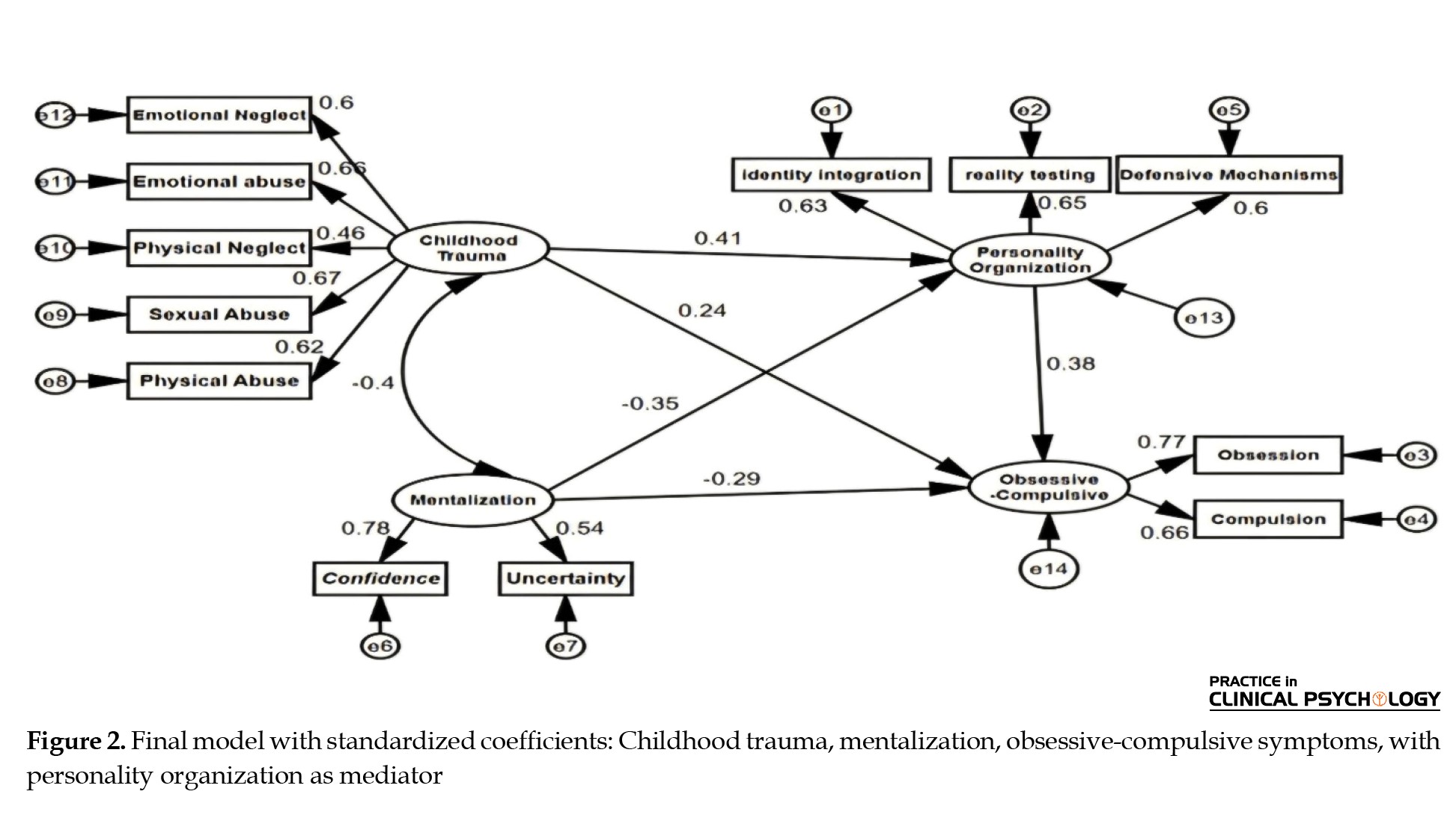
In this section, the proposed model was fitted using SEM. Data were analyzed using SPSS software, version 26, and AMOS software, version 24. Figure 2 shows the final model output from AMOS software, version 24.
We analyzed fit indices to evaluate model fit. Table 3 presents the fit indices for the research model. The results showed that the final research model fit adequately.
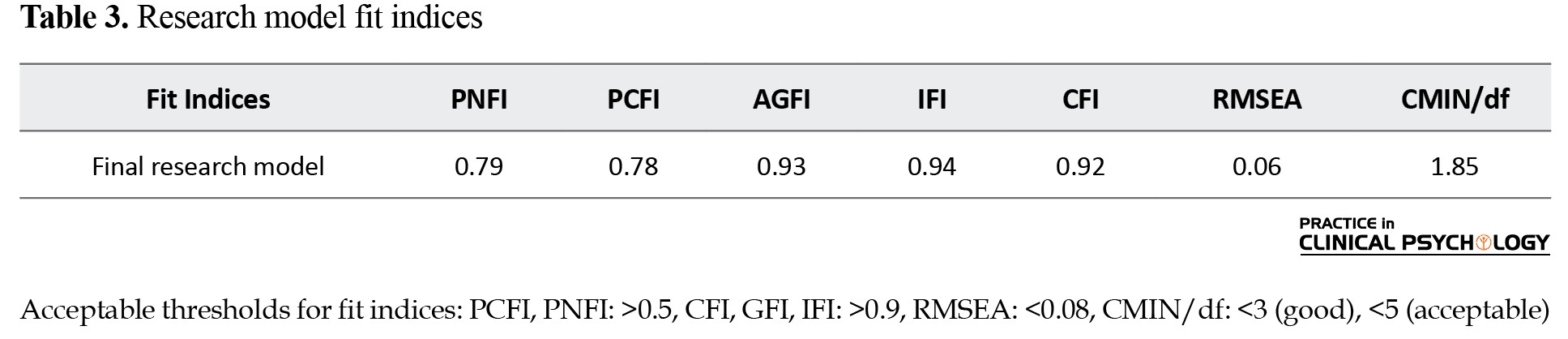
Model fit
The SEM results (Table 4) indicate significant relationships between variables at a 0.05 significance level (CR>1.97).
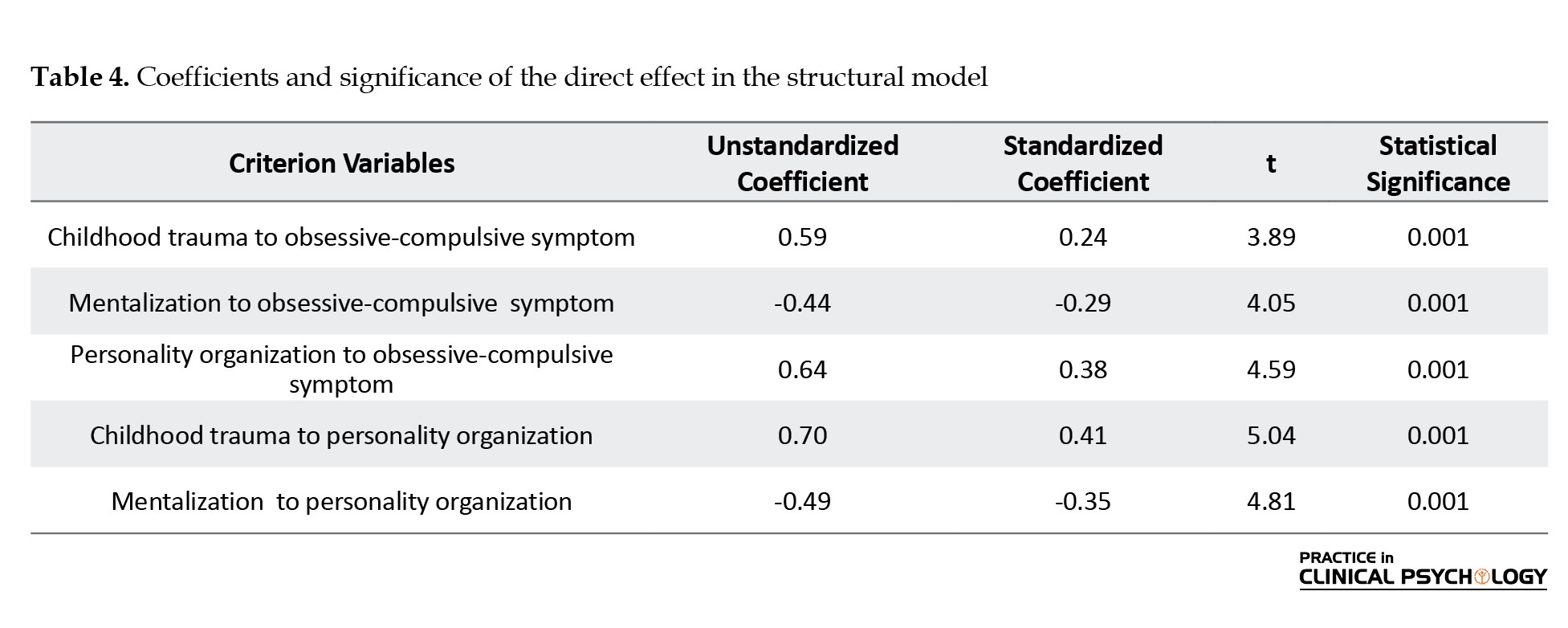
Specifically, childhood trauma positively and significantly relates to obsessive-compulsive symptoms (coefficient=0.24, CR=3.89) and personality organization (coefficient=0.41, CR=5.04). Mentalization has a negative and significant relationship with obsessive-compulsive symptoms (coefficient=-0.29, CR=4.05) and personality organization (coefficient=-0.35, CR=4.81). Personality organization also shows a positive and significant association with obsessive-compulsive symptoms (coefficient=0.38, CR=4.59).
The mediating role of the personality organization variable
Based on the results of the bootstrap analysis (Table 5), the “personality organization” variable acts as a mediating variable in the relationship between “childhood trauma” and “obsessive-compulsive symptoms,” with the confidence interval (CI) (95%) for this relationship ranging between 0.10 and 0.29.
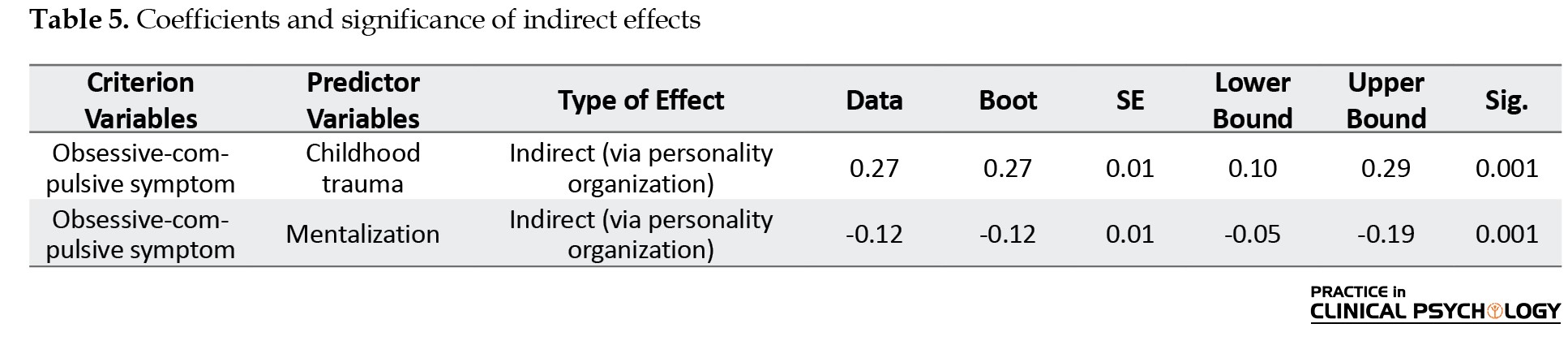
Furthermore, this variable also plays a mediating role in the relationship between “mentalization” and “obsessive-compulsive symptoms,” with the CI for this path being between -0.05 and -0.19. A total of 2000 bootstrap samples were used. Because zero falls outside the CI in both pathways and P<0.05, the “personality organization” variable plays a significant mediating role in these relationships.
Discussion
The present study examined the relationships between childhood trauma, mentalization, and obsessive-compulsive symptoms, with particular emphasis on the mediating role of personality organization. The findings demonstrated significant associations among these constructs and provided preliminary evidence for understanding obsessive-compulsive symptoms within a developmental and personality-based framework. The findings indicated that childhood traumatic experiences were significantly associated with the severity of obsessive-compulsive symptoms. This finding is consistent with studies by Beutel et al. (2017), Taşören et al. (2023), Kroska et al. (2018), and Destree et al. (2021). Individuals who reported greater exposure to childhood trauma also tended to report higher levels of obsessive-compulsive symptoms. Previous studies suggest that childhood trauma may be associated with maladaptive cognitive processes, increased rumination, emotional dysregulation, and experiential avoidance, all of which have been linked to obsessive-compulsive symptom severity. Shirkhani et al. (2022) suggested that traumatic childhood experiences may be associated with reduced emotional regulation capacities and maladaptive cognitive patterns. Therefore, experiential avoidance and diminished emotional regulation capacities may represent potential mechanisms underlying the observed associations. However, given the cross-sectional nature of the present study, these interpretations should be considered cautiously and do not imply causal relationships. Based on the present findings, this may be explained by the fact that adverse childhood experiences may be associated with difficulties in coping with emotional experiences and psychological distress. Consequently, individuals reporting greater childhood trauma may also experience higher levels of obsessive–compulsive symptoms.
The findings also demonstrated a significant association between mentalization and obsessive-compulsive symptoms. This finding is consistent with previous findings by Robinson et al. (2019), Pino et al. (2015), and Sloover et al. (2022). Mentalization refers to the capacity to understand and interpret one’s own and others’ mental states, including emotions, beliefs, intentions, and motivations. Lower levels of mentalization were associated with greater obsessive-compulsive symptom severity, suggesting that difficulties in emotional understanding and interpersonal processing may be related to symptom expression. Previous studies conducted by Pino et al. (2016) and Sloover et al. (2022) suggest that impairments in reflective functioning may be associated with emotional distress, maladaptive coping strategies, and difficulties in managing uncertainty, all of which are frequently observed in individuals with OCD symptoms.
Nevertheless, because all variables were measured simultaneously, the findings should be interpreted as associations rather than directional effects. Based on these findings, difficulties in understanding and interpreting mental states may be associated with challenges in processing emotional experiences. Such difficulties may coexist with greater obsessive-compulsive symptom severity.
The present findings further indicated a significant relationship between personality organization and obsessive–compulsive symptoms. This finding is consistent with previous literature emphasizing the role of structural personality functioning in psychopathology, as reported by Giynaş et al. (2019) and Kernberg et al. (2005). In the current study, personality organization was conceptualized within Kernberg’s framework as a dimensional construct reflecting identity integration, defensive functioning, and reality-testing capacities. Individuals with lower levels of adaptive personality organization tended to report greater obsessive–compulsive symptom severity. Disturbances in identity integration, reliance on immature defense mechanisms, and impairments in structural functioning may therefore be associated with symptom severity. However, given the reliance on self-report measures and the use of a non-clinical sample, interpret these findings cautiously. These findings may reflect that difficulties in identity integration and adaptive functioning accompany lower levels of personality organization. These characteristics may coexist with greater severity of obsessive-compulsive symptoms.
The results also demonstrated a significant association between childhood trauma and personality organization. This finding is consistent with Fullana et al. (2009), suggesting that adverse childhood experiences may relate to disruptions in identity development, interpersonal functioning, and emotional regulation capacities. Participants reporting greater childhood trauma tended to demonstrate lower levels of adaptive personality organization. Early adverse experiences may influence the development of internal representations of self and others, which could subsequently be associated with personality functioning. Nevertheless, because childhood trauma and personality organization were assessed concurrently, conclusions regarding developmental pathways cannot be drawn from the present findings. Based on the present findings, this may be explained by the fact that adverse developmental experiences may be associated with variations in structural personality functioning. Individuals with greater childhood trauma may therefore report lower levels of adaptive personality organization.
Similarly, mentalization was significantly associated with personality organization. This finding is consistent with previous studies conducted by Atanassov and Savov (2016) and Ensink et al. (2017). Participants with stronger mentalization capacities tended to demonstrate healthier personality organization. This finding may reflect the shared developmental origins of these constructs, as both mentalization and personality organization are thought to emerge through early attachment relationships and caregiver-child interactions. Accordingly, the observed relationship may indicate overlapping developmental processes rather than directional influences. Based on the present findings, this may be explained by the fact that both mentalization and personality organization involve understanding internal experiences and interpersonal functioning. Therefore, stronger reflective capacities may be associated with healthier personality functioning.
Regarding indirect pathways, the findings suggested that personality organization statistically accounted for part of the association between childhood trauma and obsessive–compulsive symptoms. To the best of the authors’ knowledge, limited research has directly examined this pathway. Although the mediation findings provide preliminary support for the relevance of personality organization, mediation analyses based on cross-sectional data do not establish temporal sequencing or causal mechanisms. Therefore, personality organization should be viewed as a potential explanatory construct rather than a confirmed developmental mechanism linking childhood trauma and obsessive-compulsive symptoms. Based on the present findings, this may be explained by the fact that personality organization may statistically account for part of the association between childhood trauma and obsessive-compulsive symptoms. However, this interpretation should be considered preliminary given the study design.
Likewise, personality organization statistically accounted for part of the relationship between mentalization and obsessive-compulsive symptoms. Although direct empirical evidence regarding this pathway remains limited, the findings suggest that structural personality functioning may represent an important factor when examining the relationship between reflective capacities and obsessive-compulsive symptom severity. Additional longitudinal and replication studies are needed before stronger conclusions regarding this pathway can be established.
Conclusion
Overall, the findings suggest that childhood trauma, mentalization, and personality organization are meaningfully associated with obsessive-compulsive symptoms within a non-clinical student population. These findings contribute to the literature by integrating developmental, personality-based, and relational perspectives into a unified conceptual framework. However, because the study was conducted using a non-clinical sample, caution should be exercised when extending these findings to individuals with diagnosed OCD. Based on the present findings, this may be explained by the fact that personality organization may represent one aspect through which reflective capacities are associated with symptom severity. Nevertheless, further studies are required to clarify this relationship.
Several limitations should be acknowledged. First, the cross-sectional design restricts conclusions regarding temporal ordering and causal relationships among variables. Second, all constructs were assessed using self-report questionnaires, increasing the possibility of common method variance, shared variance inflation, and response biases. Third, the use of a non-clinical student sample limits the generalizability of findings to clinical populations with diagnosed obsessive-compulsive disorder. Finally, lengthy questionnaires may have affected participant engagement and response accuracy.
Future studies should employ longitudinal designs, multimethod assessment approaches, and clinical samples to clarify developmental pathways and improve external validity. Furthermore, integrating clinician-rated assessments and observational measures may provide a more comprehensive understanding of the relationships identified in the present study. In conclusion, the present findings suggest that childhood trauma, mentalization, and personality organization are significantly associated with obsessive-compulsive symptoms and may collectively contribute to understanding individual differences in symptom severity. Although additional research is required to clarify causal mechanisms, the findings highlight the importance of considering developmental experiences, reflective functioning, and structural personality characteristics when examining obsessive-compulsive symptoms.
Ethical Considerations
Compliance with ethical guidelines
This study was approved by the Ethics Committee of Qazvin University of Medical Sciences, Qazvin, Iran (Code: IR.QUMS.REC.1403.310).
Funding
This research did not receive any grant from funding agencies in the public, commercial, or non-profit sectors.
Authors' contributions
Conceptualization, methodology, and validation: Seyedeh Soraya Seyed Abootalebi and Esmaeil Shiri; Software, formal analysis, writing the original draft, and visualization: Masoumeh Rahimpour; Investigation: Seyedeh Soraya Seyed Abootalebi, Ali Reza Kakavand, and Masoumeh Rahimpour; Resources, and supervision: Esmaeil Shiri and Ali Reza Kakavand; Data collection: Seyedeh Soraya Seyed Abootalebi; Review & editing: Seyedeh Soraya Seyed Abootalebi, Esmaeil Shiri, Ali Reza Kakavand, and Masoumeh Rahimpour; Project Administration: Esmaeil Shiri.
Conflict of interest
The authors declared no conflict of interest.
Acknowledgments
The authors thank the students of Imam Khomeini International University for their participation.
References
Al Behbahani, M., & Mohammadi, N. (2007). A study of the psychometric properties of Kernberg’s inventory of personality organization. Journal of Psychology, 11(2), 185–195. [Link]
Atanassov, N., & Savov, S. (2016). Mentalization and personality organization in heroin addicted patients: A narrative analysis. Language and Psychoanalysis, 5(1), 14-30. [DOI:10.7565/landp.v5i1.1552]
Bernstein, D. P., Stein, J. A., Newcomb, M. D., Walker, E., Pogge, D., & Ahluvalia, T., et al. (2003). Development and validation of a brief screening version of the Childhood Trauma Questionnaire. Child Abuse & Neglect, 27(2), 169-190. [DOI:10.1016/S0145-2134(02)00541-0] [PMID]
Beutel, M. E., Tibubos, A. N., Klein, E. M., Schmutzer, G., Reiner, I., & Kocalevent, R. D., et al. (2017). Childhood adversities and distress: The role of resilience in a representative sample. PLOS ONE, 12(3), e0173826. [DOI:10.1371/journal.pone.0173826] [PMID]
Bodó, V., Horváth, Z., Paksi, B., Eisinger, A., Felvinczi, K., & Demetrovics, Z., et al. (2024). Work addiction and personality organization: Results from a representative, three-wave longitudinal study. Comprehensive Psychiatry, 134, 152513. [DOI:10.1016/j.comppsych.2024.152513] [PMID]
De Rossi, E., Imperatori, C., Sciancalepore, F., Prevete, E., Maraone, A., & Canevelli, M., et al. (2024). Childhood trauma, mentalization, and obsessive-compulsive symptoms in a non-clinical sample: A mediation analysis study. Clinical Neuropsychiatry, 21(3), 195-203. [Link]
Destree, L., Brierley, M. E., Albertella, L., Jobson, L., & Fontenelle, L. F. (2021). The effect of childhood trauma on the severity of obsessive-compulsive symptoms: A systematic review. Journal of Psychiatric Research, 142, 345-360. [DOI:10.1016/j.jpsychires.2021.08.017] [PMID]
Ensink, K., Bégin, M., Normandin, L., Godbout, N., & Fonagy, P. (2017). Mentalization and dissociation in the context of trauma: Implications for child psychopathology. Journal of Trauma & Dissociation, 18(1), 11-30. [DOI:10.1080/15299732.2016.1172536] [PMID]
Esfahani, S. R., Motaghipour, Y., Kamkari, K., Zahiredin, A., & Janbozorgi, M. (2012). Reliability and validity of the persian version of the yale-brown obsessive-compulsive scale (Y-BOCS). Iranian Journal of Psychiatry and Clinical Psychology, 17(4), 297–303. [Link]
Fonagy, P., Luyten, P., & Allison, E. (2015). Epistemic petrification and the restoration of epistemic trust: A new conceptualization of borderline personality disorder and its psychosocial treatment. Journal of Personality Disorders, 29(5), 575-609. [DOI:10.1521/pedi.2015.29.5.575] [PMID]
Fullana, M. A., Mataix-Cols, D., Caspi, A., Harrington, H., Grisham, J. R., & Moffitt, T. E., et al. (2009). Obsessions and compulsions in the community: Prevalence, interference, help-seeking, developmental stability, and co-occurring psychiatric conditions. The American Journal of Psychiatry, 166(3), 329–336. [DOI:10.1176/appi.ajp.2008.08071006] [PMID]
Garrusi, B., & Nakhaee, N. (2009). Validity and reliability of a Persian version of the Childhood Trauma Questionnaire. Psychological Reports, 104(2), 509-516. [DOI:10.2466/PR0.104.2.509-516]
Giynaş, F. F., Güleç, M. Y., Kızılkurt, Ö. K., Yılmaz, Y., Çıtak, S., & Güleç, H. (2019). Personality organization in patients with obsessive-compulsive disorder and its relationship with functionality. Anadolu Psikiyatri Dergisi, 20(1), 38–46. [DOI:10.5455/apd.300344]
Goodman, W. K., Price, L. H., Rasmussen, S. A., Mazure, C., Fleischmann, R. L., Hill, C. L., et al. (1989). The yale-brown obsessive compulsive scale: I. Development, use, and reliability. Archives of General Psychiatry, 46(11), 1006-11. [Link]
Jańczak, M. O., Górska, D., Jurek, P., & Taubner, S. (2025). Self-other mentalizing and attachment insecurity in the dimensional model of personality disorders: From research to clinical practice. Clinical Psychology & Psychotherapy, 32(6), e70172. [DOI:10.1002/cpp.70172] [PMID]
Kang, J. I., Namkoong, K., Yoo, S. W., Jhung, K., & Kim, S. J. (2012). Abnormalities of emotional awareness and perception in patients with obsessive-compulsive disorder. Journal of Affective Disorders, 141(2-3), 286-293. [DOI:10.1016/j.jad.2012.04.001] [PMID]
Kernberg, O. F., & Caligor, E. (2005). A psychoanalytic theory of personality disorders. In M. F. Lenzenweger & J. F. Clarkin (Eds.), Major theories of personality disorder ( pp. 114-156). New York: Guilford Press. [Link]
Kroska, E. B., Miller, M. L., Roche, A. I., Kroska, S. K., & O'Hara, M. W. (2018). Effects of traumatic experiences on obsessive-compulsive and internalizing symptoms: The role of avoidance and mindfulness. Journal of Affective Disorders, 225, 326–336. [DOI:10.1016/j.jad.2017.08.039] [PMID]
Lyons, M., Evans, K., & Helle, S. (2019). Do “dark” personality features buffer against adversity? The associations between cumulative life stress, the dark triad, and mental distress. SAGE Open, 9(1), 2158244018822383. [DOI:10.1177/2158244018822383]
Mahjani, B., Bey, K., Boberg, J., & Burton, C. (2021). Genetics of obsessive-compulsive disorder. Psychological Medicine, 51(13), 2247-2259. [DOI:10.1017/S0033291721001744] [PMID]
Pino, M. C., De Berardis, D., Mariano, M., Vellante, F., Serroni, N., & Valchera, A., et al. (2016). Two systems for empathy in obsessive-compulsive disorder: Mentalizing and experience sharing. Revista Brasileira de Psiquiatria, 38(4), 307-313. [DOI:10.1590/1516-4446-2015-1679] [PMID]
Robinson, P., Skårderud, F., & Sommerfeldt, B. (2018). Hunger: Mentalization-based treatments for eating disorders. Berlin: Springer. [Link]
Seyed Mousavi, P. S., Vahidi, E., Ghanbari, S., Khoshroo, S., & Sakkaki, S. Z. (2021). Reflective functioning questionnaire (RFQ): Psychometric properties of the Persian translation and exploration of its mediating role in the relationship between attachment to parents and internalizing and externalizing problems in adolescents. Journal of Infant, Child, and Adolescent Psychotherapy, 20(3), 313-330. [DOI:10.1080/15289168.2021.1945721]
Shirkhani, M., Aghamohammadian Sharbaf, H., & Moeenizadeh, M. (2022). [Predicting the severity of obsessive-compulsive symptoms based on traumatic childhood experiences: The mediating role of shame (Persian)]. Rooyesh-e-Ravanshenasi Journal, 11(4), 39-48. [Link]
Sloover, M., van Est, L. A. C., Janssen, P. G. J., Hilbink, M., & van Ee, E. (2022). A meta-analysis of mentalizing in anxiety disorders, obsessive-compulsive and related disorders, and trauma- and stressor-related disorders. Journal of Anxiety Disorders, 92, 102641. [DOI:10.1016/j.janxdis.2022.102641] [PMID]
Tabachnick, B. G., & Fidell, L. S. (2007). Using multivariate statistics (5th ed.). Boston: Allyn & Bacon/Pearson Education. [Link]
Taşören, A. B. (2022). Childhood maltreatment and emotional distress: The role of beliefs about emotion and psychological inflexibility. Current Psychology (New Brunswick, N.J.), 42, 13276–13287. [DOI:10.1007/s12144-021-02594-7] [PMID]
Model fit
The SEM results (Table 4) indicate significant relationships between variables at a 0.05 significance level (CR>1.97).
Specifically, childhood trauma positively and significantly relates to obsessive-compulsive symptoms (coefficient=0.24, CR=3.89) and personality organization (coefficient=0.41, CR=5.04). Mentalization has a negative and significant relationship with obsessive-compulsive symptoms (coefficient=-0.29, CR=4.05) and personality organization (coefficient=-0.35, CR=4.81). Personality organization also shows a positive and significant association with obsessive-compulsive symptoms (coefficient=0.38, CR=4.59).
The mediating role of the personality organization variable
Based on the results of the bootstrap analysis (Table 5), the “personality organization” variable acts as a mediating variable in the relationship between “childhood trauma” and “obsessive-compulsive symptoms,” with the confidence interval (CI) (95%) for this relationship ranging between 0.10 and 0.29.
Furthermore, this variable also plays a mediating role in the relationship between “mentalization” and “obsessive-compulsive symptoms,” with the CI for this path being between -0.05 and -0.19. A total of 2000 bootstrap samples were used. Because zero falls outside the CI in both pathways and P<0.05, the “personality organization” variable plays a significant mediating role in these relationships.
Discussion
The present study examined the relationships between childhood trauma, mentalization, and obsessive-compulsive symptoms, with particular emphasis on the mediating role of personality organization. The findings demonstrated significant associations among these constructs and provided preliminary evidence for understanding obsessive-compulsive symptoms within a developmental and personality-based framework. The findings indicated that childhood traumatic experiences were significantly associated with the severity of obsessive-compulsive symptoms. This finding is consistent with studies by Beutel et al. (2017), Taşören et al. (2023), Kroska et al. (2018), and Destree et al. (2021). Individuals who reported greater exposure to childhood trauma also tended to report higher levels of obsessive-compulsive symptoms. Previous studies suggest that childhood trauma may be associated with maladaptive cognitive processes, increased rumination, emotional dysregulation, and experiential avoidance, all of which have been linked to obsessive-compulsive symptom severity. Shirkhani et al. (2022) suggested that traumatic childhood experiences may be associated with reduced emotional regulation capacities and maladaptive cognitive patterns. Therefore, experiential avoidance and diminished emotional regulation capacities may represent potential mechanisms underlying the observed associations. However, given the cross-sectional nature of the present study, these interpretations should be considered cautiously and do not imply causal relationships. Based on the present findings, this may be explained by the fact that adverse childhood experiences may be associated with difficulties in coping with emotional experiences and psychological distress. Consequently, individuals reporting greater childhood trauma may also experience higher levels of obsessive–compulsive symptoms.
The findings also demonstrated a significant association between mentalization and obsessive-compulsive symptoms. This finding is consistent with previous findings by Robinson et al. (2019), Pino et al. (2015), and Sloover et al. (2022). Mentalization refers to the capacity to understand and interpret one’s own and others’ mental states, including emotions, beliefs, intentions, and motivations. Lower levels of mentalization were associated with greater obsessive-compulsive symptom severity, suggesting that difficulties in emotional understanding and interpersonal processing may be related to symptom expression. Previous studies conducted by Pino et al. (2016) and Sloover et al. (2022) suggest that impairments in reflective functioning may be associated with emotional distress, maladaptive coping strategies, and difficulties in managing uncertainty, all of which are frequently observed in individuals with OCD symptoms.
Nevertheless, because all variables were measured simultaneously, the findings should be interpreted as associations rather than directional effects. Based on these findings, difficulties in understanding and interpreting mental states may be associated with challenges in processing emotional experiences. Such difficulties may coexist with greater obsessive-compulsive symptom severity.
The present findings further indicated a significant relationship between personality organization and obsessive–compulsive symptoms. This finding is consistent with previous literature emphasizing the role of structural personality functioning in psychopathology, as reported by Giynaş et al. (2019) and Kernberg et al. (2005). In the current study, personality organization was conceptualized within Kernberg’s framework as a dimensional construct reflecting identity integration, defensive functioning, and reality-testing capacities. Individuals with lower levels of adaptive personality organization tended to report greater obsessive–compulsive symptom severity. Disturbances in identity integration, reliance on immature defense mechanisms, and impairments in structural functioning may therefore be associated with symptom severity. However, given the reliance on self-report measures and the use of a non-clinical sample, interpret these findings cautiously. These findings may reflect that difficulties in identity integration and adaptive functioning accompany lower levels of personality organization. These characteristics may coexist with greater severity of obsessive-compulsive symptoms.
The results also demonstrated a significant association between childhood trauma and personality organization. This finding is consistent with Fullana et al. (2009), suggesting that adverse childhood experiences may relate to disruptions in identity development, interpersonal functioning, and emotional regulation capacities. Participants reporting greater childhood trauma tended to demonstrate lower levels of adaptive personality organization. Early adverse experiences may influence the development of internal representations of self and others, which could subsequently be associated with personality functioning. Nevertheless, because childhood trauma and personality organization were assessed concurrently, conclusions regarding developmental pathways cannot be drawn from the present findings. Based on the present findings, this may be explained by the fact that adverse developmental experiences may be associated with variations in structural personality functioning. Individuals with greater childhood trauma may therefore report lower levels of adaptive personality organization.
Similarly, mentalization was significantly associated with personality organization. This finding is consistent with previous studies conducted by Atanassov and Savov (2016) and Ensink et al. (2017). Participants with stronger mentalization capacities tended to demonstrate healthier personality organization. This finding may reflect the shared developmental origins of these constructs, as both mentalization and personality organization are thought to emerge through early attachment relationships and caregiver-child interactions. Accordingly, the observed relationship may indicate overlapping developmental processes rather than directional influences. Based on the present findings, this may be explained by the fact that both mentalization and personality organization involve understanding internal experiences and interpersonal functioning. Therefore, stronger reflective capacities may be associated with healthier personality functioning.
Regarding indirect pathways, the findings suggested that personality organization statistically accounted for part of the association between childhood trauma and obsessive–compulsive symptoms. To the best of the authors’ knowledge, limited research has directly examined this pathway. Although the mediation findings provide preliminary support for the relevance of personality organization, mediation analyses based on cross-sectional data do not establish temporal sequencing or causal mechanisms. Therefore, personality organization should be viewed as a potential explanatory construct rather than a confirmed developmental mechanism linking childhood trauma and obsessive-compulsive symptoms. Based on the present findings, this may be explained by the fact that personality organization may statistically account for part of the association between childhood trauma and obsessive-compulsive symptoms. However, this interpretation should be considered preliminary given the study design.
Likewise, personality organization statistically accounted for part of the relationship between mentalization and obsessive-compulsive symptoms. Although direct empirical evidence regarding this pathway remains limited, the findings suggest that structural personality functioning may represent an important factor when examining the relationship between reflective capacities and obsessive-compulsive symptom severity. Additional longitudinal and replication studies are needed before stronger conclusions regarding this pathway can be established.
Conclusion
Overall, the findings suggest that childhood trauma, mentalization, and personality organization are meaningfully associated with obsessive-compulsive symptoms within a non-clinical student population. These findings contribute to the literature by integrating developmental, personality-based, and relational perspectives into a unified conceptual framework. However, because the study was conducted using a non-clinical sample, caution should be exercised when extending these findings to individuals with diagnosed OCD. Based on the present findings, this may be explained by the fact that personality organization may represent one aspect through which reflective capacities are associated with symptom severity. Nevertheless, further studies are required to clarify this relationship.
Several limitations should be acknowledged. First, the cross-sectional design restricts conclusions regarding temporal ordering and causal relationships among variables. Second, all constructs were assessed using self-report questionnaires, increasing the possibility of common method variance, shared variance inflation, and response biases. Third, the use of a non-clinical student sample limits the generalizability of findings to clinical populations with diagnosed obsessive-compulsive disorder. Finally, lengthy questionnaires may have affected participant engagement and response accuracy.
Future studies should employ longitudinal designs, multimethod assessment approaches, and clinical samples to clarify developmental pathways and improve external validity. Furthermore, integrating clinician-rated assessments and observational measures may provide a more comprehensive understanding of the relationships identified in the present study. In conclusion, the present findings suggest that childhood trauma, mentalization, and personality organization are significantly associated with obsessive-compulsive symptoms and may collectively contribute to understanding individual differences in symptom severity. Although additional research is required to clarify causal mechanisms, the findings highlight the importance of considering developmental experiences, reflective functioning, and structural personality characteristics when examining obsessive-compulsive symptoms.
Ethical Considerations
Compliance with ethical guidelines
This study was approved by the Ethics Committee of Qazvin University of Medical Sciences, Qazvin, Iran (Code: IR.QUMS.REC.1403.310).
Funding
This research did not receive any grant from funding agencies in the public, commercial, or non-profit sectors.
Authors' contributions
Conceptualization, methodology, and validation: Seyedeh Soraya Seyed Abootalebi and Esmaeil Shiri; Software, formal analysis, writing the original draft, and visualization: Masoumeh Rahimpour; Investigation: Seyedeh Soraya Seyed Abootalebi, Ali Reza Kakavand, and Masoumeh Rahimpour; Resources, and supervision: Esmaeil Shiri and Ali Reza Kakavand; Data collection: Seyedeh Soraya Seyed Abootalebi; Review & editing: Seyedeh Soraya Seyed Abootalebi, Esmaeil Shiri, Ali Reza Kakavand, and Masoumeh Rahimpour; Project Administration: Esmaeil Shiri.
Conflict of interest
The authors declared no conflict of interest.
Acknowledgments
The authors thank the students of Imam Khomeini International University for their participation.
References
Al Behbahani, M., & Mohammadi, N. (2007). A study of the psychometric properties of Kernberg’s inventory of personality organization. Journal of Psychology, 11(2), 185–195. [Link]
Atanassov, N., & Savov, S. (2016). Mentalization and personality organization in heroin addicted patients: A narrative analysis. Language and Psychoanalysis, 5(1), 14-30. [DOI:10.7565/landp.v5i1.1552]
Bernstein, D. P., Stein, J. A., Newcomb, M. D., Walker, E., Pogge, D., & Ahluvalia, T., et al. (2003). Development and validation of a brief screening version of the Childhood Trauma Questionnaire. Child Abuse & Neglect, 27(2), 169-190. [DOI:10.1016/S0145-2134(02)00541-0] [PMID]
Beutel, M. E., Tibubos, A. N., Klein, E. M., Schmutzer, G., Reiner, I., & Kocalevent, R. D., et al. (2017). Childhood adversities and distress: The role of resilience in a representative sample. PLOS ONE, 12(3), e0173826. [DOI:10.1371/journal.pone.0173826] [PMID]
Bodó, V., Horváth, Z., Paksi, B., Eisinger, A., Felvinczi, K., & Demetrovics, Z., et al. (2024). Work addiction and personality organization: Results from a representative, three-wave longitudinal study. Comprehensive Psychiatry, 134, 152513. [DOI:10.1016/j.comppsych.2024.152513] [PMID]
De Rossi, E., Imperatori, C., Sciancalepore, F., Prevete, E., Maraone, A., & Canevelli, M., et al. (2024). Childhood trauma, mentalization, and obsessive-compulsive symptoms in a non-clinical sample: A mediation analysis study. Clinical Neuropsychiatry, 21(3), 195-203. [Link]
Destree, L., Brierley, M. E., Albertella, L., Jobson, L., & Fontenelle, L. F. (2021). The effect of childhood trauma on the severity of obsessive-compulsive symptoms: A systematic review. Journal of Psychiatric Research, 142, 345-360. [DOI:10.1016/j.jpsychires.2021.08.017] [PMID]
Ensink, K., Bégin, M., Normandin, L., Godbout, N., & Fonagy, P. (2017). Mentalization and dissociation in the context of trauma: Implications for child psychopathology. Journal of Trauma & Dissociation, 18(1), 11-30. [DOI:10.1080/15299732.2016.1172536] [PMID]
Esfahani, S. R., Motaghipour, Y., Kamkari, K., Zahiredin, A., & Janbozorgi, M. (2012). Reliability and validity of the persian version of the yale-brown obsessive-compulsive scale (Y-BOCS). Iranian Journal of Psychiatry and Clinical Psychology, 17(4), 297–303. [Link]
Fonagy, P., Luyten, P., & Allison, E. (2015). Epistemic petrification and the restoration of epistemic trust: A new conceptualization of borderline personality disorder and its psychosocial treatment. Journal of Personality Disorders, 29(5), 575-609. [DOI:10.1521/pedi.2015.29.5.575] [PMID]
Fullana, M. A., Mataix-Cols, D., Caspi, A., Harrington, H., Grisham, J. R., & Moffitt, T. E., et al. (2009). Obsessions and compulsions in the community: Prevalence, interference, help-seeking, developmental stability, and co-occurring psychiatric conditions. The American Journal of Psychiatry, 166(3), 329–336. [DOI:10.1176/appi.ajp.2008.08071006] [PMID]
Garrusi, B., & Nakhaee, N. (2009). Validity and reliability of a Persian version of the Childhood Trauma Questionnaire. Psychological Reports, 104(2), 509-516. [DOI:10.2466/PR0.104.2.509-516]
Giynaş, F. F., Güleç, M. Y., Kızılkurt, Ö. K., Yılmaz, Y., Çıtak, S., & Güleç, H. (2019). Personality organization in patients with obsessive-compulsive disorder and its relationship with functionality. Anadolu Psikiyatri Dergisi, 20(1), 38–46. [DOI:10.5455/apd.300344]
Goodman, W. K., Price, L. H., Rasmussen, S. A., Mazure, C., Fleischmann, R. L., Hill, C. L., et al. (1989). The yale-brown obsessive compulsive scale: I. Development, use, and reliability. Archives of General Psychiatry, 46(11), 1006-11. [Link]
Jańczak, M. O., Górska, D., Jurek, P., & Taubner, S. (2025). Self-other mentalizing and attachment insecurity in the dimensional model of personality disorders: From research to clinical practice. Clinical Psychology & Psychotherapy, 32(6), e70172. [DOI:10.1002/cpp.70172] [PMID]
Kang, J. I., Namkoong, K., Yoo, S. W., Jhung, K., & Kim, S. J. (2012). Abnormalities of emotional awareness and perception in patients with obsessive-compulsive disorder. Journal of Affective Disorders, 141(2-3), 286-293. [DOI:10.1016/j.jad.2012.04.001] [PMID]
Kernberg, O. F., & Caligor, E. (2005). A psychoanalytic theory of personality disorders. In M. F. Lenzenweger & J. F. Clarkin (Eds.), Major theories of personality disorder ( pp. 114-156). New York: Guilford Press. [Link]
Kroska, E. B., Miller, M. L., Roche, A. I., Kroska, S. K., & O'Hara, M. W. (2018). Effects of traumatic experiences on obsessive-compulsive and internalizing symptoms: The role of avoidance and mindfulness. Journal of Affective Disorders, 225, 326–336. [DOI:10.1016/j.jad.2017.08.039] [PMID]
Lyons, M., Evans, K., & Helle, S. (2019). Do “dark” personality features buffer against adversity? The associations between cumulative life stress, the dark triad, and mental distress. SAGE Open, 9(1), 2158244018822383. [DOI:10.1177/2158244018822383]
Mahjani, B., Bey, K., Boberg, J., & Burton, C. (2021). Genetics of obsessive-compulsive disorder. Psychological Medicine, 51(13), 2247-2259. [DOI:10.1017/S0033291721001744] [PMID]
Pino, M. C., De Berardis, D., Mariano, M., Vellante, F., Serroni, N., & Valchera, A., et al. (2016). Two systems for empathy in obsessive-compulsive disorder: Mentalizing and experience sharing. Revista Brasileira de Psiquiatria, 38(4), 307-313. [DOI:10.1590/1516-4446-2015-1679] [PMID]
Robinson, P., Skårderud, F., & Sommerfeldt, B. (2018). Hunger: Mentalization-based treatments for eating disorders. Berlin: Springer. [Link]
Seyed Mousavi, P. S., Vahidi, E., Ghanbari, S., Khoshroo, S., & Sakkaki, S. Z. (2021). Reflective functioning questionnaire (RFQ): Psychometric properties of the Persian translation and exploration of its mediating role in the relationship between attachment to parents and internalizing and externalizing problems in adolescents. Journal of Infant, Child, and Adolescent Psychotherapy, 20(3), 313-330. [DOI:10.1080/15289168.2021.1945721]
Shirkhani, M., Aghamohammadian Sharbaf, H., & Moeenizadeh, M. (2022). [Predicting the severity of obsessive-compulsive symptoms based on traumatic childhood experiences: The mediating role of shame (Persian)]. Rooyesh-e-Ravanshenasi Journal, 11(4), 39-48. [Link]
Sloover, M., van Est, L. A. C., Janssen, P. G. J., Hilbink, M., & van Ee, E. (2022). A meta-analysis of mentalizing in anxiety disorders, obsessive-compulsive and related disorders, and trauma- and stressor-related disorders. Journal of Anxiety Disorders, 92, 102641. [DOI:10.1016/j.janxdis.2022.102641] [PMID]
Tabachnick, B. G., & Fidell, L. S. (2007). Using multivariate statistics (5th ed.). Boston: Allyn & Bacon/Pearson Education. [Link]
Taşören, A. B. (2022). Childhood maltreatment and emotional distress: The role of beliefs about emotion and psychological inflexibility. Current Psychology (New Brunswick, N.J.), 42, 13276–13287. [DOI:10.1007/s12144-021-02594-7] [PMID]
Type of Study: Original Research Article |
Subject:
Analytical approach
| Rights and permissions | |
 |
This work is licensed under a Creative Commons Attribution-NonCommercial 4.0 International License. |

This is an open access article distributed under the terms of the Creative Commons Attribution-NonCommercial 4.0 (CC-By-NC 4.0), which permits use, distribution, and reproduction in any medium, provided the original work is properly cited and is not used for commercial purposes.
Contact Information