

Volume 14, Issue 3 (Summer 2026)
Pract Clin Psychol 2026, 14(3): 281-290 |
Back to browse issues page




Download citation:
BibTeX | RIS | EndNote | Medlars | ProCite | Reference Manager | RefWorks
Send citation to:


BibTeX | RIS | EndNote | Medlars | ProCite | Reference Manager | RefWorks
Send citation to:
Bigdeli M, Khaleghipour S, Zare Neyestanak M. Neurobehavioral Rehabilitation and Mental Imagery Therapy for Mania and Cognitive Avoidance in Bipolar Disorder. Pract Clin Psychol 2026; 14 (3) :281-290
URL: http://jpcp.uswr.ac.ir/article-1-1094-en.html
URL: http://jpcp.uswr.ac.ir/article-1-1094-en.html

1- Department of Psychology, Nae.C., Islamic Azad University, Naein, Iran
2- Department of Psychology, Nae.C., Islamic Azad University, Naein, Iran ,sh.khaleghipour@iau.ac.ir
2- Department of Psychology, Nae.C., Islamic Azad University, Naein, Iran ,
Full-Text [PDF 590 kb]
(27 Downloads)
| Abstract (HTML) (1004 Views)
Full-Text: (17 Views)
Introduction
Bipolar disorder (BD) is a severe, chronic, and highly debilitating psychiatric condition characterized by profound and unpredictable fluctuations in mood, energy, and activity levels (Vieta et al., 2018). Patients typically experience alternating episodes of intense mania or hypomania and severe depression, which profoundly disrupt their cognitive functioning, emotional regulation, and interpersonal relationships (Ebrahim Zadeh Mousavi et al., 2016; McIntyre et al., 2020). The devastating impact of BD extends beyond the acute episodes, often resulting in significant occupational impairment, social isolation, markedly reduced quality of life even during euthymic phases, high rates of medication non-adherence, recurrent relapses, and increased risk of suicidality (Bonnín et al., 2019; Dome et al., 2019). Despite the widespread use of mood-stabilizing medications as the primary treatment, pharmacotherapy alone is often insufficient to fully remit symptoms or address the complex psychological and behavioral deficits associated with the disorder (Yatham et al., 2018). Consequently, there is a critical need for effective adjunctive psychological interventions.
A primary clinical indicator of functional impairment in patients with BD is overall symptom severity, which encompasses the intensity and frequency of both manic and depressive manifestations (Harrison et al., 2018). During manic phases, symptom severity is marked by cognitive distortions, impulsivity, psychomotor agitation, grandiosity, decreased need for sleep, and pressured speech (van Rheenen et al., 2021). In contrast, depressive episodes involve profound lethargy, anhedonia, and hopelessness. High symptom severity not only diminishes daily functioning but also exacerbates the risk of neuroprogressive decline over time (Scaini et al., 2020). Therefore, reducing symptom severity remains a central goal of therapeutic interventions, as it is closely associated with improved prognosis, longer remission periods, and better overall well-being (Wang et al., 2023).
In addition to core mood symptoms, patients with BD frequently employ maladaptive emotion regulation strategies, most notably cognitive avoidance (Yildiz et al., 2021). Cognitive avoidance refers to a range of internal strategies—such as thought suppression, distraction, substitution of distressing thoughts, avoidance of threatening stimuli, and transformation of images into thoughts—used to escape or minimize aversive emotional experiences (Sexton & Dugas, 2008; Elkjaer et al., 2022). Although these strategies may offer temporary relief, their chronic use prevents adequate emotional processing and perpetuates psychological distress, thereby increasing vulnerability to mood relapses (Miklowitz et al., 2021; Eftekari & Bakhtiari, 2022; Aghabaki et al., 2026). In the context of BD, cognitive avoidance often serves as a maladaptive coping mechanism for managing the overwhelming intensity of mood swings, which in turn maintains cognitive rigidity and emotional dysregulation (Rowland & Marwaha, 2018).
To address these multifaceted challenges, emerging therapeutic approaches have focused on the intersection of neurobiological and behavioral factors. The psychological rehabilitation package based on the neurobehavioral model is a structured intervention that targets dysregulation in the behavioral approach system (BAS) and behavioral inhibition system (BIS), which are considered central to the pathophysiology of BD (Mellick et al., 2021; Sperry et al., 2025; Nusslock & Alloy, 2017). This model posits that manic episodes are associated with hypersensitivity of the BAS to reward cues, while depressive episodes relate to hypoactivation or excessive BIS sensitivity. Previous studies suggest that interventions addressing these neurobehavioral vulnerabilities can improve mood stability, executive functioning, and adaptive emotional regulation by helping patients identify prodromal symptoms and implement goal-directed behaviors instead of avoidance or impulsivity (Ventriglio et al., 2025; Nusslock & Alloy, 2017).
Alternatively, mental imagery-based therapy has received growing empirical support for emotional disorders, including BD (Holmes et al., 2019). Patients with BD frequently experience highly vivid, emotionally charged, and intrusive mental images that amplify both manic and depressive states (M’Bailara et al., 2024). Mental imagery-based therapy focuses on identifying, evaluating, and restructuring these spontaneous images, replacing maladaptive ones with more balanced and adaptive mental representations (van den Berg & Holmes 2023; Blackwell, 2019). By directly engaging emotional brain networks more powerfully than verbal techniques alone, this approach can reduce emotional reactivity and the reliance on cognitive avoidance strategies (Iyadurai et al., 2018; Hirsch et al., 2007).
Despite the promising theoretical foundations and preliminary evidence supporting both the neurobehavioral rehabilitation model and mental imagery-based therapy, a notable gap remains in the literature regarding direct comparisons of their efficacy, particularly concerning their simultaneous effects on manic symptom severity and cognitive avoidance in clinical populations with BD (Nierenberg et al., 2023; Yatham et al., 2024). Most existing studies have examined these approaches separately, and few have been conducted in inpatient settings or with Persian-speaking populations. Determining the relative strengths of these two interventions is essential for optimizing personalized treatment plans and reducing the substantial burden of this chronic condition.
Therefore, the present quasi-experimental study aimed to compare the effect of a neurobehavioral model-based psychological rehabilitation package and mental imagery-based therapy on manic symptom severity and cognitive avoidance in patients with BD.
Materials and Methods
Design and participants
This study employed a quasi-experimental design with a pre-test, post-test, and control group framework. The statistical population comprised all inpatients diagnosed with BD who were hospitalized at Golestan Hospital in Ahvaz, Iran, during the first half of 2025 (January to June 2025). The entire data collection and intervention period lasted approximately six months. Using purposive sampling, eligible patients were identified through review of medical records and consultation with ward psychiatrists. All eligible patients who met the inclusion criteria were approached individually by the researcher, received a full explanation of the study objectives and procedures, and were invited to participate voluntarily. High cooperation was observed; out of 58 patients screened, 45 agreed to participate and provided written informed consent (participation rate=77.6%). These 45 patients were then randomly assigned to three equal groups (n=15 in each group): neurobehavioral rehabilitation group, mental imagery-based therapy group, and control group.
Inclusion criteria were a definitive diagnosis of BD by a psychiatrist according to DSM-5-TR criteria, age between 20 and 50 years, and minimum middle-school education level. Exclusion criteria included the presence of comorbid substance use disorders, acute psychotic features, or missing more than two intervention sessions. All ethical considerations were strictly followed; participants provided written informed consent, were assured of confidentiality, and were informed of their right to withdraw from the study at any time without any impact on their treatment.
To determine the adequacy of the sample size, a priori power analysis was conducted using G*Power software, version 3.1. Assuming a medium effect size (f=0.25), an alpha level of 0.05, and statistical power of 0.80 for repeated measures ANOVA, the minimum required sample size was calculated as 36 participants. Considering potential attrition, a total of 45 participants (15 per group) were recruited, which provided sufficient power for the study.
Instruments
Mania symptom checklist (MSC): This instrument is a clinical tool designed to quantify the intensity of manic symptoms. It consists of 20 items that reflect core diagnostic features of mania, such as grandiosity, decreased need for sleep, pressured speech, and other manic symptoms. All items are scored on a 4-point Likert scale (ranging from 0 to 3), with total scores ranging from 0 to 60, where higher scores indicate greater symptom severity (Young et al., 1978). In the current study, the instrument demonstrated robust internal consistency with a Cronbach’s alpha of 0.88, which is consistent with previous Iranian validations (Barekatain et al., 2016).
Cognitive avoidance questionnaire (CAQ): Developed by Sexton and Dugas (2008), this 25-item self-report scale assesses five distinct subscales of cognitive avoidance strategies: thought suppression, substitution, distraction, avoidance of threatening stimuli, and transformation of images into thoughts. Each item is rated on a 5-point Likert scale from 1 (not at all) to 5 (completely). Higher scores represent more frequent use of maladaptive cognitive avoidance strategies. The Persian version of the questionnaire has shown strong psychometric properties (Rahimi et al., 2026); in this study, the total Cronbach’s α was 0.91.
Procedure
Following the selection and random assignment of participants, all individuals underwent a pre-test assessment using the MSC and the CAQ. Subsequently, the two experimental groups received their respective interventions consisting of eight 90-minute sessions (twice weekly). The control group remained on the waiting list and received only the standard hospital care. Immediately after the completion of the intervention sessions, a post-test assessment was administered to all three groups under the same standardized conditions to evaluate the changes in manic symptom severity and cognitive avoidance strategies.
Intervention protocols
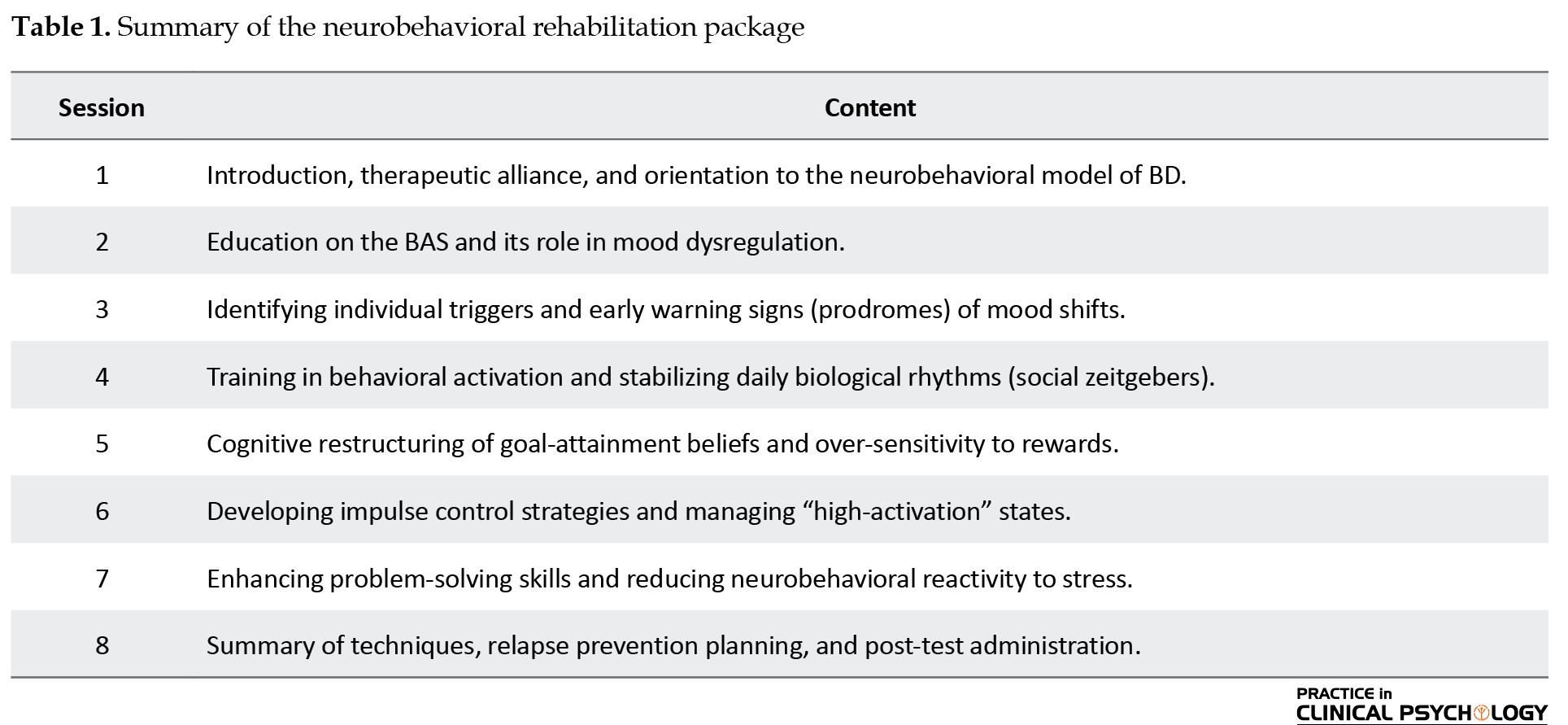
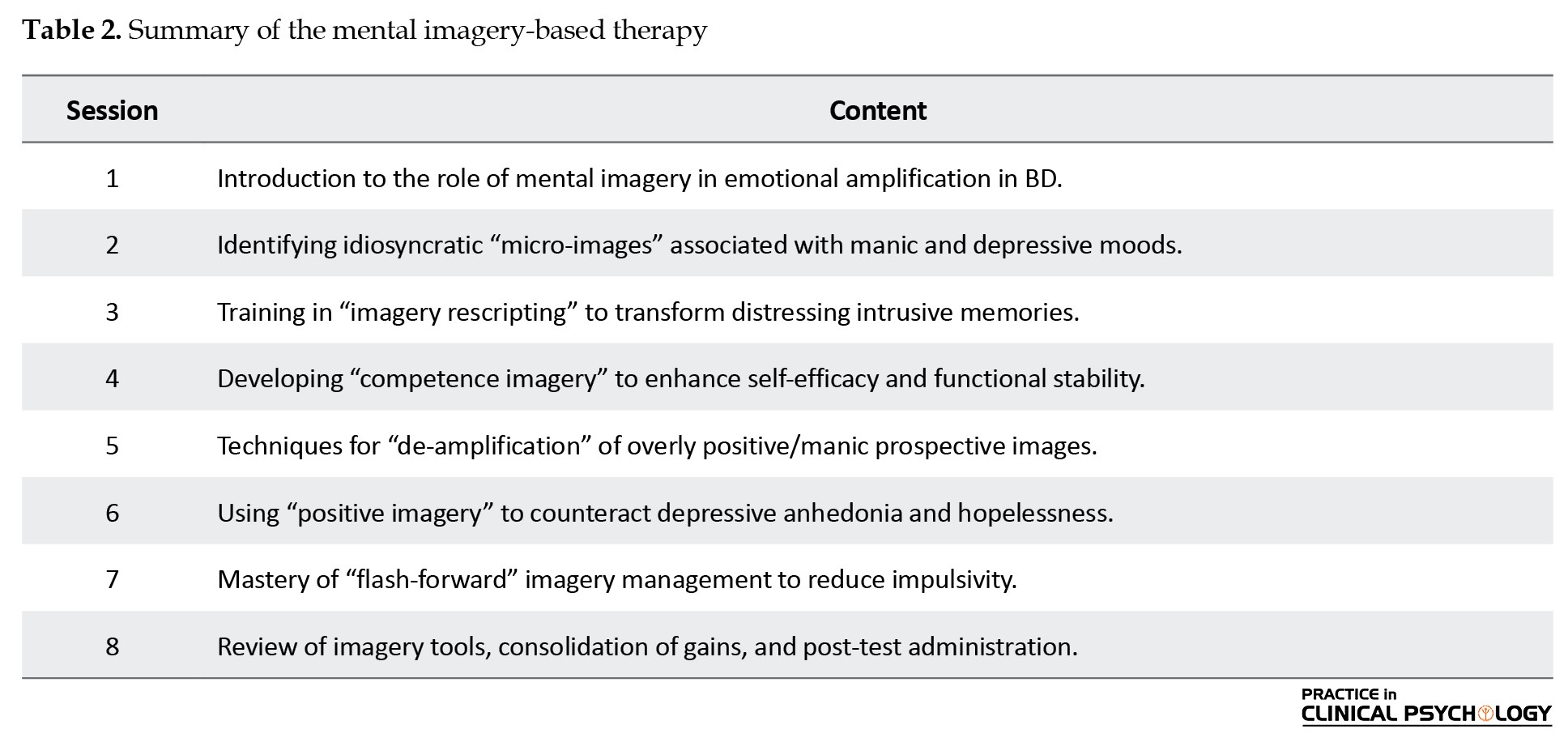
Both experimental groups underwent a total of eight therapeutic sessions, each lasting exactly 90 minutes. The detailed content of the sessions for the neurobehavioral rehabilitation package and mental imagery-based therapy are summarized in Tables 1 and 2, respectively.
Data analysis
Statistical analysis was conducted using SPSS software, version 27. Descriptive statistics, including Mean±SD were used to summarize the data. For inferential statistics, repeated measures analysis of variance (ANOVA) was utilized to examine the main effects of group and time, as well as the group×time interaction effect. When significant differences were found, Bonferroni post-hoc tests were performed for pairwise comparisons. The level of statistical significance was set at P<0.05.
Results
The mean age was 37.5±8.1 years in the neurobehavioral rehabilitation group, 38.2±7.6 years in the mental imagery-based therapy group, and 38.7±8.3 years in the control group. Regarding gender distribution, the neurobehavioral rehabilitation group consisted of 9 males (60%) and 6 females (40%), the mental imagery-based therapy group included 7 males (46.7%) and 8 females (53.3%), and the control group comprised 9 males (60%) and 6 females (40%). Preliminary analyses using chi-square test and one-way ANOVA confirmed no statistically significant differences among the three groups in terms of age, gender, or other demographic variables at baseline (P>0.05), indicating successful randomization and group homogeneity.
Table 3 presents the Mean±SD for manic symptom severity and the five subscales of cognitive avoidance across the three assessment phases (pre-test, post-test, and follow-up).
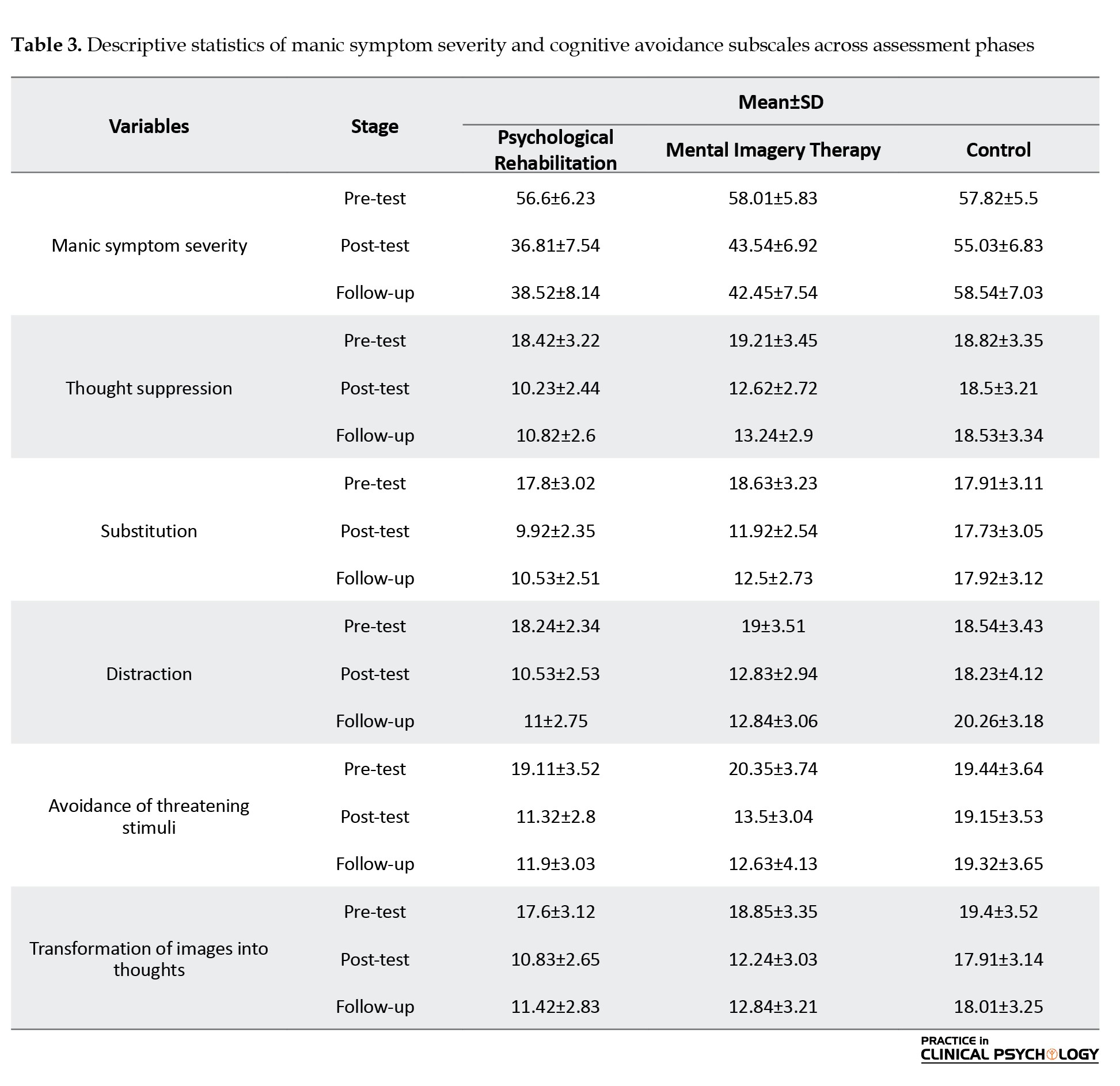
As shown in Table 3, the three groups were highly similar at pre-test, indicating successful baseline equivalence. Following the interventions, both experimental groups demonstrated substantial reductions in manic symptom severity and all cognitive avoidance subscales. These improvements were largely maintained at the follow-up assessment. In contrast, the control group showed minimal change or slight worsening over time.
Prior to conducting the main analyses, all statistical assumptions were rigorously examined. The Shapiro-Wilk test confirmed the normality of data distribution for all variables (P>0.05). Levene’s test verified homogeneity of variances, and Box’s M test supported the equality of covariance matrices. Mauchly’s test indicated that the sphericity assumption was met for all variables. Therefore, the use of parametric tests was justified.
The results of the repeated measures ANOVA for the main effect of group and the group×time interaction are summarized in Table 4.
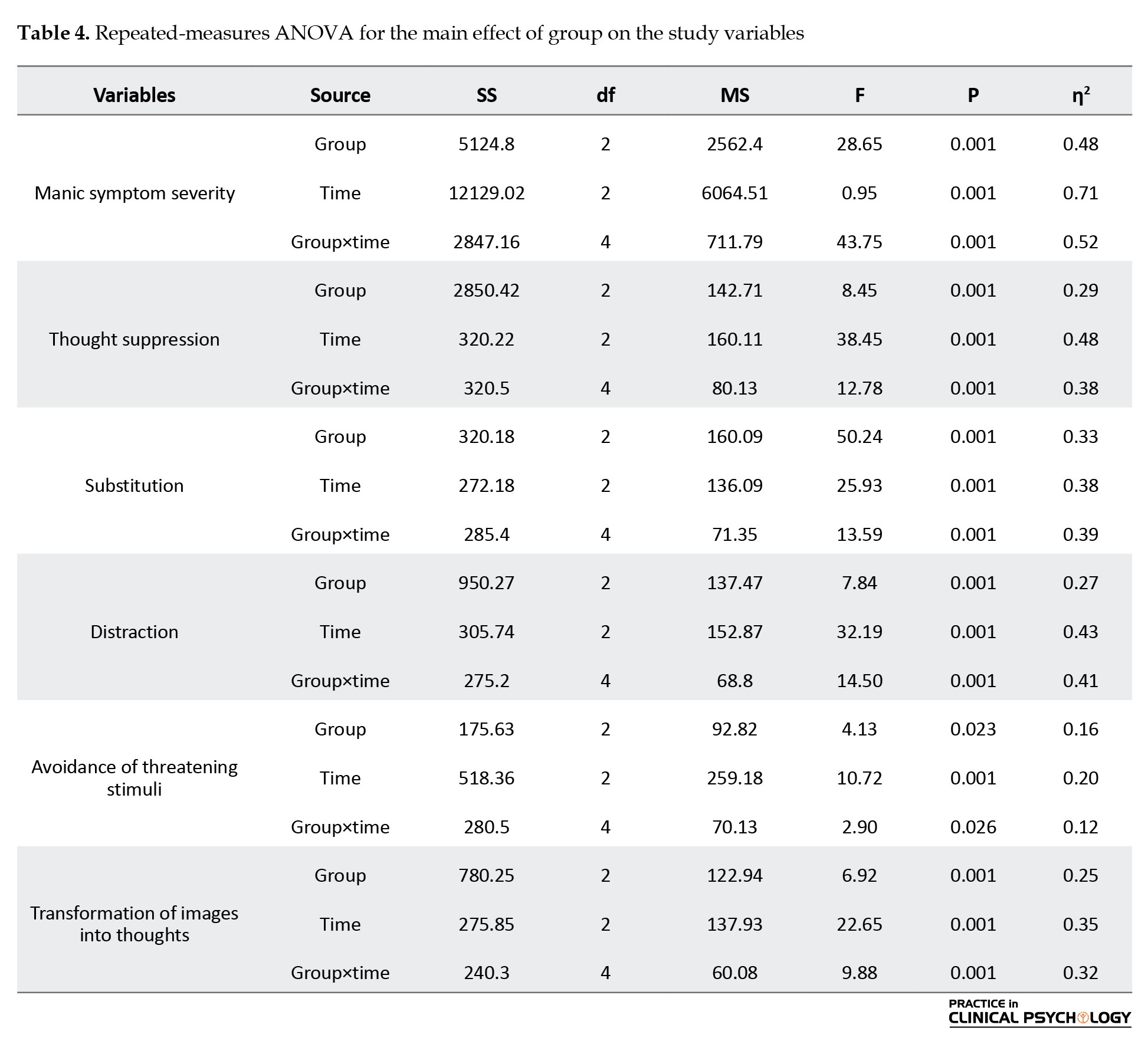
There was a significant main effect of group on manic symptom severity and all cognitive avoidance subscales. The group×time interaction effect was also statistically significant for manic symptom severity and all cognitive avoidance dimensions, indicating that the pattern of change over time differed significantly between the three groups.
Bonferroni post-hoc tests were conducted to determine the source of the significant differences. The results (Table 5) indicated that both the neurobehavioral rehabilitation and mental imagery-based therapy groups showed significantly greater reductions in manic symptom severity compared to the control group (P<0.001).
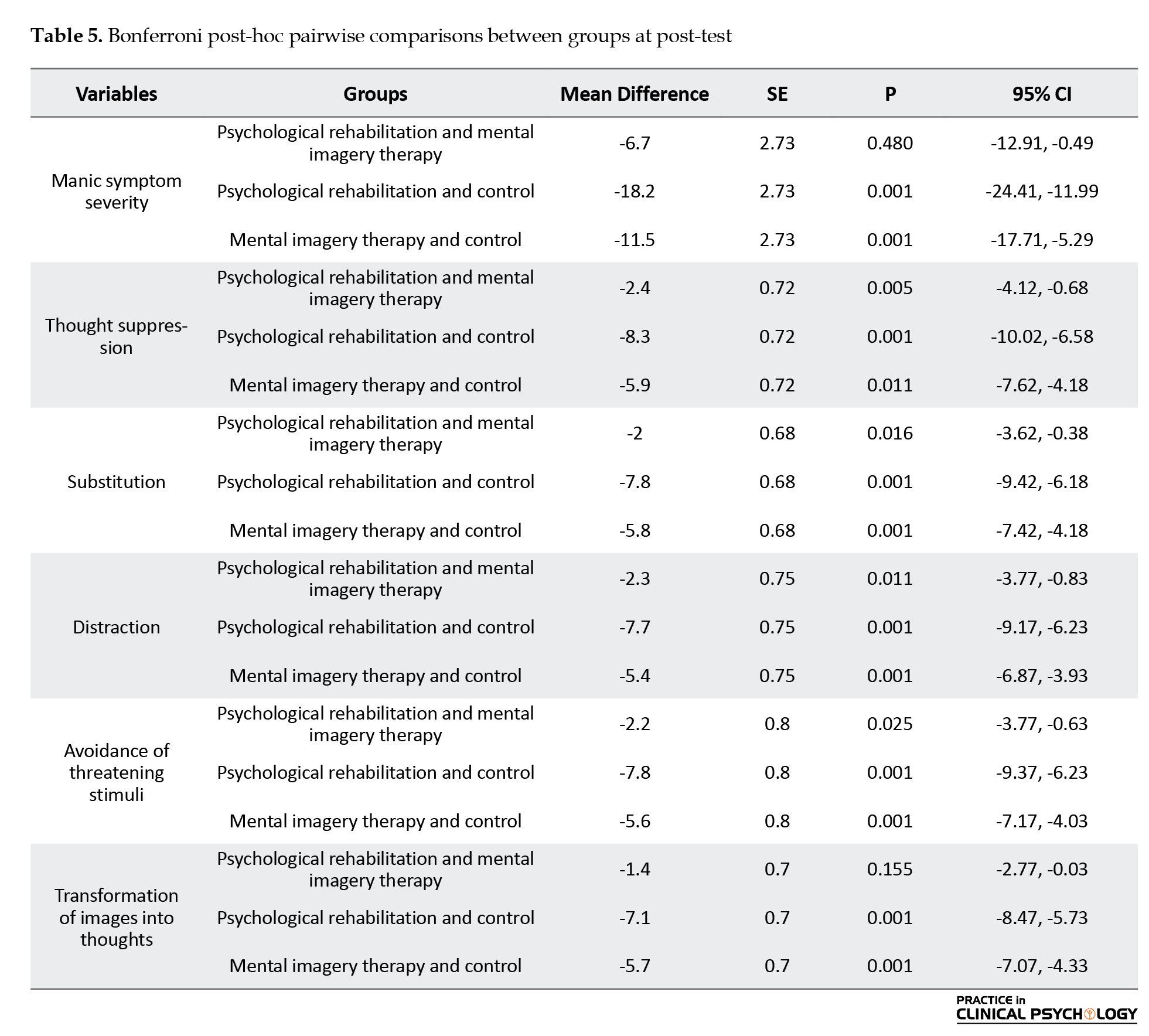
However, no significant difference was observed between the two experimental groups in reducing manic symptom severity (P=0.480).
Regarding cognitive avoidance subscales, both interventions were significantly superior to the control group across all five subscales (P≤0.011). Importantly, the neurobehavioral rehabilitation package demonstrated statistically significant superiority over mental imagery-based therapy in four out of the five subscales: thought suppression (P=0.005), substitution (P=0.016), distraction (P=0.011), and avoidance of threatening stimuli (P=0.025). No significant difference was found between the two active interventions on the “transformation of images into thoughts” subscale (P=0.155). In summary, both psychological interventions led to clinically meaningful improvements, but the neurobehavioral rehabilitation package produced greater reductions in most domains of cognitive avoidance.
Discussion
The present study aimed to compare the effect of a neurobehavioral model-based psychological rehabilitation package and mental imagery-based therapy on manic symptom severity and cognitive avoidance in patients with BD. The findings indicated that both interventions produced significant reductions in manic symptom severity compared to the control group, with no statistically significant difference between the two experimental groups. This suggests that both approaches are comparably effective in alleviating core manic symptoms. Regarding cognitive avoidance, both treatments significantly decreased maladaptive strategies across all subscales compared to the control group; however, the neurobehavioral rehabilitation package demonstrated superior efficacy in four out of five subscales (thought suppression, substitution, distraction, and avoidance of threatening stimuli).
These results are consistent with the neurobehavioral model of BD, which emphasizes dysregulation in the BAS and BIS (Mellick et al., 2021; Nusslock & Alloy, 2017). By targeting these underlying systems through psychoeducation, behavioral activation, cognitive restructuring, and impulse control training, the neurobehavioral rehabilitation package appears particularly effective in reducing reliance on cognitive avoidance as a maladaptive coping strategy. This superiority may stem from its direct focus on modifying approach- and avoidance-related behaviors and enhancing problem-solving skills, which helps patients confront rather than evade emotional experiences.
Mental imagery-based therapy also yielded meaningful improvements, particularly in reducing the transformation of images into thoughts and overall manic symptoms. This aligns with previous research highlighting the powerful role of mental imagery in emotional amplification and mood dysregulation in BD (Holmes et al., 2019; van den Berg & Holmes 2023). The therapy’s focus on imagery rescripting and de-amplification likely helps patients reprocess emotionally charged mental representations, thereby decreasing the need for cognitive avoidance.
The comparable effect of both interventions on manic symptom severity supports the notion that different therapeutic pathways—top-down cognitive-behavioral versus bottom-up imagery-based—can lead to similar clinical outcomes in mood stabilization. However, the greater impact of neurobehavioral rehabilitation on most cognitive avoidance dimensions suggests that a more structured, behaviorally oriented approach may be particularly beneficial for addressing entrenched avoidance patterns in bipolar patients. These findings extend the existing literature by directly comparing these two promising adjunctive therapies within an inpatient Persian-speaking population.
Despite these promising results, several limitations should be acknowledged. First, the relatively small sample size, although justified by power analysis, limits the generalizability of the findings. Second, the study was conducted in a single hospital setting, which may restrict broader applicability. Third, reliance on self-report measures may be subject to social desirability or recall bias. Future studies should employ larger, multi-center samples, include longer follow-up periods, and incorporate objective physiological or clinician-rated measures to strengthen the evidence base.
Conclusion
In conclusion, the findings of this quasi-experimental study suggest that both the neurobehavioral model-based psychological rehabilitation package and mental imagery-based therapy are effective adjunctive interventions for reducing manic symptom severity and cognitive avoidance in patients with BD. While both approaches demonstrated comparable benefits in alleviating manic symptoms, the neurobehavioral rehabilitation package showed greater effectiveness in reducing most dimensions of cognitive avoidance. These results highlight the value of integrating structured psychological interventions alongside standard pharmacotherapy to enhance emotional regulation and psychological flexibility in individuals with BD. It is recommended that clinicians consider these evidence-based approaches in routine practice, with preference for neurobehavioral rehabilitation when targeting cognitive avoidance is a primary concern. Further large-scale randomized controlled trials are warranted to confirm these findings and explore the long-term effects of these interventions.
Ethical Considerations
Compliance with ethical guidelines
The research received approval from the Institutional Ethics Committee of Naein Branch, Islamic Azad University, Naein, Iran. (Code: IR.IAU.KHUISF.REC.1404.378).
Funding
This research did not receive any grant from funding agencies in the public, commercial, or non-profit sectors.
Authors' contributions
Conceptualization, methodology, data collection, and writing the original draft: Mahboubeh Bigdeli; Supervision, project administration, review and editing Shahnaz Khaleghipour; Statistical analysis, data interpretation and validation: Mohammad Zare Neyestanak; Final approal: All authors.
Conflict of interest
The authors declared no conflict of interest.
Acknowledgments
The authors would like to express their gratitude to the patients and staff of Golestan Hospital in Ahvaz for their cooperation and participation in this study.
References
Aghabaki, S., Shahbazi, M., Mohebi Nouredinvand, M. H., & Alavi, S. Z. (2026). Effectiveness of CBT and SFBT on cognitive avoidance and perceived stress in adolescent girls from divorced families in Izeh, Iran. Practice in Clinical Psychology, 14(1), 93-102. [DOI:10.32598/jpcp.14.1.1081.1]
Barekatain, M., Tavakoli, M., Molavi, H., Maroufi, M., & Salehi, M. (2007). [Standardization, reliability and validity of the young mania rating scale (Persian)]. Journal of Psychology, 11(2), 150–166. [Link]
Blackwell, S. E. (2019). Mental imagery: From basic research to clinical practice. Journal of Psychotherapy Integration, 29(3), 235-247. [Link]
Bonnín, C. D. M., Reinares, M., Martínez-Arán, A., Jiménez, E., Sánchez-Moreno, J., & Solé, B., et al. (2019). Improving functioning, quality of life, and well-being in patients with bipolar disorder. The International Journal of Neuropsychopharmacology, 22(8), 467–477. [DOI:10.1093/ijnp/pyz018] [PMID]
Dome, P., Rihmer, Z., & Gonda, X. (2019). Suicide risk in bipolar disorder: A brief review. Medicina, 55(8), 403. [DOI:10.3390/medicina55080403] [PMID]
Ebrahim Zadeh Mousavi, M., MohammadKhani, P., Pourshahbaz, A., Samiei, M., & Rigi Kooteh, B. (2016). Nonadherence effective factors in bipolar disorder with previous rehospitalization. Practice in Clinical Psychology, 4(4), 255-262. [DOI:10.18869/acadpub.jpcp.4.4.255]
Eftekari, A., & Bakhtiari, M. (2022). Comparing the effectiveness of schema therapy with acceptance and commitment therapy on cognitive avoidance in patients with generalized anxiety disorder. Practice in Clinical Psychology, 10(1), 11-22. [DOI:10.32598/jpcp.10.1.593.1]
Elkjaer, E., Mikkelsen, M. B., & O’Toole, M. S. (2022). Emotion regulation patterns: Capturing variability and flexibility in emotion regulation in an experience sampling study. Scandinavian Journal of Psychology, 63(4), 297–307. [DOI:10.1111/sjop.12808] [PMID]
Harrison, P. J., Geddes, J. R., & Tunbridge, E. M. (2018). The emerging neurobiology of bipolar disorder. Trends in Neurosciences, 41(1), 18-30. [DOI:10.1016/j.tins.2017.10.006] [PMID]
Hirsch CR, Holmes EA. Mental imagery in anxiety disorders. Psychiatry. 2007; 6(4):161–5. [DOI:10.1016/j.mppsy.2007.01.005]
Holmes, E. A., Hales, S. A., Young, K., & Di Simplicio, M. (2019). Imagery-based cognitive therapy for bipolar disorder and mood instability. New York City: Guilford Press. [Link]
Iyadurai, L., Blackwell, S. E., Meiser-Stedman, R., Watson, P. C., Bonsall, M. B., & Geddes, J. R., et al. (2018). Preventing intrusive memories after trauma via a brief intervention involving Tetris computer game play in the emergency department: A proof-of-concept randomized controlled trial. Molecular Psychiatry, 23(3), 674–682. [DOI:10.1038/mp.2017.23] [PMID]
M’Bailara, K., Echegaray, F., & Di Simplicio, M. (2024). What’s in the mind’s eye of individuals with bipolar disorders: an exploration of the content and characteristics of mental images in different thymic phases. Behavioural and Cognitive Psychotherapy, 52(2), 178-193. [DOI:10.1017/S1352465823000401] [PMID]
McIntyre, R. S., Berk, M., Brietzke, E., Goldstein, B. I., López-Jaramillo, C., & Kessing, L. V., et al. (2020). Bipolar disorders. Lancet (London, England), 396(10265), 1841–1856. [DOI:10.1016/S0140-6736(20)31544-0] [PMID]
Mellick, W., Prisciandaro, J. J., Brenner, H., Brown, D., & Tolliver, B. K. (2021). A multimethod examination of sensitivity to reward and sensitivity to punishment in bipolar disorder and alcohol dependence: Results from a 2× 2 factorial design. Psychopathology, 54(2), 70–77. [DOI:10.1159/000512661] [PMID]
Miklowitz, D. J., Efthimiou, O., Furukawa, T. A., Scott, J., McLaren, R., & Geddes, J. R., et al. (2021). Adjunctive psychotherapy for bipolar disorder: A systematic review and component network Meta-analysis. JAMA Psychiatry, 78(2), 141–150.[DOI:10.1001/jamapsychiatry.2020.2993] [PMID]
Nierenberg, A. A., Agustini, B., Köhler-Forsberg, O., Cusin, C., Katz, D., & Sylvia, L. G., et al. (2023). Diagnosis and treatment of bipolar disorder: A review. JAMA, 330(14), 1370–1380.[DOI:10.1001/jama.2023.18588] [PMID]
Nusslock, R., & Alloy, L. B. (2017). Reward processing and mood-related symptoms: An RDoC and translational neuroscience perspective. Journal of Affective Disorders, 216, 3-16. [DOI:10.1016/j.jad.2017.02.001] [PMID]
Rahimi, R., & Khodaei, A. (2026). Psychometric analysis of the cognitive avoidance questionnaire and its relation with intolerance of uncertainty, negative problem orientation and positive beliefs to worry in multiple sclerosis patients. Quarterly Journal of Health Psychology, 15(57), 109–122. [DOI:10.30473/hpj.2026.75372.6294]
Rowland, T. A., & Marwaha, S. (2018). Epidemiology and risk factors for bipolar disorder. Therapeutic Advances in Psychopharmacology, 8(9), 251-269. [DOI:10.1177/2045125318769235] [PMID]
Scaini, G., Valvassori, S. S., Diaz, A. P., Lima, C. N., Benevenuto, D., & Fries, G. R., et al. (2020). Neurobiology of bipolar disorders: a review of genetic components, signaling pathways, biochemical changes, and neuroimaging findings. Revista Brasileira de Psiquiatria (Sao Paulo, Brazil: 1999), 42(5), 536–551. [DOI:10.1590/1516-4446-2019-0732] [PMID]
Sexton, K. A., & Dugas, M. J. (2008). The cognitive avoidance questionnaire: Validation of the English translation. Journal of Anxiety Disorders, 22(3), 355-370. [DOI:10.1016/j.janxdis.2007.04.005] [PMID]
Sperry, S. H., Stromberg, A. R., Roberts, J. E., & Prisciandaro, J. J. (2025). Behavioral approach and inhibition sensitivity predicts depressive and hypomanic mood and behavior in daily life. Psychiatry Research, 353, 116734. [DOI:10.1016/j.psychres.2025.116734] [PMID]
van Rheenen, T. E., & Miskowiak, K. (2021). Recognising the relevance of cognitive dysfunction in the clinical management of bipolar disorder. Bipolar Disorders, 23(4), 414–415. [DOI:10.1111/bdi.13063]
van den Berg, K. C., Hendrickson, A. T., Hales, S. A., Voncken, M., & Keijsers, G. P. J. (2023). Comparing the effectiveness of imagery focussed cognitive therapy to group psychoeducation for patients with bipolar disorder: A randomised trial. Journal of Affective Disorders, 320, 691–700. [DOI:10.1016/j.jad.2022.09.160
Ventriglio, A., Ricci, F., Giallanella, D., Gaggiano, C., Torales, J., & Castaldelli-Maia, J. M., et al. (2025). Psychosocial interventions in bipolar disorders: A guidelines’ review. The International Journal of Social Psychiatry, 71(7), 1204–1218.[DOI:10.1177/00207640251333296] [PMID]
Vieta, E., Berk, M., Schulze, T. G., Carvalho, A. F., Suppes, T., & Calabrese, J. R.,et al. (2018). Bipolar disorders. Nature Reviews. Disease Primers, 4, 18008. [DOI:10.1038/nrdp.2018.8] [PMID]
Wang, Z., Cao, H., Cao, Y., Song, H., Jiang, X., & Wei, C., et al. (2023). Clinical characteristics and cognitive function in bipolar disorder patients with different onset symptom. Frontiers in Psychiatry, 14, 1253088. [DOI:10.3389/fpsyt.2023.1253088] [PMID]
Yatham, L. N., Chakrabarty, T., Bond, D. J., Schaffer, A., Beaulieu, S., Parikh, S. V., … & Post, R. (2021). Canadian network for mood and anxiety treatments (CANMAT) and international society for bipolar disorders (ISBD) recommendations for the management of patients with bipolar disorder with mixed presentations. Bipolar Disorders, 23(8), 767–788. [DOI:10.1111/bdi.13135]
Yatham, L. N., Kennedy, S. H., Parikh, S. V., Schaffer, A., Bond, D. J., & Frey, B. N., et al. (2018). Canadian network for mood and anxiety treatments (CANMAT) and international society for bipolar disorders (ISBD) 2018 guidelines for the management of patients with bipolar disorder. Bipolar Disorders, 20(2), 97-170. [DOI:10.1111/bdi.12609] [PMID]
Yildiz, M. (2021). Psychosocial rehabilitation interventions in the treatment of schizophrenia and bipolar disorder. Noro Psikiyatri Arsivi, 58(Suppl 1), S77-S82. [DOI:10.29399/npa.27430]
Young, R. C., Biggs, J. T., Ziegler, V. E., & Meyer, D. A. (1978). A rating scale for mania: Reliability, validity and sensitivity. The British Journal of Psychiatry: The Journal of Mental Science, 133, 429–435. [DOI:10.1192/bjp.133.5.429] [PMID]
Bipolar disorder (BD) is a severe, chronic, and highly debilitating psychiatric condition characterized by profound and unpredictable fluctuations in mood, energy, and activity levels (Vieta et al., 2018). Patients typically experience alternating episodes of intense mania or hypomania and severe depression, which profoundly disrupt their cognitive functioning, emotional regulation, and interpersonal relationships (Ebrahim Zadeh Mousavi et al., 2016; McIntyre et al., 2020). The devastating impact of BD extends beyond the acute episodes, often resulting in significant occupational impairment, social isolation, markedly reduced quality of life even during euthymic phases, high rates of medication non-adherence, recurrent relapses, and increased risk of suicidality (Bonnín et al., 2019; Dome et al., 2019). Despite the widespread use of mood-stabilizing medications as the primary treatment, pharmacotherapy alone is often insufficient to fully remit symptoms or address the complex psychological and behavioral deficits associated with the disorder (Yatham et al., 2018). Consequently, there is a critical need for effective adjunctive psychological interventions.
A primary clinical indicator of functional impairment in patients with BD is overall symptom severity, which encompasses the intensity and frequency of both manic and depressive manifestations (Harrison et al., 2018). During manic phases, symptom severity is marked by cognitive distortions, impulsivity, psychomotor agitation, grandiosity, decreased need for sleep, and pressured speech (van Rheenen et al., 2021). In contrast, depressive episodes involve profound lethargy, anhedonia, and hopelessness. High symptom severity not only diminishes daily functioning but also exacerbates the risk of neuroprogressive decline over time (Scaini et al., 2020). Therefore, reducing symptom severity remains a central goal of therapeutic interventions, as it is closely associated with improved prognosis, longer remission periods, and better overall well-being (Wang et al., 2023).
In addition to core mood symptoms, patients with BD frequently employ maladaptive emotion regulation strategies, most notably cognitive avoidance (Yildiz et al., 2021). Cognitive avoidance refers to a range of internal strategies—such as thought suppression, distraction, substitution of distressing thoughts, avoidance of threatening stimuli, and transformation of images into thoughts—used to escape or minimize aversive emotional experiences (Sexton & Dugas, 2008; Elkjaer et al., 2022). Although these strategies may offer temporary relief, their chronic use prevents adequate emotional processing and perpetuates psychological distress, thereby increasing vulnerability to mood relapses (Miklowitz et al., 2021; Eftekari & Bakhtiari, 2022; Aghabaki et al., 2026). In the context of BD, cognitive avoidance often serves as a maladaptive coping mechanism for managing the overwhelming intensity of mood swings, which in turn maintains cognitive rigidity and emotional dysregulation (Rowland & Marwaha, 2018).
To address these multifaceted challenges, emerging therapeutic approaches have focused on the intersection of neurobiological and behavioral factors. The psychological rehabilitation package based on the neurobehavioral model is a structured intervention that targets dysregulation in the behavioral approach system (BAS) and behavioral inhibition system (BIS), which are considered central to the pathophysiology of BD (Mellick et al., 2021; Sperry et al., 2025; Nusslock & Alloy, 2017). This model posits that manic episodes are associated with hypersensitivity of the BAS to reward cues, while depressive episodes relate to hypoactivation or excessive BIS sensitivity. Previous studies suggest that interventions addressing these neurobehavioral vulnerabilities can improve mood stability, executive functioning, and adaptive emotional regulation by helping patients identify prodromal symptoms and implement goal-directed behaviors instead of avoidance or impulsivity (Ventriglio et al., 2025; Nusslock & Alloy, 2017).
Alternatively, mental imagery-based therapy has received growing empirical support for emotional disorders, including BD (Holmes et al., 2019). Patients with BD frequently experience highly vivid, emotionally charged, and intrusive mental images that amplify both manic and depressive states (M’Bailara et al., 2024). Mental imagery-based therapy focuses on identifying, evaluating, and restructuring these spontaneous images, replacing maladaptive ones with more balanced and adaptive mental representations (van den Berg & Holmes 2023; Blackwell, 2019). By directly engaging emotional brain networks more powerfully than verbal techniques alone, this approach can reduce emotional reactivity and the reliance on cognitive avoidance strategies (Iyadurai et al., 2018; Hirsch et al., 2007).
Despite the promising theoretical foundations and preliminary evidence supporting both the neurobehavioral rehabilitation model and mental imagery-based therapy, a notable gap remains in the literature regarding direct comparisons of their efficacy, particularly concerning their simultaneous effects on manic symptom severity and cognitive avoidance in clinical populations with BD (Nierenberg et al., 2023; Yatham et al., 2024). Most existing studies have examined these approaches separately, and few have been conducted in inpatient settings or with Persian-speaking populations. Determining the relative strengths of these two interventions is essential for optimizing personalized treatment plans and reducing the substantial burden of this chronic condition.
Therefore, the present quasi-experimental study aimed to compare the effect of a neurobehavioral model-based psychological rehabilitation package and mental imagery-based therapy on manic symptom severity and cognitive avoidance in patients with BD.
Materials and Methods
Design and participants
This study employed a quasi-experimental design with a pre-test, post-test, and control group framework. The statistical population comprised all inpatients diagnosed with BD who were hospitalized at Golestan Hospital in Ahvaz, Iran, during the first half of 2025 (January to June 2025). The entire data collection and intervention period lasted approximately six months. Using purposive sampling, eligible patients were identified through review of medical records and consultation with ward psychiatrists. All eligible patients who met the inclusion criteria were approached individually by the researcher, received a full explanation of the study objectives and procedures, and were invited to participate voluntarily. High cooperation was observed; out of 58 patients screened, 45 agreed to participate and provided written informed consent (participation rate=77.6%). These 45 patients were then randomly assigned to three equal groups (n=15 in each group): neurobehavioral rehabilitation group, mental imagery-based therapy group, and control group.
Inclusion criteria were a definitive diagnosis of BD by a psychiatrist according to DSM-5-TR criteria, age between 20 and 50 years, and minimum middle-school education level. Exclusion criteria included the presence of comorbid substance use disorders, acute psychotic features, or missing more than two intervention sessions. All ethical considerations were strictly followed; participants provided written informed consent, were assured of confidentiality, and were informed of their right to withdraw from the study at any time without any impact on their treatment.
To determine the adequacy of the sample size, a priori power analysis was conducted using G*Power software, version 3.1. Assuming a medium effect size (f=0.25), an alpha level of 0.05, and statistical power of 0.80 for repeated measures ANOVA, the minimum required sample size was calculated as 36 participants. Considering potential attrition, a total of 45 participants (15 per group) were recruited, which provided sufficient power for the study.
Instruments
Mania symptom checklist (MSC): This instrument is a clinical tool designed to quantify the intensity of manic symptoms. It consists of 20 items that reflect core diagnostic features of mania, such as grandiosity, decreased need for sleep, pressured speech, and other manic symptoms. All items are scored on a 4-point Likert scale (ranging from 0 to 3), with total scores ranging from 0 to 60, where higher scores indicate greater symptom severity (Young et al., 1978). In the current study, the instrument demonstrated robust internal consistency with a Cronbach’s alpha of 0.88, which is consistent with previous Iranian validations (Barekatain et al., 2016).
Cognitive avoidance questionnaire (CAQ): Developed by Sexton and Dugas (2008), this 25-item self-report scale assesses five distinct subscales of cognitive avoidance strategies: thought suppression, substitution, distraction, avoidance of threatening stimuli, and transformation of images into thoughts. Each item is rated on a 5-point Likert scale from 1 (not at all) to 5 (completely). Higher scores represent more frequent use of maladaptive cognitive avoidance strategies. The Persian version of the questionnaire has shown strong psychometric properties (Rahimi et al., 2026); in this study, the total Cronbach’s α was 0.91.
Procedure
Following the selection and random assignment of participants, all individuals underwent a pre-test assessment using the MSC and the CAQ. Subsequently, the two experimental groups received their respective interventions consisting of eight 90-minute sessions (twice weekly). The control group remained on the waiting list and received only the standard hospital care. Immediately after the completion of the intervention sessions, a post-test assessment was administered to all three groups under the same standardized conditions to evaluate the changes in manic symptom severity and cognitive avoidance strategies.
Intervention protocols
Both experimental groups underwent a total of eight therapeutic sessions, each lasting exactly 90 minutes. The detailed content of the sessions for the neurobehavioral rehabilitation package and mental imagery-based therapy are summarized in Tables 1 and 2, respectively.
Data analysis
Statistical analysis was conducted using SPSS software, version 27. Descriptive statistics, including Mean±SD were used to summarize the data. For inferential statistics, repeated measures analysis of variance (ANOVA) was utilized to examine the main effects of group and time, as well as the group×time interaction effect. When significant differences were found, Bonferroni post-hoc tests were performed for pairwise comparisons. The level of statistical significance was set at P<0.05.
Results
The mean age was 37.5±8.1 years in the neurobehavioral rehabilitation group, 38.2±7.6 years in the mental imagery-based therapy group, and 38.7±8.3 years in the control group. Regarding gender distribution, the neurobehavioral rehabilitation group consisted of 9 males (60%) and 6 females (40%), the mental imagery-based therapy group included 7 males (46.7%) and 8 females (53.3%), and the control group comprised 9 males (60%) and 6 females (40%). Preliminary analyses using chi-square test and one-way ANOVA confirmed no statistically significant differences among the three groups in terms of age, gender, or other demographic variables at baseline (P>0.05), indicating successful randomization and group homogeneity.
Table 3 presents the Mean±SD for manic symptom severity and the five subscales of cognitive avoidance across the three assessment phases (pre-test, post-test, and follow-up).
As shown in Table 3, the three groups were highly similar at pre-test, indicating successful baseline equivalence. Following the interventions, both experimental groups demonstrated substantial reductions in manic symptom severity and all cognitive avoidance subscales. These improvements were largely maintained at the follow-up assessment. In contrast, the control group showed minimal change or slight worsening over time.
Prior to conducting the main analyses, all statistical assumptions were rigorously examined. The Shapiro-Wilk test confirmed the normality of data distribution for all variables (P>0.05). Levene’s test verified homogeneity of variances, and Box’s M test supported the equality of covariance matrices. Mauchly’s test indicated that the sphericity assumption was met for all variables. Therefore, the use of parametric tests was justified.
The results of the repeated measures ANOVA for the main effect of group and the group×time interaction are summarized in Table 4.
There was a significant main effect of group on manic symptom severity and all cognitive avoidance subscales. The group×time interaction effect was also statistically significant for manic symptom severity and all cognitive avoidance dimensions, indicating that the pattern of change over time differed significantly between the three groups.
Bonferroni post-hoc tests were conducted to determine the source of the significant differences. The results (Table 5) indicated that both the neurobehavioral rehabilitation and mental imagery-based therapy groups showed significantly greater reductions in manic symptom severity compared to the control group (P<0.001).
However, no significant difference was observed between the two experimental groups in reducing manic symptom severity (P=0.480).
Regarding cognitive avoidance subscales, both interventions were significantly superior to the control group across all five subscales (P≤0.011). Importantly, the neurobehavioral rehabilitation package demonstrated statistically significant superiority over mental imagery-based therapy in four out of the five subscales: thought suppression (P=0.005), substitution (P=0.016), distraction (P=0.011), and avoidance of threatening stimuli (P=0.025). No significant difference was found between the two active interventions on the “transformation of images into thoughts” subscale (P=0.155). In summary, both psychological interventions led to clinically meaningful improvements, but the neurobehavioral rehabilitation package produced greater reductions in most domains of cognitive avoidance.
Discussion
The present study aimed to compare the effect of a neurobehavioral model-based psychological rehabilitation package and mental imagery-based therapy on manic symptom severity and cognitive avoidance in patients with BD. The findings indicated that both interventions produced significant reductions in manic symptom severity compared to the control group, with no statistically significant difference between the two experimental groups. This suggests that both approaches are comparably effective in alleviating core manic symptoms. Regarding cognitive avoidance, both treatments significantly decreased maladaptive strategies across all subscales compared to the control group; however, the neurobehavioral rehabilitation package demonstrated superior efficacy in four out of five subscales (thought suppression, substitution, distraction, and avoidance of threatening stimuli).
These results are consistent with the neurobehavioral model of BD, which emphasizes dysregulation in the BAS and BIS (Mellick et al., 2021; Nusslock & Alloy, 2017). By targeting these underlying systems through psychoeducation, behavioral activation, cognitive restructuring, and impulse control training, the neurobehavioral rehabilitation package appears particularly effective in reducing reliance on cognitive avoidance as a maladaptive coping strategy. This superiority may stem from its direct focus on modifying approach- and avoidance-related behaviors and enhancing problem-solving skills, which helps patients confront rather than evade emotional experiences.
Mental imagery-based therapy also yielded meaningful improvements, particularly in reducing the transformation of images into thoughts and overall manic symptoms. This aligns with previous research highlighting the powerful role of mental imagery in emotional amplification and mood dysregulation in BD (Holmes et al., 2019; van den Berg & Holmes 2023). The therapy’s focus on imagery rescripting and de-amplification likely helps patients reprocess emotionally charged mental representations, thereby decreasing the need for cognitive avoidance.
The comparable effect of both interventions on manic symptom severity supports the notion that different therapeutic pathways—top-down cognitive-behavioral versus bottom-up imagery-based—can lead to similar clinical outcomes in mood stabilization. However, the greater impact of neurobehavioral rehabilitation on most cognitive avoidance dimensions suggests that a more structured, behaviorally oriented approach may be particularly beneficial for addressing entrenched avoidance patterns in bipolar patients. These findings extend the existing literature by directly comparing these two promising adjunctive therapies within an inpatient Persian-speaking population.
Despite these promising results, several limitations should be acknowledged. First, the relatively small sample size, although justified by power analysis, limits the generalizability of the findings. Second, the study was conducted in a single hospital setting, which may restrict broader applicability. Third, reliance on self-report measures may be subject to social desirability or recall bias. Future studies should employ larger, multi-center samples, include longer follow-up periods, and incorporate objective physiological or clinician-rated measures to strengthen the evidence base.
Conclusion
In conclusion, the findings of this quasi-experimental study suggest that both the neurobehavioral model-based psychological rehabilitation package and mental imagery-based therapy are effective adjunctive interventions for reducing manic symptom severity and cognitive avoidance in patients with BD. While both approaches demonstrated comparable benefits in alleviating manic symptoms, the neurobehavioral rehabilitation package showed greater effectiveness in reducing most dimensions of cognitive avoidance. These results highlight the value of integrating structured psychological interventions alongside standard pharmacotherapy to enhance emotional regulation and psychological flexibility in individuals with BD. It is recommended that clinicians consider these evidence-based approaches in routine practice, with preference for neurobehavioral rehabilitation when targeting cognitive avoidance is a primary concern. Further large-scale randomized controlled trials are warranted to confirm these findings and explore the long-term effects of these interventions.
Ethical Considerations
Compliance with ethical guidelines
The research received approval from the Institutional Ethics Committee of Naein Branch, Islamic Azad University, Naein, Iran. (Code: IR.IAU.KHUISF.REC.1404.378).
Funding
This research did not receive any grant from funding agencies in the public, commercial, or non-profit sectors.
Authors' contributions
Conceptualization, methodology, data collection, and writing the original draft: Mahboubeh Bigdeli; Supervision, project administration, review and editing Shahnaz Khaleghipour; Statistical analysis, data interpretation and validation: Mohammad Zare Neyestanak; Final approal: All authors.
Conflict of interest
The authors declared no conflict of interest.
Acknowledgments
The authors would like to express their gratitude to the patients and staff of Golestan Hospital in Ahvaz for their cooperation and participation in this study.
References
Aghabaki, S., Shahbazi, M., Mohebi Nouredinvand, M. H., & Alavi, S. Z. (2026). Effectiveness of CBT and SFBT on cognitive avoidance and perceived stress in adolescent girls from divorced families in Izeh, Iran. Practice in Clinical Psychology, 14(1), 93-102. [DOI:10.32598/jpcp.14.1.1081.1]
Barekatain, M., Tavakoli, M., Molavi, H., Maroufi, M., & Salehi, M. (2007). [Standardization, reliability and validity of the young mania rating scale (Persian)]. Journal of Psychology, 11(2), 150–166. [Link]
Blackwell, S. E. (2019). Mental imagery: From basic research to clinical practice. Journal of Psychotherapy Integration, 29(3), 235-247. [Link]
Bonnín, C. D. M., Reinares, M., Martínez-Arán, A., Jiménez, E., Sánchez-Moreno, J., & Solé, B., et al. (2019). Improving functioning, quality of life, and well-being in patients with bipolar disorder. The International Journal of Neuropsychopharmacology, 22(8), 467–477. [DOI:10.1093/ijnp/pyz018] [PMID]
Dome, P., Rihmer, Z., & Gonda, X. (2019). Suicide risk in bipolar disorder: A brief review. Medicina, 55(8), 403. [DOI:10.3390/medicina55080403] [PMID]
Ebrahim Zadeh Mousavi, M., MohammadKhani, P., Pourshahbaz, A., Samiei, M., & Rigi Kooteh, B. (2016). Nonadherence effective factors in bipolar disorder with previous rehospitalization. Practice in Clinical Psychology, 4(4), 255-262. [DOI:10.18869/acadpub.jpcp.4.4.255]
Eftekari, A., & Bakhtiari, M. (2022). Comparing the effectiveness of schema therapy with acceptance and commitment therapy on cognitive avoidance in patients with generalized anxiety disorder. Practice in Clinical Psychology, 10(1), 11-22. [DOI:10.32598/jpcp.10.1.593.1]
Elkjaer, E., Mikkelsen, M. B., & O’Toole, M. S. (2022). Emotion regulation patterns: Capturing variability and flexibility in emotion regulation in an experience sampling study. Scandinavian Journal of Psychology, 63(4), 297–307. [DOI:10.1111/sjop.12808] [PMID]
Harrison, P. J., Geddes, J. R., & Tunbridge, E. M. (2018). The emerging neurobiology of bipolar disorder. Trends in Neurosciences, 41(1), 18-30. [DOI:10.1016/j.tins.2017.10.006] [PMID]
Hirsch CR, Holmes EA. Mental imagery in anxiety disorders. Psychiatry. 2007; 6(4):161–5. [DOI:10.1016/j.mppsy.2007.01.005]
Holmes, E. A., Hales, S. A., Young, K., & Di Simplicio, M. (2019). Imagery-based cognitive therapy for bipolar disorder and mood instability. New York City: Guilford Press. [Link]
Iyadurai, L., Blackwell, S. E., Meiser-Stedman, R., Watson, P. C., Bonsall, M. B., & Geddes, J. R., et al. (2018). Preventing intrusive memories after trauma via a brief intervention involving Tetris computer game play in the emergency department: A proof-of-concept randomized controlled trial. Molecular Psychiatry, 23(3), 674–682. [DOI:10.1038/mp.2017.23] [PMID]
M’Bailara, K., Echegaray, F., & Di Simplicio, M. (2024). What’s in the mind’s eye of individuals with bipolar disorders: an exploration of the content and characteristics of mental images in different thymic phases. Behavioural and Cognitive Psychotherapy, 52(2), 178-193. [DOI:10.1017/S1352465823000401] [PMID]
McIntyre, R. S., Berk, M., Brietzke, E., Goldstein, B. I., López-Jaramillo, C., & Kessing, L. V., et al. (2020). Bipolar disorders. Lancet (London, England), 396(10265), 1841–1856. [DOI:10.1016/S0140-6736(20)31544-0] [PMID]
Mellick, W., Prisciandaro, J. J., Brenner, H., Brown, D., & Tolliver, B. K. (2021). A multimethod examination of sensitivity to reward and sensitivity to punishment in bipolar disorder and alcohol dependence: Results from a 2× 2 factorial design. Psychopathology, 54(2), 70–77. [DOI:10.1159/000512661] [PMID]
Miklowitz, D. J., Efthimiou, O., Furukawa, T. A., Scott, J., McLaren, R., & Geddes, J. R., et al. (2021). Adjunctive psychotherapy for bipolar disorder: A systematic review and component network Meta-analysis. JAMA Psychiatry, 78(2), 141–150.[DOI:10.1001/jamapsychiatry.2020.2993] [PMID]
Nierenberg, A. A., Agustini, B., Köhler-Forsberg, O., Cusin, C., Katz, D., & Sylvia, L. G., et al. (2023). Diagnosis and treatment of bipolar disorder: A review. JAMA, 330(14), 1370–1380.[DOI:10.1001/jama.2023.18588] [PMID]
Nusslock, R., & Alloy, L. B. (2017). Reward processing and mood-related symptoms: An RDoC and translational neuroscience perspective. Journal of Affective Disorders, 216, 3-16. [DOI:10.1016/j.jad.2017.02.001] [PMID]
Rahimi, R., & Khodaei, A. (2026). Psychometric analysis of the cognitive avoidance questionnaire and its relation with intolerance of uncertainty, negative problem orientation and positive beliefs to worry in multiple sclerosis patients. Quarterly Journal of Health Psychology, 15(57), 109–122. [DOI:10.30473/hpj.2026.75372.6294]
Rowland, T. A., & Marwaha, S. (2018). Epidemiology and risk factors for bipolar disorder. Therapeutic Advances in Psychopharmacology, 8(9), 251-269. [DOI:10.1177/2045125318769235] [PMID]
Scaini, G., Valvassori, S. S., Diaz, A. P., Lima, C. N., Benevenuto, D., & Fries, G. R., et al. (2020). Neurobiology of bipolar disorders: a review of genetic components, signaling pathways, biochemical changes, and neuroimaging findings. Revista Brasileira de Psiquiatria (Sao Paulo, Brazil: 1999), 42(5), 536–551. [DOI:10.1590/1516-4446-2019-0732] [PMID]
Sexton, K. A., & Dugas, M. J. (2008). The cognitive avoidance questionnaire: Validation of the English translation. Journal of Anxiety Disorders, 22(3), 355-370. [DOI:10.1016/j.janxdis.2007.04.005] [PMID]
Sperry, S. H., Stromberg, A. R., Roberts, J. E., & Prisciandaro, J. J. (2025). Behavioral approach and inhibition sensitivity predicts depressive and hypomanic mood and behavior in daily life. Psychiatry Research, 353, 116734. [DOI:10.1016/j.psychres.2025.116734] [PMID]
van Rheenen, T. E., & Miskowiak, K. (2021). Recognising the relevance of cognitive dysfunction in the clinical management of bipolar disorder. Bipolar Disorders, 23(4), 414–415. [DOI:10.1111/bdi.13063]
van den Berg, K. C., Hendrickson, A. T., Hales, S. A., Voncken, M., & Keijsers, G. P. J. (2023). Comparing the effectiveness of imagery focussed cognitive therapy to group psychoeducation for patients with bipolar disorder: A randomised trial. Journal of Affective Disorders, 320, 691–700. [DOI:10.1016/j.jad.2022.09.160
Ventriglio, A., Ricci, F., Giallanella, D., Gaggiano, C., Torales, J., & Castaldelli-Maia, J. M., et al. (2025). Psychosocial interventions in bipolar disorders: A guidelines’ review. The International Journal of Social Psychiatry, 71(7), 1204–1218.[DOI:10.1177/00207640251333296] [PMID]
Vieta, E., Berk, M., Schulze, T. G., Carvalho, A. F., Suppes, T., & Calabrese, J. R.,et al. (2018). Bipolar disorders. Nature Reviews. Disease Primers, 4, 18008. [DOI:10.1038/nrdp.2018.8] [PMID]
Wang, Z., Cao, H., Cao, Y., Song, H., Jiang, X., & Wei, C., et al. (2023). Clinical characteristics and cognitive function in bipolar disorder patients with different onset symptom. Frontiers in Psychiatry, 14, 1253088. [DOI:10.3389/fpsyt.2023.1253088] [PMID]
Yatham, L. N., Chakrabarty, T., Bond, D. J., Schaffer, A., Beaulieu, S., Parikh, S. V., … & Post, R. (2021). Canadian network for mood and anxiety treatments (CANMAT) and international society for bipolar disorders (ISBD) recommendations for the management of patients with bipolar disorder with mixed presentations. Bipolar Disorders, 23(8), 767–788. [DOI:10.1111/bdi.13135]
Yatham, L. N., Kennedy, S. H., Parikh, S. V., Schaffer, A., Bond, D. J., & Frey, B. N., et al. (2018). Canadian network for mood and anxiety treatments (CANMAT) and international society for bipolar disorders (ISBD) 2018 guidelines for the management of patients with bipolar disorder. Bipolar Disorders, 20(2), 97-170. [DOI:10.1111/bdi.12609] [PMID]
Yildiz, M. (2021). Psychosocial rehabilitation interventions in the treatment of schizophrenia and bipolar disorder. Noro Psikiyatri Arsivi, 58(Suppl 1), S77-S82. [DOI:10.29399/npa.27430]
Young, R. C., Biggs, J. T., Ziegler, V. E., & Meyer, D. A. (1978). A rating scale for mania: Reliability, validity and sensitivity. The British Journal of Psychiatry: The Journal of Mental Science, 133, 429–435. [DOI:10.1192/bjp.133.5.429] [PMID]
Type of Study: Original Research Article |
Subject:
Cognitive behavioral
| Rights and permissions | |
 |
This work is licensed under a Creative Commons Attribution-NonCommercial 4.0 International License. |

This is an open access article distributed under the terms of the Creative Commons Attribution-NonCommercial 4.0 (CC-By-NC 4.0), which permits use, distribution, and reproduction in any medium, provided the original work is properly cited and is not used for commercial purposes.
Contact Information