

Volume 14, Issue 3 (Summer 2026)
Pract Clin Psychol 2026, 14(3): 225-232 |
Back to browse issues page




Download citation:
BibTeX | RIS | EndNote | Medlars | ProCite | Reference Manager | RefWorks
Send citation to:


BibTeX | RIS | EndNote | Medlars | ProCite | Reference Manager | RefWorks
Send citation to:
Amerikhah H, Dasht Bozorgi Z. Effect of Logotherapy Intervention on Death Anxiety, Pain Catastrophizing, and Hope in Patients With Multiple Sclerosis. Pract Clin Psychol 2026; 14 (3) :225-232
URL: http://jpcp.uswr.ac.ir/article-1-1083-en.html
URL: http://jpcp.uswr.ac.ir/article-1-1083-en.html

1- Department of Psychology, Ahv.C., Islamic Aza5d University, Ahvaz, Iran.
2- Department of Psychology, Ahv.C., Islamic Aza5d University, Ahvaz, Iran. ,dashtbozorgi.z@iau.ac.ir
2- Department of Psychology, Ahv.C., Islamic Aza5d University, Ahvaz, Iran. ,
Full-Text [PDF 595 kb]
(83 Downloads)
| Abstract (HTML) (1152 Views)
Full-Text: (61 Views)
Introduction
Multiple sclerosis (MS) is a chronic, progressive neurological condition marked by ongoing inflammation and progressive damage to the central nervous system. It is marked by ongoing damage to the myelin sheath and eventual injury to axons (Boutitah-Benyaich et al., 2025). As a result, individuals experience a wide array of physical symptoms, such as sensory changes, muscle weakness, and difficulties with thinking and cognition. The prevalence of MS has seen a substantial rise globally, with a particularly marked increase in Iran, where rates are among the highest in the Middle East and North Africa; recent estimates indicate a prevalence exceeding 100 per 100,000 population, disproportionately affecting young women (Dastoorpoor et al., 2022). For these individuals, MS is not merely a medical diagnosis but a life-altering event that disrupts professional, social, and personal trajectories. The unpredictable nature of relapses and the cumulative disability associated with the disease impose an immense psychological burden, often resulting in severe emotional distress, social isolation, and a significant decline in quality of life (Barkhordari-Sharifabad et al., 2023). Addressing these multifaceted challenges requires a shift from purely somatic treatments toward integrated biopsychosocial models of care that prioritize the patient’s mental well-being alongside physical rehabilitation (Kassie et al., 2021).
A significant psychological issue for patients with MS is death anxiety — a persistent and intense fear of one’s own death or the dying process (Francalancia et al., 2021). Given the progressive and currently incurable nature of MS, patients frequently encounter existential crises and a heightened awareness of their physiological vulnerability (Zare et al., 2024). This anxiety is not merely a fear of the end of life; it encompasses profound concerns regarding physical deterioration, the loss of autonomy, and the potential impact of one’s death on family members. High levels of death anxiety can exacerbate other psychiatric symptoms, lead to avoidance behaviors, and significantly reduce the patient’s capacity to engage in rehabilitative efforts (Lotfifar et al., 2021).
Pain is a hallmark symptom of MS. Beyond its sensory aspects, pain catastrophizing — a maladaptive cognitive-emotional reaction involving rumination, magnification, and helplessness — is particularly detrimental in this population (Arewasikporn et al., 2018). Empirical evidence indicates that higher levels of pain catastrophizing in MS patients are associated with increased pain intensity, greater functional disability, elevated psychological distress, and poorer treatment outcomes, making it a critical target for psychological intervention (Anagnostopoulos et al., 2023; Webster et al., 2023).
Unlike these maladaptive patterns, hope functions as a key psychological strength and a safeguard against the burdens of chronic disease (Gülırmak Güler et al., 2024). Drawing from Snyder’s model, hope is viewed as a cognitive process oriented toward goals, consisting of two main components: “agency,” which reflects the drive and determination to reach objectives, and “pathways,” which refers to the belief in one’s capacity to devise routes toward those objectives (Laranjeira & Querido, 2022). Among individuals with MS, hope shows strong connections to greater resilience, better compliance with treatment, and higher overall satisfaction with life (Lee et al., 2022; Maghsoudi et al., 2024).
Given the profound existential dimensions of death anxiety, pain catastrophizing, and diminished hope in patients with MS, logotherapy was employed as the intervention in the present study. Logotherapy, developed by Viktor Frankl, is a meaning-centered psychotherapeutic approach based on the belief that the primary motivational force in humans is the “will to meaning” (Rahgozar & Giménez-Llort, 2020). It is particularly well-suited to address death anxiety by helping patients discover meaning despite the threat of mortality and by fostering “tragic optimism.” It can reduce pain catastrophizing through dereflection techniques that shift focus away from hyper-attention to somatic symptoms toward meaningful external tasks and values. Furthermore, logotherapy enhances hope by strengthening both agency (through a renewed sense of purpose) and pathways (by encouraging the pursuit of meaning-oriented goals even amid physical limitations).
Earlier empirical research has confirmed the effectiveness of logotherapy in reducing death anxiety and increasing hope among individuals facing serious illness. Studies indicate that interventions focused on meaning markedly decrease death-related fears among cancer survivors and individuals with chronic kidney disease (Wang et al., 2025; Mehrizi et al., 2022). In the context of MS, initial findings suggest potential benefits; however, research examining the specific impact of logotherapy on the combination of death anxiety, pain catastrophizing, and hope remains relatively scarce (Hajibabaei et al., 2020).
The present study was conducted exclusively with female patients with MS because the disease shows a markedly higher prevalence among women, who also tend to report greater psychological distress and existential concerns related to chronic illness compared with men; focusing on this group enhances the clinical relevance and applicability of the findings in a high-risk population.
The necessity of this study arises from the increasing psychological complexity observed in patients with MS and the limitations of purely pharmacological treatments in addressing existential and cognitive-emotional distortions. While medical therapies manage physical symptoms, existential fears, maladaptive pain-related cognitions, and diminished hope often remain unaddressed. There is a critical need for structured, meaning-centered interventions that can simultaneously target these interrelated psychological challenges. Accordingly, the current research aimed to evaluate the effect of logotherapy on death anxiety, pain catastrophizing, and hope in women with MS.
Materials and Methods
Study design and participants
This research employed a randomized controlled trial (RCT) featuring pre- and post-treatment assessments along with a control group. The target population consisted of female patients with a confirmed diagnosis of MS who attended the neurology outpatient department at Golestan Hospital in Ahvaz, Iran, during 2025. Thirty eligible patients with MS were enrolled using convenience sampling. Participants were recruited through the neurology outpatient clinic at Golestan Hospital in Ahvaz, Iran, where potential candidates were identified by reviewing medical records and approaching eligible patients during their routine clinic visits. They were subsequently randomized into two groups: An intervention arm (n=15) and a control arm (n=15). Randomization was performed using a computer-generated random number sequence with allocation concealment.
The sample size was determined a priori using G*Power software, version 3.1 for a multivariate analysis of covariance (MANCOVA), assuming a medium-to-large effect size (f²=0.25), power of 0.80, and α=0.05. Eligibility criteria for inclusion were neurologist-confirmed MS diagnosis, identifying as women, age range of 20–50 years, and voluntary written informed consent. Participants were excluded if they had any severe co-occurring psychiatric conditions, were simultaneously enrolled in another psychological therapy program, or failed to attend more than two of the intervention sessions.
All procedures were performed in accordance with the ethical standards of the institutional research committee and the 1964 Helsinki Declaration and its later amendments. Written informed consent was obtained from all individual participants prior to their inclusion in the study. Participants were assured of confidentiality, their right to withdraw at any time without any negative consequences, and that their decision to participate or not would not affect their routine medical care.
Procedure
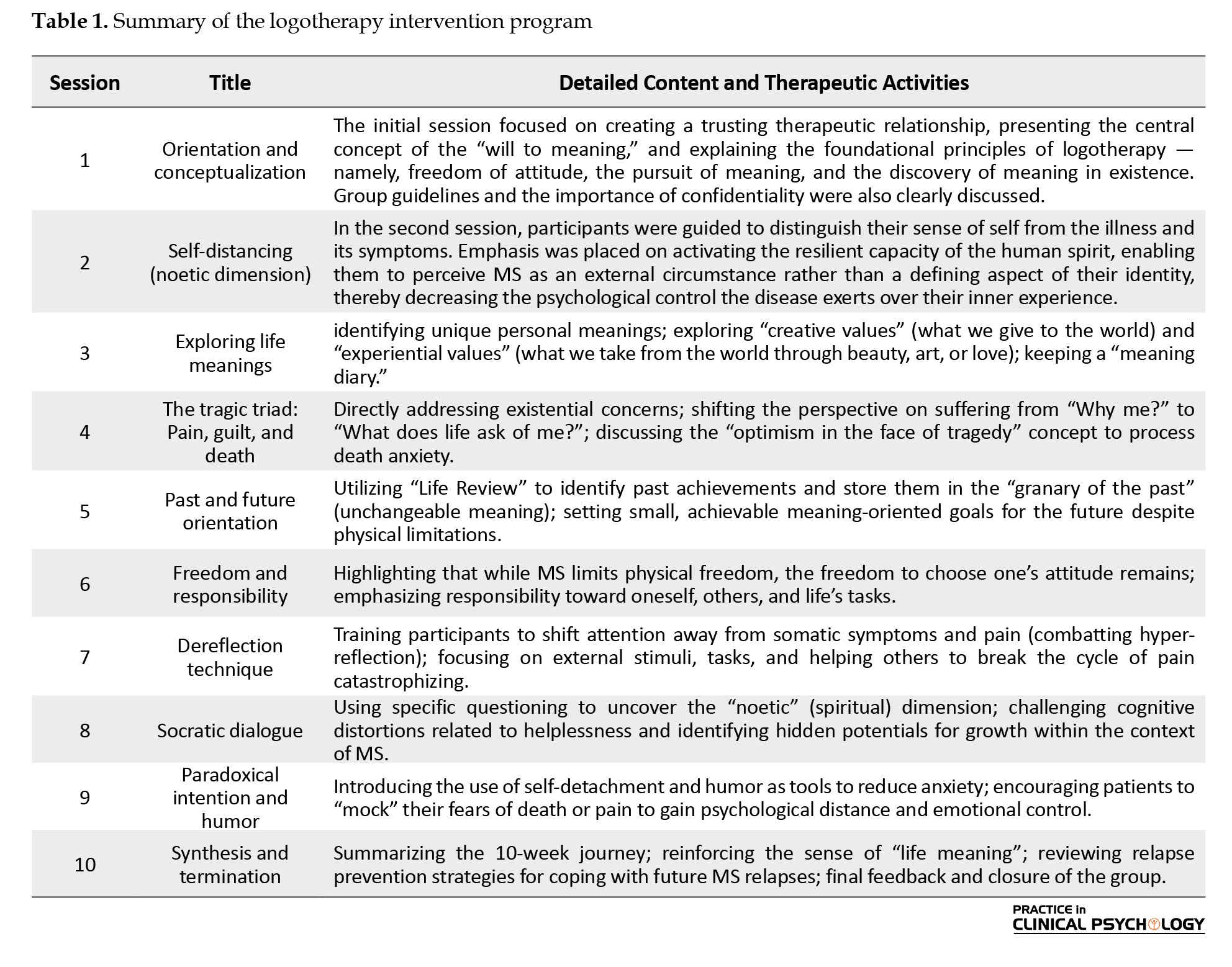
Following the selection process, participants in both groups completed the pre-test questionnaires. The experimental group then participated in ten weekly 60-minute logotherapy sessions delivered in a group format by a trained therapist. The sessions were held at the hospital’s counseling center. The therapist was a clinical psychologist with a master’s degree who served as the first author of this study. During this period, the control group participants received no psychological intervention but remained on their standard medical treatment plan. At the conclusion of the ten sessions, both groups underwent a post-treatment assessment to measure changes in the dependent variables. The logotherapy intervention was based on the principles of Viktor Frankl’s existential analysis and followed a structured 10-session protocol adapted for patients with chronic illness (Frankl, 1984; Rahgozar & Giménez-Llort, 2020). The sessions are summarized in Table 1.
To adhere to ethical standards, after the study, a summary workshop on logotherapy was offered to the participants in the control group.
Measures
Death anxiety scale
The templer death anxiety scale (TDAS) (Templer, 1970) is a 15-item questionnaire that evaluates the intensity of death-related fear using a dichotomous (true/false) response format, with total scores ranging from 0 to 15; higher scores indicate greater death anxiety. Its internal consistency reliability (Cronbach’s α) in the current sample reached α=0.81, consistent with previously reported acceptable reliability in Iranian populations (α=0.89) (Sharif Nia et al., 2014).
Pain catastrophizing scale
The pain catastrophizing scale (PCS) (Sullivan et al., 1995) contains 13 items that capture maladaptive cognitive and emotional responses to pain across three dimensions—rumination, magnification, and helplessness—rated on a 5-point Likert scale (0=not at all to 4=all the time), producing a total score between 0 and 52; higher values reflect stronger catastrophizing tendencies. The Persian version showed good reliability (α=0.87), (Rahmati et al., 2017), and Cronbach’s α in the present study was 0.85.
Adult hope scale
The adult hope scale (AHS), (Snyder et al., 1996) is a 12-item instrument (with 4 filler items) assessing hope as a cognitive construct through two subscales—agency and pathways—using an 8-point Likert response format; the final score (derived from 8 items) ranges from 8 to 64, with higher scores denoting greater dispositional hope. Reliability of the Persian form was previously reported as 0.78 (Nooripour et al., 2022), while internal consistency reliability in this research reached α=0.84.
Data analysis
All statistical procedures were carried out using SPSS software, version 27. Mean±SD were computed to summarize the characteristics of the study variables. In order to assess the combined effect of the intervention across the dependent variables, MANCOVA was performed. Subsequent univariate analyses of covariance (ANCOVA) were then conducted to evaluate the intervention’s specific impact on each outcome variable individually. A type I error rate of α=0.05 was used to determine statistical significance.
Results
The participants were 30 women diagnosed with MS who attended the neurology clinic of Golestan Hospital in Ahvaz, Iran. Mean age in the experimental group (n=15) was 34.8±7.2 years with disease duration of 6.1±3.4 years. The control group (n=15) showed a mean age of 35.4±6.9 years and mean disease duration of 6.4±3.7 years. Independent samples t-tests confirmed that the groups did not differ significantly in age (t(28)=0.24, P=0.813) or illness duration (t(28)=0.25, P=0.807), supporting baseline equivalence.
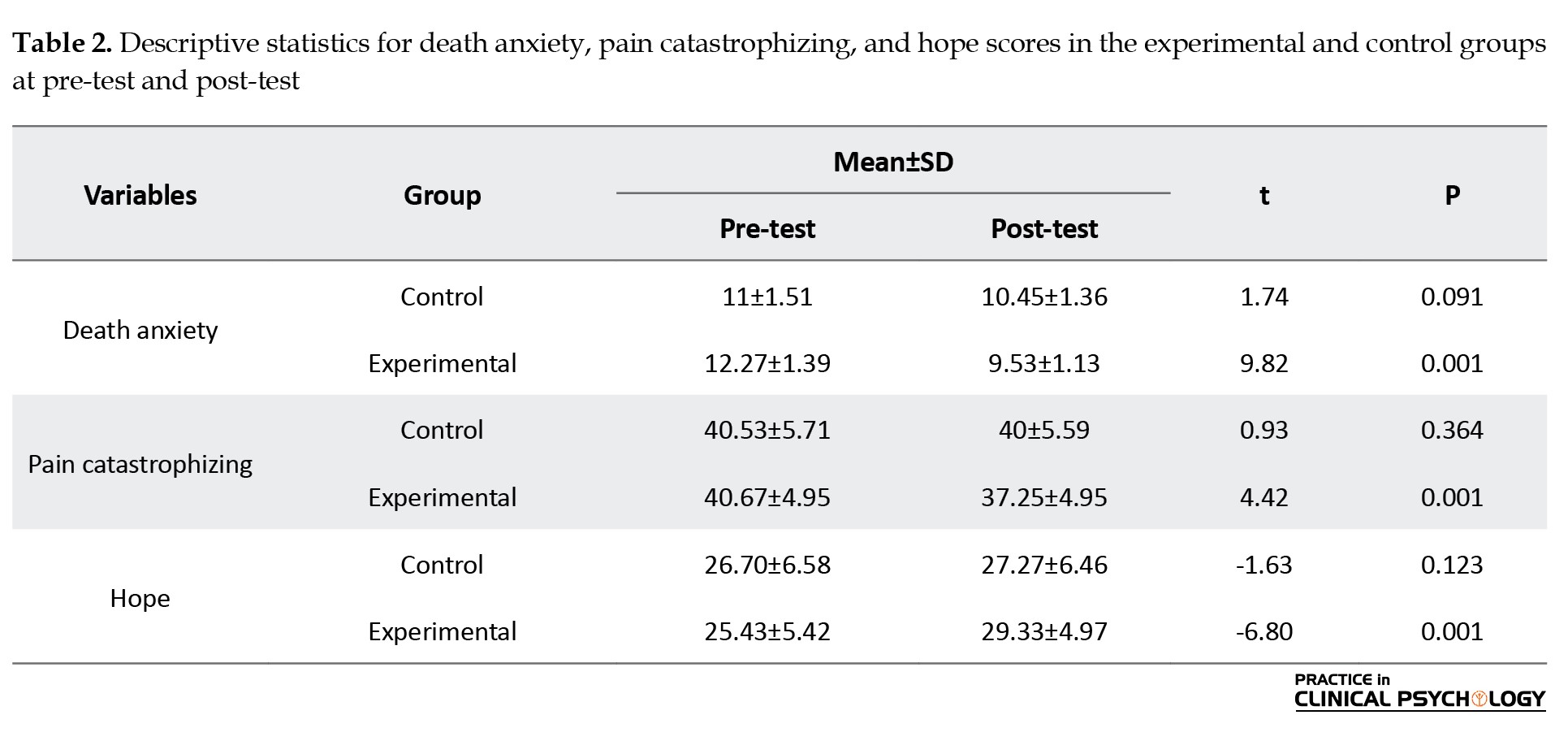
At baseline, the experimental and control groups showed comparable scores on the study variables. Following the 10-session logotherapy intervention, the experimental group showed reductions in death anxiety and pain catastrophizing, along with an increase in hope scores. In contrast, the control group exhibited only small changes in these variables (Table 2).
Prior to conducting the MANCOVA, all necessary assumptions for covariance analysis were thoroughly examined. Results of the Kolmogorov–Smirnov test demonstrated that the distribution of pre- and post-test scores for death anxiety, pain catastrophizing, and hope did not deviate significantly from normality in either group (P>0.05). Levene’s test for homogeneity of variances showed no statistically significant difference in baseline scores between the two groups (P>0.05). Additionally, the assumptions of homogeneity of regression slopes and homogeneity of variance-covariance matrices were satisfied. MANCOVA was then carried out to assess the combined effect of the logotherapy intervention on the three outcome measures, while statistically adjusting for pre-test scores. A significant multivariate effect was observed (Wilks’ Lambda=0.16, F3, 23=41.43, P<0.001, ηp²=0.84).
Subsequent univariate ANCOVAs were carried out separately for each outcome measure (Table 3).
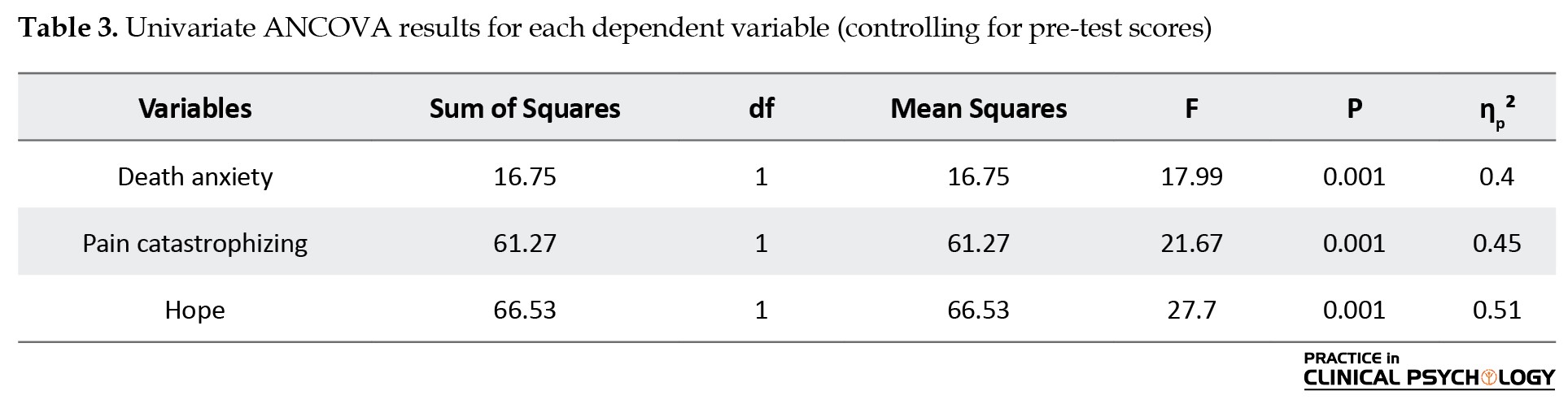
The intervention produced a statistically significant effect on death anxiety (F1, 27=17.99, P<0.001, ηp²=0.4), reflecting a large decrease in death-related fear among participants in the experimental condition relative to the control group after accounting for baseline scores. A comparable pattern emerged for pain catastrophizing, with the intervention group exhibiting a significant reduction F1, 27=21.67, P<0.001, ηp²=0.45). The largest effect size was found for hope, where the experimental group displayed a clearly greater improvement in hope scores compared with the control group F1, 27=27.7, P<0.001, ηp²=0.51). These findings confirm that participation in the 10-session logotherapy program was associated with clinically meaningful improvements across all three targeted psychological constructs.
Discussion
The present study sought to evaluate the therapeutic efficacy of logotherapy on death anxiety, pain catastrophizing, and hope among women diagnosed with MS. The results showed that logotherapy leads to significant reductions in death anxiety and pain catastrophizing, alongside a robust increase in levels of hope. These findings are largely consistent with previous research demonstrating the beneficial effects of logotherapy on death anxiety and hope in individuals living with chronic medical conditions (Eskigülek & Kav, 2024; Wang et al., 2025).
The significant reduction in death anxiety can be attributed to specific techniques employed in the 10-session protocol. In session 4, participants directly addressed the tragic triad (pain, guilt, and death) and were guided to shift from “Why me?” to “What does life ask of me?” through the cultivation of tragic optimism. Session 9 further reinforced this change by introducing paradoxical intention and humor to create psychological distance from death-related fears. These concrete techniques enabled participants to reframe their mortality within a broader context of meaning, thereby reducing the intensity of death anxiety (Rahgozar & Giménez-Llort, 2020; Eskigülek & Kav, 2024).
The decrease in pain catastrophizing appears to have resulted from the dereflection technique introduced in session 7, which trained participants to shift attention away from somatic symptoms and hyper-reflection on pain toward external tasks and helping others. In addition, Socratic dialogue in session 8 helped challenge cognitive distortions related to helplessness and magnification of pain. By redirecting attentional resources and fostering a sense of meaning beyond physical suffering, the intervention effectively interrupted the cycle of rumination and catastrophic thinking about pain (Arewasikporn et al., 2018; Webster et al., 2023).
The most pronounced improvement was observed in hope. Sessions 3 and 5 encouraged participants to identify personal meanings, review past achievements (the “granary of the past”), and set small, meaningful goals for the future despite physical limitations. These activities directly strengthened both the agency and pathways components of Snyder’s hope theory. Session 6 further reinforced a sense of responsibility and freedom of attitude, which appeared to revitalize participants’ motivational resources and dispositional hope (Laranjeira & Querido, 2022; Lee et al., 2022).
Although the results were statistically robust, this study has several limitations. The use of convenience sampling combined with conducting the entire study in one city (Ahvaz) limits the generalizability of the findings to other groups of patients with MS or to different cultural environments. Furthermore, the absence of long-term follow-up assessments makes it impossible to determine the durability of the observed benefits over extended periods. Another important limitation is that the sample included only women; therefore, the findings may not be generalizable to male patients with MS.
The current findings have important theoretical and clinical implications. By demonstrating simultaneous improvements in death anxiety, pain catastrophizing, and hope, the study highlights the interconnected nature of these constructs through the lens of existential meaning. When patients with MS discover a sense of purpose that transcends their physical limitations, it appears to simultaneously alleviate existential fears, reduce maladaptive cognitive responses to pain, and enhance dispositional hope. Clinically, these results support the integration of brief logotherapy protocols into routine care for patients with MS, particularly within cultures where meaning-making and spiritual dimensions are highly valued. Future research should examine whether combining logotherapy with standard medical and rehabilitation services produces additive benefits and whether similar effects are observed in more diverse samples, including male patients and those with greater disease severity.
Conclusion
Overall, the results of this study provide preliminary evidence that logotherapy is a promising psychological intervention for reducing death anxiety and pain catastrophizing while enhancing hope among women with MS. By facilitating the discovery of existential meaning and fostering tragic optimism, the intervention appears to alleviate death-related fears, decrease maladaptive cognitive responses to pain, such as catastrophizing, and improve dispositional hope. These findings suggest potential benefits of incorporating brief, meaning-centered interventions, such as logotherapy into the multidisciplinary care of patients with MS. Future research with larger, more diverse samples and long-term follow-up assessments is needed to confirm the durability and generalizability of these effects.
Ethical Considerations
Compliance with ethical guidelines
The study was conducted in accordance with the ethical principles of the Declaration of Helsinki and approved by the Ethics Committee of the Ahvaz Branch, Islamic Azad University, Ahvaz, Iran (Code: IR.IAU.AHVAZ.REC.1404.100). It was also registered in the Iranian Registry of Clinical Trials (IRCT) (Code: IRCT20250619066209N1).
Funding
This research did not receive any grant from funding agencies in the public, commercial, or non-profit sectors.
Authors' contributions
All authors equally contributed to preparing this article.
Conflict of interest
The authors declared no conflict of interest.
Acknowledgments
The authors wish to express their profound gratitude to the patients with multiple sclerosis whose participation and commitment made this study possible.
References
Anagnostopoulos, F., Paraponiari, A., & Kafetsios, K. (2023). The role of pain catastrophizing, emotional intelligence, and pain intensity in the quality of life of cancer patients with chronic pain. Journal of Clinical Psychology in Medical Settings, 30(3), 501–519. [DOI:10.1007/s10880-022-09921-5] [PMID]
Arewasikporn, A., Turner, A. P., Alschuler, K. N., Hughes, A. J., & Ehde, D. M. (2018). Cognitive and affective mechanisms of pain and fatigue in multiple sclerosis. Health psychology: Official Journal of the Division of Health Psychology, American Psychological Association, 37(6), 544–552. [DOI:10.1037/hea0000611] [PMID]
Barkhordari-Sharifabad, M., Zangeneh Soroush, M., & Yazdani, S. (2023). The relationship between perceived social support with depression, anxiety, and stress in patients with multiple sclerosis. Practice in Clinical Psychology, 11(4), 319-328. [DOI:10.32598/jpcp.11.4.885.1]
Boutitah-Benyaich, I., Eixarch, H., Villacieros-Álvarez, J., Hervera, A., Cobo-Calvo, Á., & Montalban, X., et al. (2025). Multiple sclerosis: Molecular pathogenesis and therapeutic intervention. Signal Transduction and Targeted Therapy, 10(1), 324. [DOI:10.1038/s41392-025-02415-4] [PMID]
Dastoorpoor, M., Khodadadi, N., Majdinasab, N., Soltani, M., & Ghanbari, S. (2022). The time-trend of multiple sclerosis incidence and prevalence in Khuzestan province, Iran. Caspian Journal of Neurological Sciences, 8(2), 104-116. [DOI:10.32598/CJNS.8.29.4]
Eskigülek, Y., & Kav, S. (2024). Effect of logotherapy counseling program on chronic sorrow, dignity, and meaning in life of palliative care patients: A randomized controlled trial. Supportive Care in Cancer: Official Journal of the Multinational Association of Supportive Care in Cancer, 32(9), 587. [DOI:10.1007/s00520-024-08792-w] [PMID]
Francalancia, J., Mavrogiorgou, P., Juckel, G., Mitrovic, T., Kuhle, J., & Naegelin, Y., et al. (2021). Death anxiety and attitudes towards death in patients with multiple sclerosis: An exploratory study. Brain Sciences, 11(8), 964. [DOI:10.3390/brainsci11080964] [PMID]
Frankl, V. E. (1984). Man’s Search for Meaning. New York, NY: Washington Square Press. [Link]
Gülırmak Güler, K., Güleç Keskin, S., & Terzi, M. (2024). Transformative impact of positive psychotherapy-based hope placement program on life goals and hope level of individuals with multiple sclerosis. Public Health Nursing (Boston, Mass.), 41(6), 1402–1417. [DOI:10.1111/phn.13389] [PMID]
Hajibabaei, M., Kajbaf, B., Esmaeili, M., Harirchian, M. H., & Montazeri, A. (2020). Impact of an existential-spiritual intervention compared with a cognitive-behavioral therapy on quality of life and meaning in life among women with multiple sclerosis. Iranian Journal of Psychiatry, 15(4), 322–330.[DOI:10.18502/ijps.v15i4.4298] [PMID]
Kassie, S. A., Alia, J., & Hyland, L. (2021). Biopsychosocial implications of living with multiple sclerosis: A qualitative study using interpretative phenomenological analysis. BMJ Open, 11(8), e049041. [DOI:10.1136/bmjopen-2021-049041] [PMID]
Laranjeira, C., & Querido, A. (2022). Hope and optimism as an opportunity to improve the “positive mental health” demand. Frontiers in Psychology, 13, 827320. [DOI:10.3389/fpsyg.2022.827320] [PMID]
Lee, B., Rumrill, P., & Tansey, T. N. (2022). Examining the role of resilience and hope in grit in multiple sclerosis. Frontiers in Neurology, 13, 875133. [DOI:10.3389/fneur.2022.875133] [PMID]
Lotfifar, B., Ghadampour, E., & Bagheri, N. (2021). Comparative effectiveness of psychotherapy approaches on death anxiety in multiple sclerosis patients. A pilot randomized controlled trial. Multiple Sclerosis and Related Disorders, 51, 102914. [DOI:10.1016/j.msard.2021.102914] [PMID]
Maghsoudi, Z., Oshvandi, K., Mohammadi, Y., & Motavakel, N. (2024). The Effect of spiritual care on hope in patients with multiple sclerosis referred to the MS association of Hamadan in Iran. Journal of Religion and Health, 63(5), 3410–3418. [DOI:10.1007/s10943-024-02020-9] [PMID]
Mehrizi, F. Z., Bagherian, S., Bahramnejad, A., & Khoshnood, Z. (2022). The impact of logo-therapy on disease acceptance and self-awareness of patients undergoing hemodialysis; a pre-test-post-test research. BMC Psychiatry, 22(1), 670. [DOI:10.1186/s12888-022-04295-2] [PMID]
Nooripour, R., Farmani, F., Brand, S., Ghanbari, N., Ilanloo, H., & Matacotta, J. J., et al. (2022). Psychometric characteristics of persian version of adult hope scale (AHS) in Iranian females with multiple sclerosis (MS). Journal of Kermanshah University of Medical Sciences, 26(2), e123276. [DOI:10.5812/jkums-123276]
Rahgozar, S., & Giménez-Llort, L. (2020). Foundations and applications of logotherapy to improve mental health of immigrant populations in the third millennium. Frontiers in Psychiatry, 11, 451. [DOI:10.3389/fpsyt.2020.00451] [PMID]
Rahmati, N., Asghari Moghadam, M. A., Shairi, M., Paknejad, M., Rahmati, Z., & Ghassami, M., et al. (2017). [A study of the psychometric properties of the pain catastrophizing scale amongst Iranian patients with chronic persistent Pain (Persian)]. Journal of Ilam University of Medical Sciences, 25(1), 63-79. [DOI:10.29252/sjimu.25.1.63]
Sharif Nia, H., Ebadi, A., Lehto, R. H., Mousavi, B., Peyrovi, H., & Chan, Y. H. (2014). Reliability and validity of the Persian version of Templer death anxiety scale-extended in veterans of iran-iraq warfare. Iranian Journal of Psychiatry and behavioral Sciences, 8(4), 29–37. [PMID]
Snyder, C. R., Sympson, S. C., Ybasco, F. C., Borders, T. F., Babyak, M. A., & Higgins, R. L. (1996). development and validation of the state hope scale. Journal of Personality and Social Psychology, 70(2), 321–335. [DOI:10.1037//0022-3514.70.2.321] [PMID]
Sullivan, M., Bishop, S. R., & Pivik, J. R. (1995). The pain catastrophizing scale: Development and validation. Psychological Assessment, 7(4), 524-532. [DOI:10.1037/1040-3590.7.4.524]
Templer, D. I. (1970). The construction and validation of a death anxiety scale. The Journal of General Psychology, 82(2d Half), 165–177. [DOI:10.1080/00221309.1970.9920634] [PMID]
Wang, Z., Xu, D., Yu, S., Liu, Y., Han, Y., & Zhao, W., et al. (2025). Effectiveness of meaning-centered interventions on existential distress and mental health outcomes in cancer survivors and their family caregivers: A systematic review and meta-analysis of randomized controlled trials. Worldviews on Evidence-Based Nursing, 22(1), e12752. [DOI:10.1111/wvn.12752] [PMID]
Webster, F., Connoy, L., Longo, R., Ahuja, D., Amtmann, D., & Anderson, A., et al. (2023). Patient responses to the term pain catastrophizing: thematic analysis of cross-sectional international data. The Journal of Pain, 24(2), 356-367. [DOI:10.1016/j.jpain.2022.10.001] [PMID]
Zare, L., Nayeri, N. D., Bahramnezhad, F., & Rasti, A. (2024). Living with multiple sclerosis: the rainbow of inspiring experiences and resilience in the face of the disease. Health Expectations: An International Journal of Public Participation in Health Care and Health Policy, 27(5), e70044. [DOI:10.1111/hex.70044] [PMID]
Multiple sclerosis (MS) is a chronic, progressive neurological condition marked by ongoing inflammation and progressive damage to the central nervous system. It is marked by ongoing damage to the myelin sheath and eventual injury to axons (Boutitah-Benyaich et al., 2025). As a result, individuals experience a wide array of physical symptoms, such as sensory changes, muscle weakness, and difficulties with thinking and cognition. The prevalence of MS has seen a substantial rise globally, with a particularly marked increase in Iran, where rates are among the highest in the Middle East and North Africa; recent estimates indicate a prevalence exceeding 100 per 100,000 population, disproportionately affecting young women (Dastoorpoor et al., 2022). For these individuals, MS is not merely a medical diagnosis but a life-altering event that disrupts professional, social, and personal trajectories. The unpredictable nature of relapses and the cumulative disability associated with the disease impose an immense psychological burden, often resulting in severe emotional distress, social isolation, and a significant decline in quality of life (Barkhordari-Sharifabad et al., 2023). Addressing these multifaceted challenges requires a shift from purely somatic treatments toward integrated biopsychosocial models of care that prioritize the patient’s mental well-being alongside physical rehabilitation (Kassie et al., 2021).
A significant psychological issue for patients with MS is death anxiety — a persistent and intense fear of one’s own death or the dying process (Francalancia et al., 2021). Given the progressive and currently incurable nature of MS, patients frequently encounter existential crises and a heightened awareness of their physiological vulnerability (Zare et al., 2024). This anxiety is not merely a fear of the end of life; it encompasses profound concerns regarding physical deterioration, the loss of autonomy, and the potential impact of one’s death on family members. High levels of death anxiety can exacerbate other psychiatric symptoms, lead to avoidance behaviors, and significantly reduce the patient’s capacity to engage in rehabilitative efforts (Lotfifar et al., 2021).
Pain is a hallmark symptom of MS. Beyond its sensory aspects, pain catastrophizing — a maladaptive cognitive-emotional reaction involving rumination, magnification, and helplessness — is particularly detrimental in this population (Arewasikporn et al., 2018). Empirical evidence indicates that higher levels of pain catastrophizing in MS patients are associated with increased pain intensity, greater functional disability, elevated psychological distress, and poorer treatment outcomes, making it a critical target for psychological intervention (Anagnostopoulos et al., 2023; Webster et al., 2023).
Unlike these maladaptive patterns, hope functions as a key psychological strength and a safeguard against the burdens of chronic disease (Gülırmak Güler et al., 2024). Drawing from Snyder’s model, hope is viewed as a cognitive process oriented toward goals, consisting of two main components: “agency,” which reflects the drive and determination to reach objectives, and “pathways,” which refers to the belief in one’s capacity to devise routes toward those objectives (Laranjeira & Querido, 2022). Among individuals with MS, hope shows strong connections to greater resilience, better compliance with treatment, and higher overall satisfaction with life (Lee et al., 2022; Maghsoudi et al., 2024).
Given the profound existential dimensions of death anxiety, pain catastrophizing, and diminished hope in patients with MS, logotherapy was employed as the intervention in the present study. Logotherapy, developed by Viktor Frankl, is a meaning-centered psychotherapeutic approach based on the belief that the primary motivational force in humans is the “will to meaning” (Rahgozar & Giménez-Llort, 2020). It is particularly well-suited to address death anxiety by helping patients discover meaning despite the threat of mortality and by fostering “tragic optimism.” It can reduce pain catastrophizing through dereflection techniques that shift focus away from hyper-attention to somatic symptoms toward meaningful external tasks and values. Furthermore, logotherapy enhances hope by strengthening both agency (through a renewed sense of purpose) and pathways (by encouraging the pursuit of meaning-oriented goals even amid physical limitations).
Earlier empirical research has confirmed the effectiveness of logotherapy in reducing death anxiety and increasing hope among individuals facing serious illness. Studies indicate that interventions focused on meaning markedly decrease death-related fears among cancer survivors and individuals with chronic kidney disease (Wang et al., 2025; Mehrizi et al., 2022). In the context of MS, initial findings suggest potential benefits; however, research examining the specific impact of logotherapy on the combination of death anxiety, pain catastrophizing, and hope remains relatively scarce (Hajibabaei et al., 2020).
The present study was conducted exclusively with female patients with MS because the disease shows a markedly higher prevalence among women, who also tend to report greater psychological distress and existential concerns related to chronic illness compared with men; focusing on this group enhances the clinical relevance and applicability of the findings in a high-risk population.
The necessity of this study arises from the increasing psychological complexity observed in patients with MS and the limitations of purely pharmacological treatments in addressing existential and cognitive-emotional distortions. While medical therapies manage physical symptoms, existential fears, maladaptive pain-related cognitions, and diminished hope often remain unaddressed. There is a critical need for structured, meaning-centered interventions that can simultaneously target these interrelated psychological challenges. Accordingly, the current research aimed to evaluate the effect of logotherapy on death anxiety, pain catastrophizing, and hope in women with MS.
Materials and Methods
Study design and participants
This research employed a randomized controlled trial (RCT) featuring pre- and post-treatment assessments along with a control group. The target population consisted of female patients with a confirmed diagnosis of MS who attended the neurology outpatient department at Golestan Hospital in Ahvaz, Iran, during 2025. Thirty eligible patients with MS were enrolled using convenience sampling. Participants were recruited through the neurology outpatient clinic at Golestan Hospital in Ahvaz, Iran, where potential candidates were identified by reviewing medical records and approaching eligible patients during their routine clinic visits. They were subsequently randomized into two groups: An intervention arm (n=15) and a control arm (n=15). Randomization was performed using a computer-generated random number sequence with allocation concealment.
The sample size was determined a priori using G*Power software, version 3.1 for a multivariate analysis of covariance (MANCOVA), assuming a medium-to-large effect size (f²=0.25), power of 0.80, and α=0.05. Eligibility criteria for inclusion were neurologist-confirmed MS diagnosis, identifying as women, age range of 20–50 years, and voluntary written informed consent. Participants were excluded if they had any severe co-occurring psychiatric conditions, were simultaneously enrolled in another psychological therapy program, or failed to attend more than two of the intervention sessions.
All procedures were performed in accordance with the ethical standards of the institutional research committee and the 1964 Helsinki Declaration and its later amendments. Written informed consent was obtained from all individual participants prior to their inclusion in the study. Participants were assured of confidentiality, their right to withdraw at any time without any negative consequences, and that their decision to participate or not would not affect their routine medical care.
Procedure
Following the selection process, participants in both groups completed the pre-test questionnaires. The experimental group then participated in ten weekly 60-minute logotherapy sessions delivered in a group format by a trained therapist. The sessions were held at the hospital’s counseling center. The therapist was a clinical psychologist with a master’s degree who served as the first author of this study. During this period, the control group participants received no psychological intervention but remained on their standard medical treatment plan. At the conclusion of the ten sessions, both groups underwent a post-treatment assessment to measure changes in the dependent variables. The logotherapy intervention was based on the principles of Viktor Frankl’s existential analysis and followed a structured 10-session protocol adapted for patients with chronic illness (Frankl, 1984; Rahgozar & Giménez-Llort, 2020). The sessions are summarized in Table 1.
To adhere to ethical standards, after the study, a summary workshop on logotherapy was offered to the participants in the control group.
Measures
Death anxiety scale
The templer death anxiety scale (TDAS) (Templer, 1970) is a 15-item questionnaire that evaluates the intensity of death-related fear using a dichotomous (true/false) response format, with total scores ranging from 0 to 15; higher scores indicate greater death anxiety. Its internal consistency reliability (Cronbach’s α) in the current sample reached α=0.81, consistent with previously reported acceptable reliability in Iranian populations (α=0.89) (Sharif Nia et al., 2014).
Pain catastrophizing scale
The pain catastrophizing scale (PCS) (Sullivan et al., 1995) contains 13 items that capture maladaptive cognitive and emotional responses to pain across three dimensions—rumination, magnification, and helplessness—rated on a 5-point Likert scale (0=not at all to 4=all the time), producing a total score between 0 and 52; higher values reflect stronger catastrophizing tendencies. The Persian version showed good reliability (α=0.87), (Rahmati et al., 2017), and Cronbach’s α in the present study was 0.85.
Adult hope scale
The adult hope scale (AHS), (Snyder et al., 1996) is a 12-item instrument (with 4 filler items) assessing hope as a cognitive construct through two subscales—agency and pathways—using an 8-point Likert response format; the final score (derived from 8 items) ranges from 8 to 64, with higher scores denoting greater dispositional hope. Reliability of the Persian form was previously reported as 0.78 (Nooripour et al., 2022), while internal consistency reliability in this research reached α=0.84.
Data analysis
All statistical procedures were carried out using SPSS software, version 27. Mean±SD were computed to summarize the characteristics of the study variables. In order to assess the combined effect of the intervention across the dependent variables, MANCOVA was performed. Subsequent univariate analyses of covariance (ANCOVA) were then conducted to evaluate the intervention’s specific impact on each outcome variable individually. A type I error rate of α=0.05 was used to determine statistical significance.
Results
The participants were 30 women diagnosed with MS who attended the neurology clinic of Golestan Hospital in Ahvaz, Iran. Mean age in the experimental group (n=15) was 34.8±7.2 years with disease duration of 6.1±3.4 years. The control group (n=15) showed a mean age of 35.4±6.9 years and mean disease duration of 6.4±3.7 years. Independent samples t-tests confirmed that the groups did not differ significantly in age (t(28)=0.24, P=0.813) or illness duration (t(28)=0.25, P=0.807), supporting baseline equivalence.
At baseline, the experimental and control groups showed comparable scores on the study variables. Following the 10-session logotherapy intervention, the experimental group showed reductions in death anxiety and pain catastrophizing, along with an increase in hope scores. In contrast, the control group exhibited only small changes in these variables (Table 2).
Prior to conducting the MANCOVA, all necessary assumptions for covariance analysis were thoroughly examined. Results of the Kolmogorov–Smirnov test demonstrated that the distribution of pre- and post-test scores for death anxiety, pain catastrophizing, and hope did not deviate significantly from normality in either group (P>0.05). Levene’s test for homogeneity of variances showed no statistically significant difference in baseline scores between the two groups (P>0.05). Additionally, the assumptions of homogeneity of regression slopes and homogeneity of variance-covariance matrices were satisfied. MANCOVA was then carried out to assess the combined effect of the logotherapy intervention on the three outcome measures, while statistically adjusting for pre-test scores. A significant multivariate effect was observed (Wilks’ Lambda=0.16, F3, 23=41.43, P<0.001, ηp²=0.84).
Subsequent univariate ANCOVAs were carried out separately for each outcome measure (Table 3).
The intervention produced a statistically significant effect on death anxiety (F1, 27=17.99, P<0.001, ηp²=0.4), reflecting a large decrease in death-related fear among participants in the experimental condition relative to the control group after accounting for baseline scores. A comparable pattern emerged for pain catastrophizing, with the intervention group exhibiting a significant reduction F1, 27=21.67, P<0.001, ηp²=0.45). The largest effect size was found for hope, where the experimental group displayed a clearly greater improvement in hope scores compared with the control group F1, 27=27.7, P<0.001, ηp²=0.51). These findings confirm that participation in the 10-session logotherapy program was associated with clinically meaningful improvements across all three targeted psychological constructs.
Discussion
The present study sought to evaluate the therapeutic efficacy of logotherapy on death anxiety, pain catastrophizing, and hope among women diagnosed with MS. The results showed that logotherapy leads to significant reductions in death anxiety and pain catastrophizing, alongside a robust increase in levels of hope. These findings are largely consistent with previous research demonstrating the beneficial effects of logotherapy on death anxiety and hope in individuals living with chronic medical conditions (Eskigülek & Kav, 2024; Wang et al., 2025).
The significant reduction in death anxiety can be attributed to specific techniques employed in the 10-session protocol. In session 4, participants directly addressed the tragic triad (pain, guilt, and death) and were guided to shift from “Why me?” to “What does life ask of me?” through the cultivation of tragic optimism. Session 9 further reinforced this change by introducing paradoxical intention and humor to create psychological distance from death-related fears. These concrete techniques enabled participants to reframe their mortality within a broader context of meaning, thereby reducing the intensity of death anxiety (Rahgozar & Giménez-Llort, 2020; Eskigülek & Kav, 2024).
The decrease in pain catastrophizing appears to have resulted from the dereflection technique introduced in session 7, which trained participants to shift attention away from somatic symptoms and hyper-reflection on pain toward external tasks and helping others. In addition, Socratic dialogue in session 8 helped challenge cognitive distortions related to helplessness and magnification of pain. By redirecting attentional resources and fostering a sense of meaning beyond physical suffering, the intervention effectively interrupted the cycle of rumination and catastrophic thinking about pain (Arewasikporn et al., 2018; Webster et al., 2023).
The most pronounced improvement was observed in hope. Sessions 3 and 5 encouraged participants to identify personal meanings, review past achievements (the “granary of the past”), and set small, meaningful goals for the future despite physical limitations. These activities directly strengthened both the agency and pathways components of Snyder’s hope theory. Session 6 further reinforced a sense of responsibility and freedom of attitude, which appeared to revitalize participants’ motivational resources and dispositional hope (Laranjeira & Querido, 2022; Lee et al., 2022).
Although the results were statistically robust, this study has several limitations. The use of convenience sampling combined with conducting the entire study in one city (Ahvaz) limits the generalizability of the findings to other groups of patients with MS or to different cultural environments. Furthermore, the absence of long-term follow-up assessments makes it impossible to determine the durability of the observed benefits over extended periods. Another important limitation is that the sample included only women; therefore, the findings may not be generalizable to male patients with MS.
The current findings have important theoretical and clinical implications. By demonstrating simultaneous improvements in death anxiety, pain catastrophizing, and hope, the study highlights the interconnected nature of these constructs through the lens of existential meaning. When patients with MS discover a sense of purpose that transcends their physical limitations, it appears to simultaneously alleviate existential fears, reduce maladaptive cognitive responses to pain, and enhance dispositional hope. Clinically, these results support the integration of brief logotherapy protocols into routine care for patients with MS, particularly within cultures where meaning-making and spiritual dimensions are highly valued. Future research should examine whether combining logotherapy with standard medical and rehabilitation services produces additive benefits and whether similar effects are observed in more diverse samples, including male patients and those with greater disease severity.
Conclusion
Overall, the results of this study provide preliminary evidence that logotherapy is a promising psychological intervention for reducing death anxiety and pain catastrophizing while enhancing hope among women with MS. By facilitating the discovery of existential meaning and fostering tragic optimism, the intervention appears to alleviate death-related fears, decrease maladaptive cognitive responses to pain, such as catastrophizing, and improve dispositional hope. These findings suggest potential benefits of incorporating brief, meaning-centered interventions, such as logotherapy into the multidisciplinary care of patients with MS. Future research with larger, more diverse samples and long-term follow-up assessments is needed to confirm the durability and generalizability of these effects.
Ethical Considerations
Compliance with ethical guidelines
The study was conducted in accordance with the ethical principles of the Declaration of Helsinki and approved by the Ethics Committee of the Ahvaz Branch, Islamic Azad University, Ahvaz, Iran (Code: IR.IAU.AHVAZ.REC.1404.100). It was also registered in the Iranian Registry of Clinical Trials (IRCT) (Code: IRCT20250619066209N1).
Funding
This research did not receive any grant from funding agencies in the public, commercial, or non-profit sectors.
Authors' contributions
All authors equally contributed to preparing this article.
Conflict of interest
The authors declared no conflict of interest.
Acknowledgments
The authors wish to express their profound gratitude to the patients with multiple sclerosis whose participation and commitment made this study possible.
References
Anagnostopoulos, F., Paraponiari, A., & Kafetsios, K. (2023). The role of pain catastrophizing, emotional intelligence, and pain intensity in the quality of life of cancer patients with chronic pain. Journal of Clinical Psychology in Medical Settings, 30(3), 501–519. [DOI:10.1007/s10880-022-09921-5] [PMID]
Arewasikporn, A., Turner, A. P., Alschuler, K. N., Hughes, A. J., & Ehde, D. M. (2018). Cognitive and affective mechanisms of pain and fatigue in multiple sclerosis. Health psychology: Official Journal of the Division of Health Psychology, American Psychological Association, 37(6), 544–552. [DOI:10.1037/hea0000611] [PMID]
Barkhordari-Sharifabad, M., Zangeneh Soroush, M., & Yazdani, S. (2023). The relationship between perceived social support with depression, anxiety, and stress in patients with multiple sclerosis. Practice in Clinical Psychology, 11(4), 319-328. [DOI:10.32598/jpcp.11.4.885.1]
Boutitah-Benyaich, I., Eixarch, H., Villacieros-Álvarez, J., Hervera, A., Cobo-Calvo, Á., & Montalban, X., et al. (2025). Multiple sclerosis: Molecular pathogenesis and therapeutic intervention. Signal Transduction and Targeted Therapy, 10(1), 324. [DOI:10.1038/s41392-025-02415-4] [PMID]
Dastoorpoor, M., Khodadadi, N., Majdinasab, N., Soltani, M., & Ghanbari, S. (2022). The time-trend of multiple sclerosis incidence and prevalence in Khuzestan province, Iran. Caspian Journal of Neurological Sciences, 8(2), 104-116. [DOI:10.32598/CJNS.8.29.4]
Eskigülek, Y., & Kav, S. (2024). Effect of logotherapy counseling program on chronic sorrow, dignity, and meaning in life of palliative care patients: A randomized controlled trial. Supportive Care in Cancer: Official Journal of the Multinational Association of Supportive Care in Cancer, 32(9), 587. [DOI:10.1007/s00520-024-08792-w] [PMID]
Francalancia, J., Mavrogiorgou, P., Juckel, G., Mitrovic, T., Kuhle, J., & Naegelin, Y., et al. (2021). Death anxiety and attitudes towards death in patients with multiple sclerosis: An exploratory study. Brain Sciences, 11(8), 964. [DOI:10.3390/brainsci11080964] [PMID]
Frankl, V. E. (1984). Man’s Search for Meaning. New York, NY: Washington Square Press. [Link]
Gülırmak Güler, K., Güleç Keskin, S., & Terzi, M. (2024). Transformative impact of positive psychotherapy-based hope placement program on life goals and hope level of individuals with multiple sclerosis. Public Health Nursing (Boston, Mass.), 41(6), 1402–1417. [DOI:10.1111/phn.13389] [PMID]
Hajibabaei, M., Kajbaf, B., Esmaeili, M., Harirchian, M. H., & Montazeri, A. (2020). Impact of an existential-spiritual intervention compared with a cognitive-behavioral therapy on quality of life and meaning in life among women with multiple sclerosis. Iranian Journal of Psychiatry, 15(4), 322–330.[DOI:10.18502/ijps.v15i4.4298] [PMID]
Kassie, S. A., Alia, J., & Hyland, L. (2021). Biopsychosocial implications of living with multiple sclerosis: A qualitative study using interpretative phenomenological analysis. BMJ Open, 11(8), e049041. [DOI:10.1136/bmjopen-2021-049041] [PMID]
Laranjeira, C., & Querido, A. (2022). Hope and optimism as an opportunity to improve the “positive mental health” demand. Frontiers in Psychology, 13, 827320. [DOI:10.3389/fpsyg.2022.827320] [PMID]
Lee, B., Rumrill, P., & Tansey, T. N. (2022). Examining the role of resilience and hope in grit in multiple sclerosis. Frontiers in Neurology, 13, 875133. [DOI:10.3389/fneur.2022.875133] [PMID]
Lotfifar, B., Ghadampour, E., & Bagheri, N. (2021). Comparative effectiveness of psychotherapy approaches on death anxiety in multiple sclerosis patients. A pilot randomized controlled trial. Multiple Sclerosis and Related Disorders, 51, 102914. [DOI:10.1016/j.msard.2021.102914] [PMID]
Maghsoudi, Z., Oshvandi, K., Mohammadi, Y., & Motavakel, N. (2024). The Effect of spiritual care on hope in patients with multiple sclerosis referred to the MS association of Hamadan in Iran. Journal of Religion and Health, 63(5), 3410–3418. [DOI:10.1007/s10943-024-02020-9] [PMID]
Mehrizi, F. Z., Bagherian, S., Bahramnejad, A., & Khoshnood, Z. (2022). The impact of logo-therapy on disease acceptance and self-awareness of patients undergoing hemodialysis; a pre-test-post-test research. BMC Psychiatry, 22(1), 670. [DOI:10.1186/s12888-022-04295-2] [PMID]
Nooripour, R., Farmani, F., Brand, S., Ghanbari, N., Ilanloo, H., & Matacotta, J. J., et al. (2022). Psychometric characteristics of persian version of adult hope scale (AHS) in Iranian females with multiple sclerosis (MS). Journal of Kermanshah University of Medical Sciences, 26(2), e123276. [DOI:10.5812/jkums-123276]
Rahgozar, S., & Giménez-Llort, L. (2020). Foundations and applications of logotherapy to improve mental health of immigrant populations in the third millennium. Frontiers in Psychiatry, 11, 451. [DOI:10.3389/fpsyt.2020.00451] [PMID]
Rahmati, N., Asghari Moghadam, M. A., Shairi, M., Paknejad, M., Rahmati, Z., & Ghassami, M., et al. (2017). [A study of the psychometric properties of the pain catastrophizing scale amongst Iranian patients with chronic persistent Pain (Persian)]. Journal of Ilam University of Medical Sciences, 25(1), 63-79. [DOI:10.29252/sjimu.25.1.63]
Sharif Nia, H., Ebadi, A., Lehto, R. H., Mousavi, B., Peyrovi, H., & Chan, Y. H. (2014). Reliability and validity of the Persian version of Templer death anxiety scale-extended in veterans of iran-iraq warfare. Iranian Journal of Psychiatry and behavioral Sciences, 8(4), 29–37. [PMID]
Snyder, C. R., Sympson, S. C., Ybasco, F. C., Borders, T. F., Babyak, M. A., & Higgins, R. L. (1996). development and validation of the state hope scale. Journal of Personality and Social Psychology, 70(2), 321–335. [DOI:10.1037//0022-3514.70.2.321] [PMID]
Sullivan, M., Bishop, S. R., & Pivik, J. R. (1995). The pain catastrophizing scale: Development and validation. Psychological Assessment, 7(4), 524-532. [DOI:10.1037/1040-3590.7.4.524]
Templer, D. I. (1970). The construction and validation of a death anxiety scale. The Journal of General Psychology, 82(2d Half), 165–177. [DOI:10.1080/00221309.1970.9920634] [PMID]
Wang, Z., Xu, D., Yu, S., Liu, Y., Han, Y., & Zhao, W., et al. (2025). Effectiveness of meaning-centered interventions on existential distress and mental health outcomes in cancer survivors and their family caregivers: A systematic review and meta-analysis of randomized controlled trials. Worldviews on Evidence-Based Nursing, 22(1), e12752. [DOI:10.1111/wvn.12752] [PMID]
Webster, F., Connoy, L., Longo, R., Ahuja, D., Amtmann, D., & Anderson, A., et al. (2023). Patient responses to the term pain catastrophizing: thematic analysis of cross-sectional international data. The Journal of Pain, 24(2), 356-367. [DOI:10.1016/j.jpain.2022.10.001] [PMID]
Zare, L., Nayeri, N. D., Bahramnezhad, F., & Rasti, A. (2024). Living with multiple sclerosis: the rainbow of inspiring experiences and resilience in the face of the disease. Health Expectations: An International Journal of Public Participation in Health Care and Health Policy, 27(5), e70044. [DOI:10.1111/hex.70044] [PMID]
Type of Study: Original Research Article |
Subject:
Rehabilitation
| Rights and permissions | |
 |
This work is licensed under a Creative Commons Attribution-NonCommercial 4.0 International License. |

This is an open access article distributed under the terms of the Creative Commons Attribution-NonCommercial 4.0 (CC-By-NC 4.0), which permits use, distribution, and reproduction in any medium, provided the original work is properly cited and is not used for commercial purposes.
Contact Information